


An insurer can hold an investment portfolio worth hundreds of trillions of dong and still need short-term funding. That is not necessarily a contradiction. Assets may be safe and interest-bearing, yet unavailable as cash at the exact moment claims or other payments fall due. Bao Viet Group's (BVH) first-half 2026 accounts illustrate both sides of that balance: investment income increased, while the cost of part of its short-term funding increased faster.
The central point is not that BVH lacks liquidity. The disclosure does not provide enough detail for that conclusion. What is clear is that the group remains profitable from financial activities, while the spread between financial income and financial expenses deserves closer attention in later reporting periods. For newer investors, this is a useful distinction between having substantial assets and having cash immediately available.
What the portfolio is doing
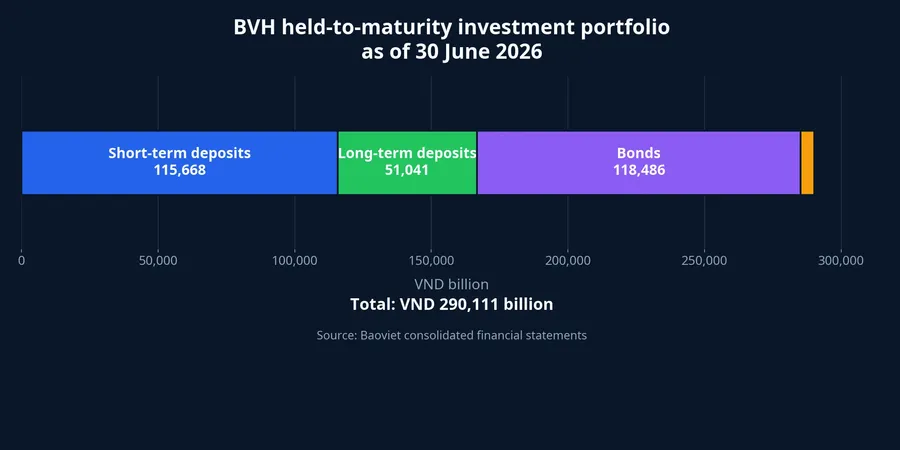
As of 30 June, BVH held VND 290,111 billion in investments held to maturity, up more than 8% from the start of the year.MarketTimes These are assets the group intends to hold until principal is repaid rather than trade on daily price moves. That structure makes sense for an insurer: premiums arrive before the claims and benefits they may ultimately fund.
Bank deposits are the portfolio's largest component. At the end of June, short-term deposits were close to VND 115,667 billion and long-term deposits exceeded VND 51,041 billion, for roughly VND 166,708 billion combined. Bonds accounted for more than VND 118,000 billion, chiefly government and corporate bonds.MarketTimes In plain terms, this is BVH's income-producing store: deposits and bonds generate periodic interest instead of forcing the group to sell assets to book a gain.
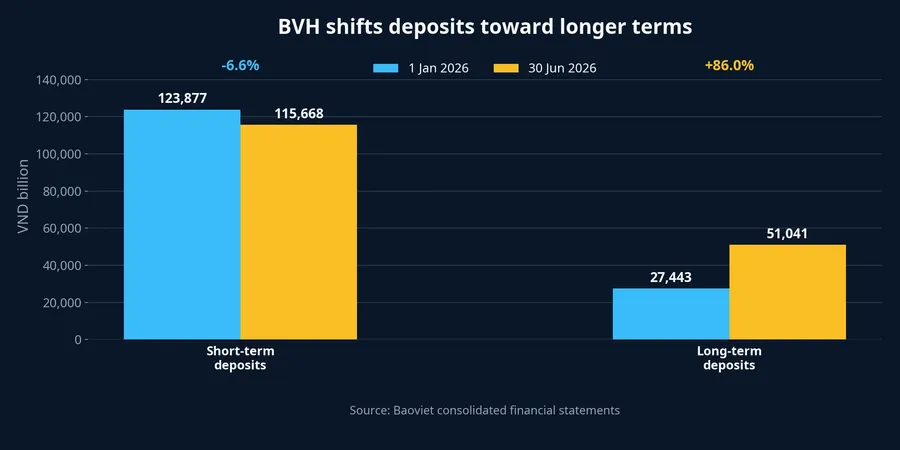
Scale is not the only relevant detail. The deposit maturity mix changed materially in the first six months. Short-term deposits fell about 6.6%, while long-term deposits rose 86.0%. That may allow BVH to lock in yields for longer. The trade-off is that a smaller share of the portfolio matures soon, so investors should not treat the total deposit balance alone as proof of stronger near-term payment capacity.
Portfolio income was still rising. Deposit interest reached approximately VND 2,636 billion in the second quarter, up 48% year on year, and nearly VND 4,927 billion in the first half. Bond interest exceeded VND 1,466 billion in the second quarter.MarketTimes Those figures show that the portfolio is not merely large on the balance sheet; it remains productive.
Why income-producing assets still need short-term funding
Think of a term deposit as household savings that have not reached maturity. It remains your asset, but withdrawing early can reduce the interest you receive. Bonds work similarly: they can be sold before maturity, but the sale price depends on market conditions at the time. For a financial institution that must actively manage payments, an outright sale is not always the best option.
A sale-and-repurchase agreement, commonly called a repo, bridges that timing gap. BVH temporarily transfers a financial asset in exchange for cash and agrees to buy it back after a set period. Economically, it resembles secured borrowing: the company gains short-term cash without abandoning its longer-term intention to hold the asset.
This instrument is not automatically a danger signal. It may be used to align claim payments and other cash needs or to fund investment activity. Calling it a liquidity risk would require more information about repo maturities, collateral, insurance-payment schedules, and refinancing. The reporting cited here does not provide that level of detail. The disciplined reading, therefore, is that the funding cost has risen, not that a cause which has not been proven should be assigned to BVH.
The margin after costs matters most
BVH's financial income in the first half was VND 8,430 billion, up nearly 29% year on year. Financial profit after expenses was nearly VND 6,196 billion, up about 17%.MarketTimes Both metrics rose, but profit rose more slowly than revenue. That signals that expenses absorbed a meaningful portion of the extra income.
Financial expenses increased about 77% to VND 2,234 billion. Repo and interest expenses were VND 1,654 billion, up approximately 145.6% from VND 673.3 billion a year earlier and accounting for more than 74% of total financial expenses.MarketTimes For a first-time reader of financial statements, this deserves separate attention. A portfolio can earn well, yet the quality of its profit is incomplete without the cost of maintaining its funding.
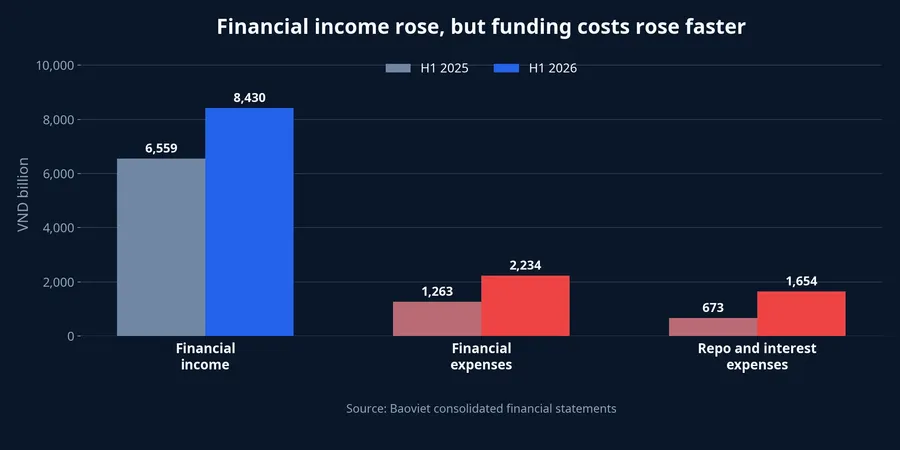
The chart also guards against overreach. The percentage increase in repo and interest expenses is large, but it does not prove that BVH is under liquidity stress. The amount of short-term funding may have increased, its price may have risen, or both may have occurred. More detailed notes in subsequent reports are needed before the contribution of each explanation can be determined.
Group-level earnings are still positive. Bao Viet reported consolidated revenue of VND 32,004 billion, up 9.2%; pre-tax profit of VND 2,289 billion and after-tax profit of VND 1,863 billion were up 34.5% and 33.9%, respectively, from a year earlier.Nhà Đầu Tư Rising funding costs have therefore not reversed overall earnings growth. They are a monitoring point for judging whether growth in financial profit can endure.
Four things to read in the next report
First, compare the growth rate of financial income with financial expenses. If income continues to outpace expenses, the investment portfolio is still expanding its net contribution. If the reverse persists, the retained margin will narrow even if total assets keep growing.
Next, examine maturities rather than a single deposit number. More long-term deposits may support yield and steadier income, but they also make assets less flexible before maturity. That shift needs to be read alongside payment obligations, borrowing, and repo balances to understand cash flow.
Third, monitor the share of repo and interest expense within total financial expenses. If it remains high, the relevant question is whether financial income can more than offset it. If the share falls while income keeps growing, funding-cost pressure may be easing. This is a way to follow an economic relationship, not a buy-or-sell signal.
Finally, wait for later notes on the maturity and use of funding. One elevated six-month cost figure is insufficient to judge liquidity health. The most supportable thesis today is this: BVH still has a large income-generating portfolio, but short-term funding costs have risen fast enough that post-cost financial profit should be tracked as its own metric. The factor that could change this picture is whether that margin stabilises or continues to narrow in the periods ahead.