


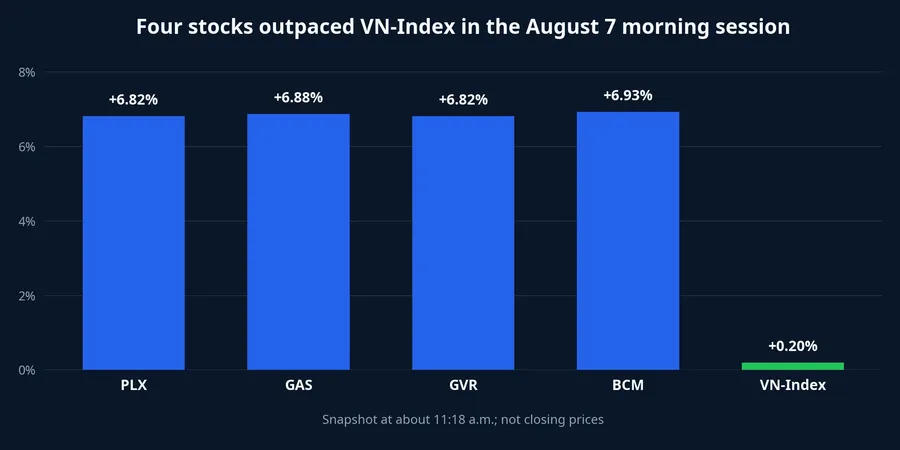
At about 11:18 a.m. on August 7, PLX, GAS, GVR and BCM were each up between 6.82% and 6.93%, while VN-Index had gained only 0.20%. The board invited a single policy narrative. Decision 40/2026/QĐ-TTg tells a more nuanced story: it establishes a framework for classifying state ownership, rather than instructing a fixed sale of shares in each company.LuatVietnam
Put simply, a share price can reprice on expectations in one session. A change in ownership takes a sequence of steps: proper classification, a restructuring plan, approval and then execution. The central point is that PLX currently has the clearest legal comparison, while GAS, GVR and BCM cannot yet be put into the same divestment scenario.

One rally, not one conclusion
The morning snapshot put PLX at VND 36,000, up 6.82%; GAS at VND 74,600, up 6.88%; GVR at VND 29,750, up 6.82%; and BCM at VND 38,600, up 6.93%. These were intraday readings rather than closing prices. They describe the market's response at a point in time, not the final verdict of the session.
It would be a mistake to turn a simultaneous price move into a proven causal link. Decision 40 took effect on August 5 and sets criteria for state-owner representatives to prepare capital-restructuring plans.Government News Short-term sector trading, sentiment toward large-cap state-linked names and sector flows may also have contributed to the August 7 move. The evidence does not allocate the entire rally to Decision 40 alone.
What Decision 40 actually does
The decision sets different ownership bands. Certain essential sectors, including energy in the appendix, may fall into a 100% state-ownership category. Airports, large-scale mining, banking and fertilizer production fall within a 65%-or-higher band. Petroleum-import focal points that meet the appendix's market-share condition are assigned to the more-than-50% but under-65% band.LuatVietnam
That framework is not an automatic answer key. For diversified companies, the relevant business is the one with the largest share of total output or revenue over the three consecutive years before a plan is approved. Beyond the appendix, a company important to defence, security, political tasks or local socioeconomic development may still be retained above 50%.LuatVietnam
So the label “state-owned” says very little by itself about future free float. It is only the starting question: which sector applies, are there special criteria, and which ownership band does the individual plan select?
This distinction matters because an ownership band is a destination in a regulatory framework, not a timetable. A company could be near a reference band and still have no approved transaction in sight. Conversely, a large apparent gap does not by itself prove that the state will sell shares. For a reader scanning a headline, the disciplined response is to separate the policy framework from the implementation document that turns it into a company-specific action.
PLX: The closest case for a comparison
Petrolimex identifies its core activities as petroleum import-export and trading, refining and related operations.Petrolimex If the formal plan confirms that PLX is a petroleum-import focal point meeting the appendix's market-share condition, the relevant reference band would be more than 50% but less than 65% state ownership.
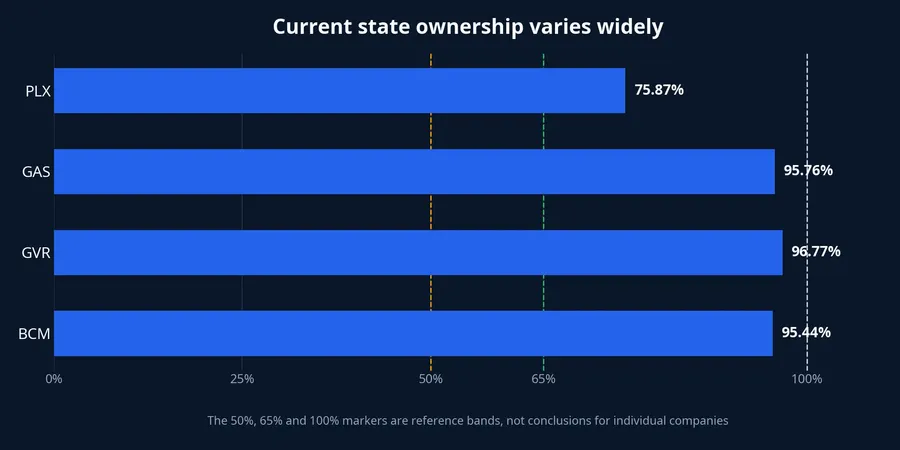
The state currently owns 75.87% of PLX, above the upper edge of that reference band. That makes PLX the most intuitive case when the market discusses a possible reduction in ownership. But intuitive is not decided: no individual plan has classified PLX, and no sale ratio or transaction method has been approved.
GAS: A free-float conclusion does not follow
PV GAS operates across the gas value chain, from gathering, transport and processing to liquefied-gas imports. Its LNG and LPG imports support fuel supply for Vietnam's gas-fired power system.Government News If its largest business is classified as energy, the reference branch is 100% state ownership, rather than a reduction to below 65%.
The state currently holds 95.76% of GAS. The assumption that every state-linked company will gain free float is therefore premature. For GAS, investors need to wait for the competent authority's application of the energy classification and for any sector-specific rule or special case it may cite.
GVR and BCM: Each has its own gateway
GVR spans rubber planting and harvesting, wood processing, industrial rubber products and industrial parks.VRG Decision 40 states that agricultural and forestry companies are to be arranged and restructured under other government or prime-ministerial rules. Its current 96.77% state ownership therefore does not translate automatically into a sale percentage under this decision.LuatVietnam
BCM is different again. Becamex describes itself as an industrial and urban real-estate developer whose activities are tied to local infrastructure and socioeconomic development. Real estate is not directly named in the appendix's sector list, but the supplementary criterion may keep a company important to local development above 50%. Only if that criterion does not apply, and no separate sector rule applies, does the framework move toward the state no longer retaining capital.
GVR's current state stake is 96.77% and BCM's is 95.44%. The gap between those holdings and the reference bands looks large, but a gap is not a plan. For both companies, the document or decision used as the basis for the individual plan will be the information that resolves the market's expectations.
The individual plan is the real milestone
Decision 40 requires state-owner representatives to approve or propose capital-restructuring plans within 30 working days of its effective date. Those plans need to identify the classification criterion, target ownership ratio, restructuring method and implementation timetable.LuatVietnam
For newer investors, this offers a practical filter. Instead of asking which ticker is “certain to be divested,” check whether the plan names the company, states the classification basis and specifies a target ratio. Without all three, the story remains an expectation rather than an announced transaction.
There is also a useful difference between a target ownership ratio and a market-price view. The former answers how much capital the state may retain after a process is completed. It does not determine the price at which shares would trade, the timing of a transaction or how other investors would respond. Those questions depend on facts not yet present in the framework, including the approved method, timetable and the conditions attached to a specific plan.
That is why the most informative future disclosure may look less dramatic than the price action that preceded it. A formal plan that explains the applied criterion can narrow the range of possibilities even before any sale is announced. Until then, treating a broad policy framework as a completed deal risks confusing a plausible narrative with a disclosed event.
The current conclusion is not that all four stocks share one policy trade. PLX has the nearest legal path to a ratio comparison. GAS depends on the energy classification. GVR needs a separate agricultural-and-forestry basis, while BCM depends on its assessment as locally important. Each company's own capital-restructuring plan is the signal that can confirm or overturn the market's current reading of Decision 40.