

Alphabet is entering a different phase of financing growth. Its August 6 preliminary bond filing does not yet contain final terms, so it is too early to treat the deal as completed or state a definitive size. Still, the decision to tap another funding channel matters: AI infrastructure spending exceeded the cash generated by operations in a single quarter.
This is not a story about Alphabet running out of cash. It is about a company deciding not to pay for every long-lived asset entirely from cash already on hand. The central thesis is straightforward: new borrowing is not yet a balance-sheet stress signal, but it makes the return on AI investment a test that comes with fixed interest obligations.
What the preliminary filing does and does not establish
The filing with the US Securities and Exchange Commission lists both floating-rate and fixed-rate notes. The decisive items, including principal amount, coupon, maturity and net proceeds, have not been fully specified. Any deal-size figure circulating in the market should therefore be read as an indication, not as cash Alphabet has already raised.
The use of proceeds also deserves more care than a one-line AI label. The legal language describes general corporate purposes and may include repayment of outstanding debt. The broader AI buildout explains why extra financial flexibility can be useful; it does not prove that every dollar of proceeds will be assigned to AI infrastructure.
For newer investors, the distinction is practical. A preliminary offering is different from an issued bond, and “general corporate purposes” is different from a ring-fenced project budget. Keeping those distinctions intact prevents a still-open legal filing from becoming a more certain story than the evidence permits.
Why a cash-rich company would still borrow
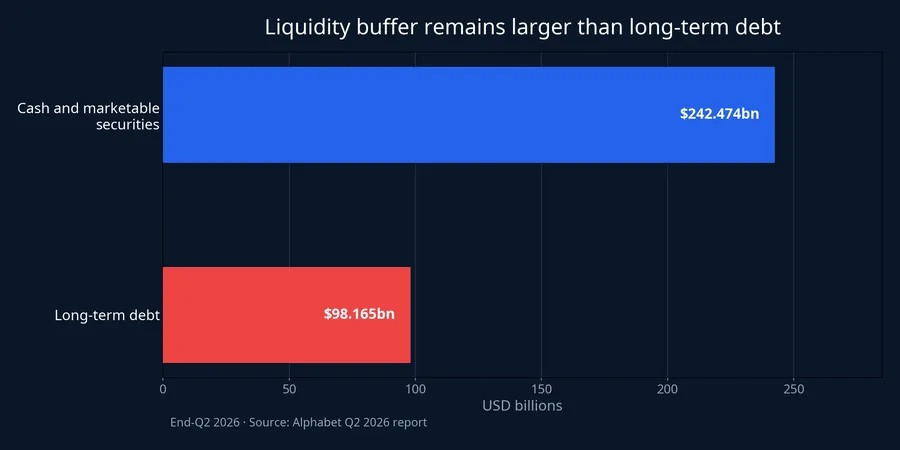
At the end of Q2 2026, Alphabet held USD 55.911 billion in cash and cash equivalents plus USD 186.563 billion in marketable securities. Together, the USD 242.474 billion total was far larger than its USD 98.165 billion of long-term debt. On those numbers, near-term liquidity is not the main concern.
But a large company’s cash balance is not a wallet reserved for data centers. It also supports day-to-day operations, taxes, dividends, acquisitions and long-term commitments. Funding most of a multi-year infrastructure build with cash would reduce the buffer available when markets or operations become less favorable.
Bond financing aligns the payment period with the useful life of the assets. Alphabet receives capital now to build computing capacity and repays interest and principal over years. That avoids immediate additional dilution, but it creates a fixed claim: interest remains payable even if revenue from the new infrastructure arrives more slowly than expected.
Alphabet also used equity financing in June 2026, receiving USD 49.6 billion in net proceeds from common stock and mandatory convertible preferred stock. Equity does not require repayment of principal, but it increases the number of claims sharing future business results. Neither source of capital is free. The company is choosing among dilution, interest cost and retained liquidity.
Cash flow turned negative in the second quarter
Alphabet generated USD 39.069 billion of operating cash flow in Q2 2026 and spent USD 44.924 billion on property and equipment. On the common operating-cash-flow-less-capex measure, that produced negative free cash flow of USD 5.855 billion for the quarter. Capital spending had moved ahead of internally generated cash.
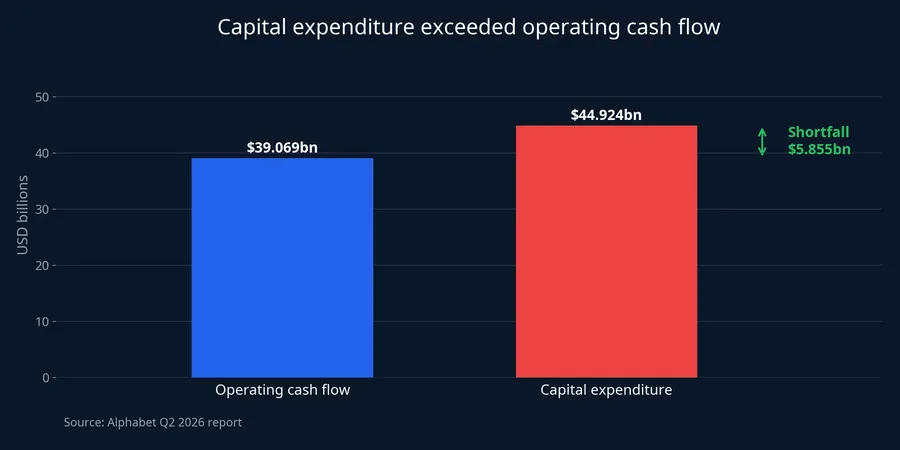
One negative free-cash-flow quarter does not mean the business model has weakened. Servers, network equipment and data centers are paid for immediately, while their economic value is used over years. The useful question is not simply whether the number is negative. It is whether the gap narrows because operating cash flow grows, rather than because construction is cut back.
This is also where causal claims should be restrained. Heavy capex and a new bond filing appearing close together do not prove that a particular borrowed dollar funded a particular server. The evidence shows that Alphabet is expanding infrastructure while quarterly self-funding is insufficient; the final allocation of net proceeds must wait for the completed terms and later reports.
Google Cloud is encouraging evidence, not a final answer
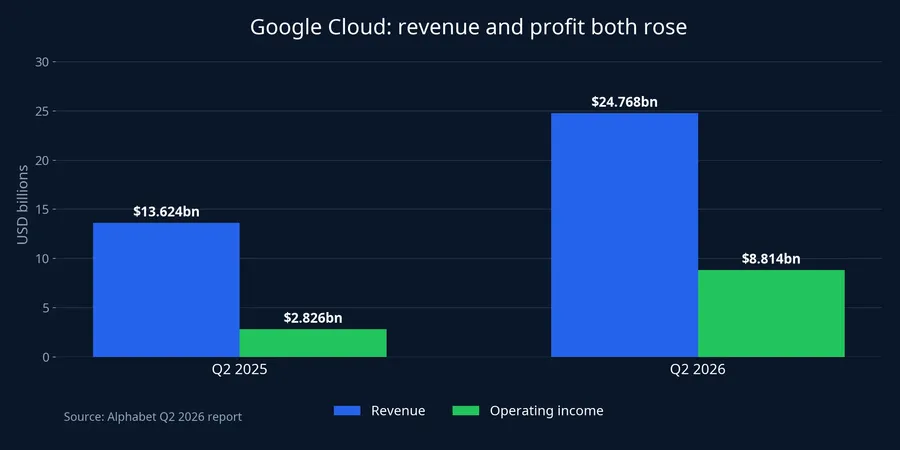
On the cash-generation side, Google Cloud is producing a constructive signal. Revenue reached USD 24.768 billion in Q2 2026, up 82% year over year. Operating income was USD 8.814 billion, versus USD 2.826 billion a year earlier. These figures show that AI infrastructure and related services are generating revenue and that the segment’s profitability is expanding.
Think of it as building another factory. More orders are encouraging, but the owner still needs to know whether profit after power, maintenance and depreciation grows fast enough. For Alphabet, Google Cloud is meaningful evidence that infrastructure has paying customers. It is not proof that every AI investment will earn the same return.
One favorable outcome is that cloud revenue and operating income continue to rise faster than the infrastructure costs recognized over time. Another is that revenue grows while margins narrow as servers, electricity, outside capacity and depreciation rise. The current disclosure does not isolate every contribution, so the more rigorous approach is to follow several quarters rather than assign a single cause to AI.
Interest is manageable today, while debt growth still matters
Q2 2026 interest expense was USD 1.278 billion, up from USD 261 million a year earlier. Group operating income was USD 40.770 billion, or roughly 31.9 times interest expense. On this snapshot, Alphabet retains substantial capacity to service interest.
The snapshot is not the whole trend. Long-term debt rose from USD 46.547 billion at the end of 2025 to USD 98.165 billion by the end of June 2026. Once the new deal is priced, its final coupon and maturity schedule will matter more than an unconfirmed headline size. A lower coupon makes a longer payback period easier to carry; a higher coupon means creditors are asking for more compensation for the pace of investment and borrowing.
That is why total debt should not be read in isolation. A company can borrow heavily and remain sound if operating cash flow grows faster than interest obligations. Conversely, a large pile of cash and securities is not an unlimited shield if negative free cash flow persists while debt and depreciation keep rising.
Three measures for the next reports
First, track the gap between operating cash flow and capital expenditure. A narrowing deficit caused by stronger business cash generation conveys something very different from a deficit that narrows because construction is reduced. It shows how much of the infrastructure build is becoming self-funded.
Second, track Google Cloud operating income alongside depreciation. Revenue growth is necessary, but growing profit after the network expands says more about whether investment is becoming earning capacity. Investors do not need a single “AI number”; the relationship between the measures over several quarters is more informative.
Third, compare interest expense with operating income and operating cash flow. If cash-generating measures keep rising faster than interest, debt is supporting growth. If interest and depreciation accelerate while cash flow stalls, borrowing becomes pressure on the balance sheet rather than a capital-allocation tool.
Alphabet still has a thick financial buffer, and Google Cloud has already demonstrated commercial demand for its infrastructure. The preliminary bond filing is therefore not, by itself, a warning of financial stress. It marks the point at which the AI buildout is no longer financed solely by cash produced quarter by quarter. That thesis would deteriorate only if capital expenditure keeps exceeding operating cash flow over several quarters while profits from new infrastructure fail to keep pace with interest and depreciation. Those are the signals worth watching, not an offering size that has not yet been finalized.