


A strong earnings report can move a share price quickly, but the market does not trade on the past alone. Airbnb shares rose by roughly 9% in after-hours trading after the company released its second-quarter 2026 results. That response says investors raised their expectations; it does not, by itself, establish that the stock is attractive at every price.CNBC
For newer investors, this is a useful case study. A company can beat forecasts, offer a brighter outlook, and still deserve a careful reading before anyone follows the price move. The completed quarter tells us what Airbnb has delivered. Its third-quarter and full-year guidance offers a clue to what the market now expects it to deliver next.
The market is pricing the part that has not happened yet
Airbnb reported second-quarter revenue of about $3.61 billion, above the $3.58 billion consensus estimate. EPS came in at $1.37, also ahead of the $1.26 consensus. In extended trading, the share price was at one point more than 10% above the regular-session close, although early coverage commonly described the gain as roughly 9%.MarketBeat
The revenue beat was only about $27.76 million. It would therefore be too simple to credit the entire share-price move to one upside surprise. Investors are not paying for a quarter that is already over. They are using that quarter to update assumptions about bookings, revenue, costs, and profitability in the quarters ahead.
That change in expectations is the central point. If the market had expected slower growth before earnings, a beat can lead valuation models to be revised. If expectations had already been exceptionally high, even a good report might not sustain a positive reaction. A share price is always a comparison between what happened and what was already priced in.
Revenue needs operating context
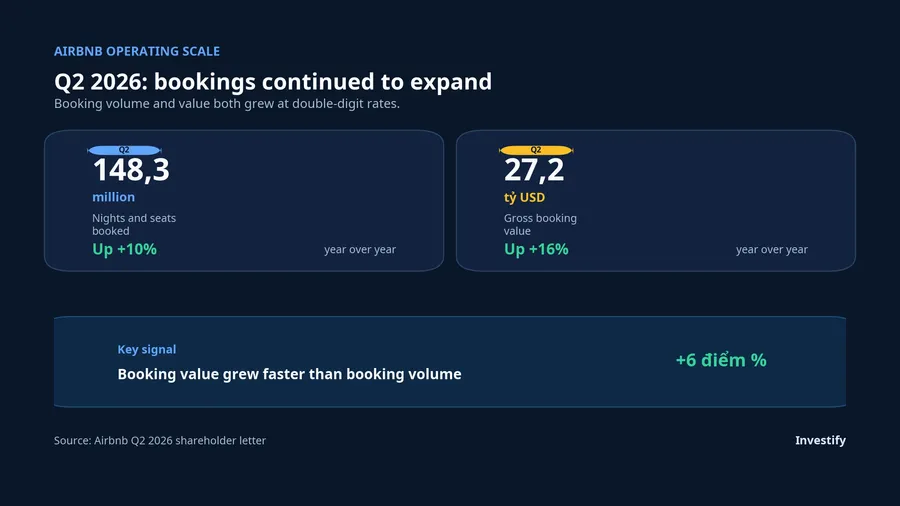
Operating data adds context. Second-quarter revenue rose 17% year over year to about $3.6 billion. Gross booking value rose 16% to $27.2 billion, while nights and seats booked grew 10%. Taken together, the measures suggest that growth was not solely the product of charging more for each transaction.MarketBeat
Think of the platform as a store. Revenue can rise because it sells more items, because the price of each item rises, or because both happen at once. For a travel platform, nights and seats booked are closer to selling more items, while gross booking value measures the activity flowing through the platform. When both are rising, the growth story has a broader base than price alone.
The measures still do not tell the whole story. Booking value grew faster than booking volume, which suggests that average prices, destination mix, or service mix also contributed. That can be constructive, but investors should follow the pattern for several quarters to distinguish durable demand from a pricing effect that may change quickly.
Adjusted EBITDA margin was 35% in the quarter, above the prior year. That points to operating efficiency because costs did not absorb the revenue growth. Yet net income of $816 million included a $77 million tax benefit related to recently issued tax guidance affecting prior years. This is a one-off item and should not be treated as recurring earnings for every future quarter.MarketBeat
Guidance is what changes the valuation discussion
Airbnb expects third-quarter revenue of $4.69 billion to $4.77 billion, or 15% to 17% year-over-year growth. It also raised its full-year outlook to at least mid-teens revenue growth and an adjusted EBITDA margin of at least 35.5%. These are forward-looking numbers, so they can matter more to valuation than a profit figure from a quarter already closed.MarketBeat
This is why the phrase “raised guidance” often matters. It does not guarantee delivery. It tells investors that management sees conditions as stronger than it did when it gave its previous forecast. If analysts subsequently lift their revenue and profit estimates, the present value of expected cash flows in their models can rise as well.
The certainty needs to remain properly calibrated. Guidance is a company forecast, not a result that has already occurred. It is more useful than a generic promise because it includes a revenue range and a margin target, but the next report still has to validate it.

There are real drivers, but no single explanation
Bookings made through the app grew 23% and represented 64% of total nights, up from 59% a year earlier. Hotel nights remain a single-digit percentage of total nights, but they are growing roughly three times faster than the homes business. These details help explain why the company is more confident about the second half of the year.MarketBeat
Still, the simultaneous appearance of these data points should not be turned into an overly simple causal story. The outcome may reflect app improvements, first-time bookers, expansion markets, pricing mix, or several product changes at once. The available evidence supports the view that the business strengthened across several indicators, but it does not precisely allocate each initiative's contribution.
That distinction matters especially in technology stories. A new feature can easily be presented as the explanation for an entire quarter of growth. In practice, the company describes the result as the combined effect of improvements made over several years. A more disciplined approach is to watch whether booking growth, new-customer growth, and cost efficiency continue in the next reports.
Three reasons to keep expectations grounded
First, approximately 3 percentage points of expected third-quarter revenue growth come from a foreign-exchange tailwind after hedging. It remains part of reported US-dollar revenue, but it does not fully represent underlying demand. If currency conditions change, that contribution can fade without necessarily implying fewer bookings.MarketBeat
Second, Airbnb expects adjusted EBITDA margin to decline slightly year over year in the third quarter because of investment timing. Revenue and profit do not have to grow at the same pace every quarter. Product, marketing, and new-business investment can support longer-term growth while putting near-term pressure on profitability.
Third, after-hours trading is less liquid than the regular session. An earnings-time price is an initial reaction from part of the market, not a final verdict. The following regular session, analyst Q&A, and subsequent estimate revisions will show whether the revised expectations hold.

A practical way to read an earnings report
Start with the gap between results and forecasts. Then ask whether that gap came from revenue, transaction volume, margins, or an unusual item. For Airbnb, both revenue and EPS exceeded consensus, but net income also benefited from a one-off tax item. Separating that detail helps avoid carrying a non-recurring gain into a long-term expectation.
Next, compare the next-quarter guidance with prior guidance. Airbnb did not merely report a good second quarter; it also raised its full-year revenue and adjusted EBITDA-margin outlook. That is the stronger explanation for why the market reassessed the outlook, rather than any single EPS number.
Finally, keep two questions separate: is the business improving, and is the stock inexpensive? This report offers constructive evidence on the first question. The second still requires the current share price, revised earnings estimates, valuation relative to the outlook, and an assessment of risks that could prevent the plan from being delivered.

The thesis from this report is clear: Airbnb is not merely selling the market on a strong second quarter. It is leading the market to assign more value to booking growth and operating efficiency through the rest of the year. Foreign exchange, investment spending, and after-hours volatility do not overturn that conclusion unless later reports show that the new guidance is not being met. The signals to watch are nights and seats booked, gross booking value growth, adjusted EBITDA margin, and the next rounds of forecast revisions.