
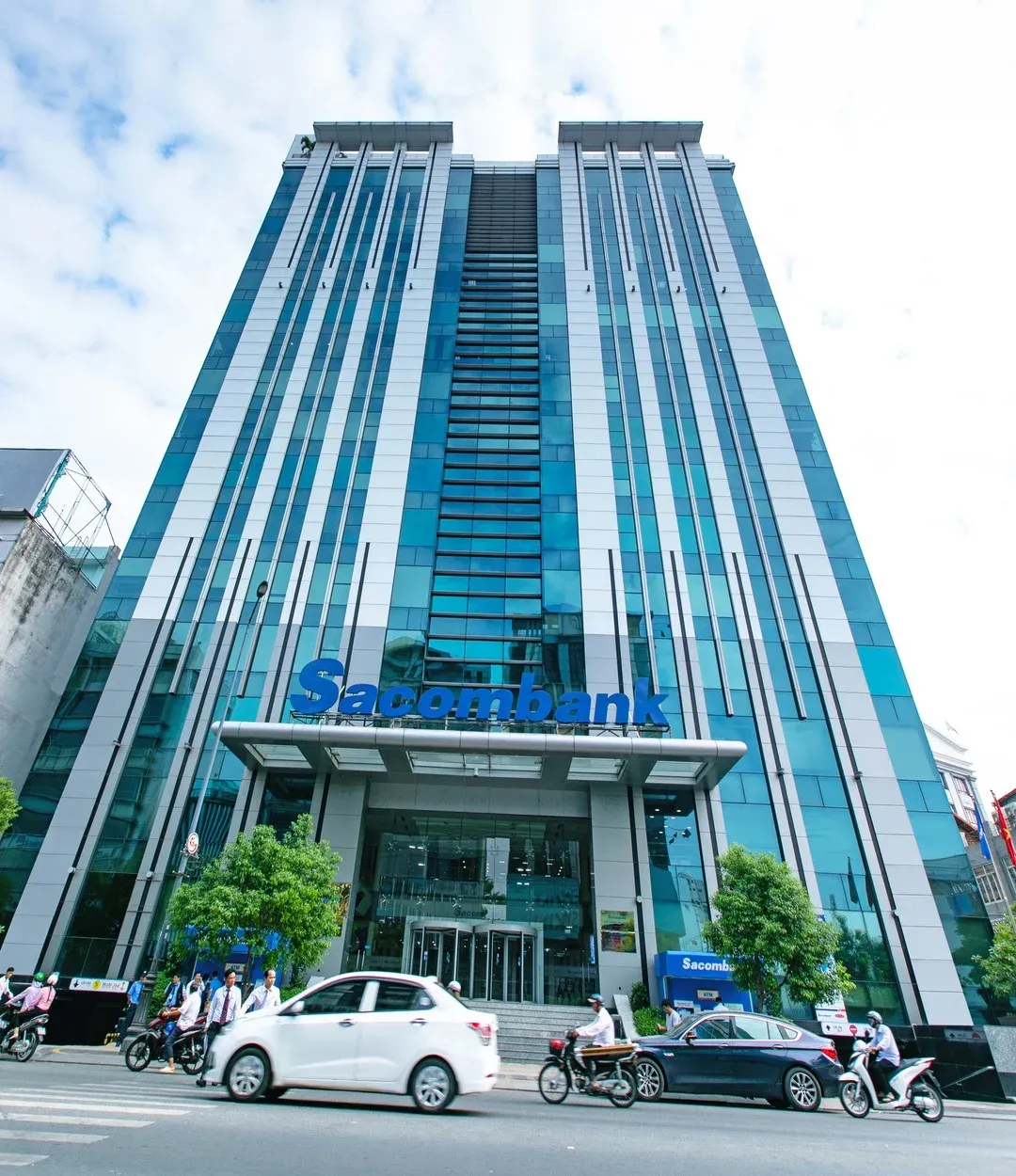

A 10% annual coupon naturally catches a new investor’s eye. Sacombank has issued three bond tranches worth a combined VND 3,650 billion, with a six-year tenor and a fixed 10% annual coupon. That is notable because the rate stands above many familiar deposit options. The useful first question, however, is not which rate is higher. It is: what contract is the buyer actually signing?Báo Đầu tư CK
In plain English, a deposit places money with a bank under a deposit relationship. Buying a bond lends money to the issuer under a separate set of terms. Both can carry a bank name and pay periodic interest, yet access to principal and treatment in a stress scenario are not the same. The central point is simple: the 10% coupon is the start of underwriting a six-year loan, not proof that the instrument is equivalent to a bank deposit.

Same bank, different legal position
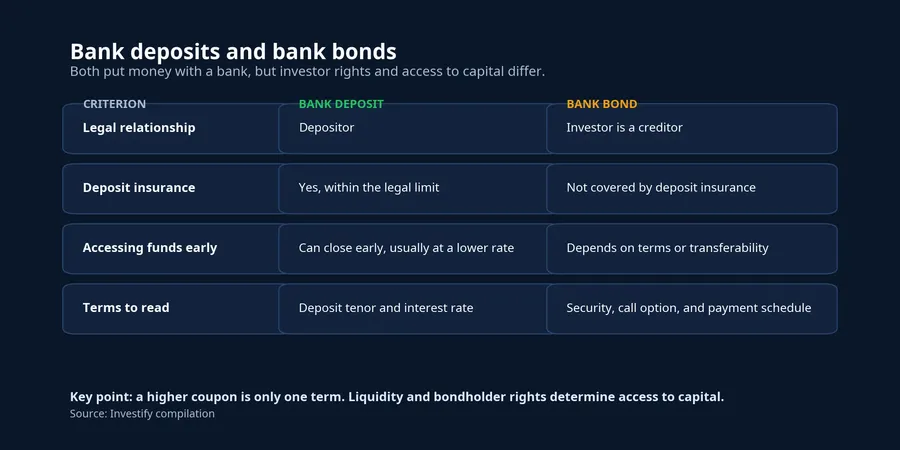
With a term deposit, the customer is a depositor. The bank agrees to return principal and interest under the deposit agreement, and the treatment of an early withdrawal is established by the product terms and regulation. Eligible deposits also sit within the statutory deposit-insurance framework. That protection follows from the nature of a deposit; it is not a blanket promise for every financial product issued by a bank.
With a bond, the buyer becomes a creditor of Sacombank. The issuer’s duty to pay coupon and principal, and the holder’s rights, depend on the bond documents: collateral, payment priority, put rights, transfer restrictions, and any early-call feature. A bank bond is not covered by deposit insurance. A bank’s name on the document therefore does not turn a bond into an insured savings account.
The distinction has practical consequences. A depositor can generally close a term deposit early, accepting a lower interest calculation. Circular 04/2022/TT-NHNN sets out how interest is applied when deposits are withdrawn early at credit institutions.Government Portal A bondholder, by contrast, has no automatic right to demand principal back from the bank on any chosen day.
Liquidity matters as much as the coupon
An investment can pay interest on schedule and still be inconvenient when its owner needs cash. For a six-year bond, the path out usually comes from one of three routes: the issuer calls the bond early, the holder has a contractual put right, or the holder transfers it to another eligible buyer. Whether any route exists must be checked in the disclosure for that specific tranche. It cannot be inferred from the 10% coupon.
This is where liquidity often gets missed. Without a put right and with limited secondary-market demand, an investor may need to hold the bond to maturity or accept an unattractive transfer price. The six-year tenor is not merely a label. It is the period during which capital can be tied up by the terms of the security.
The issuer’s call option deserves equal attention. If market rates fall, a bank may prefer to repay expensive funding early where the bond terms permit it. The investor’s planned stream of 10% income could then end sooner than expected. That outcome is not automatically good or bad, but it belongs in any comparison with a deposit.

A fixed coupon does not replace credit analysis
“Fixed” describes the interest formula. It does not guarantee an investment outcome in every circumstance, because coupon and principal payments still depend on the issuer’s ability to perform throughout the tenor. Put simply, buying a bond means assessing Sacombank as a borrower, not merely choosing a rate.
The checklist should therefore include asset quality, non-performing loans, provisioning, earnings capacity, and capital buffers. These indicators are more informative when read across several reporting periods than when one number is isolated from its context. Higher long-term funding costs may compensate lenders, but they can also signal that an issuer is paying more for funding. The available evidence does not establish why the coupon is 10%, so it would be inappropriate to assign a single cause.
In an August 4 report, Báo Đầu tư Chứng khoán said Sacombank had not yet released its second-quarter financial statements at the time. Information provided by the bank put the estimated end-June non-performing-loan ratio at approximately 5.6%, while second-quarter pre-tax profit was expected at approximately VND 1,900 billion to VND 2,000 billion, down about 50% year on year. Those are estimates, not released second-quarter financial statements.Báo Đầu tư CK
Those figures do not establish that Sacombank will fail to meet its bond obligations. They do explain why an investor should not stop at the coupon. The formal second-quarter results, subsequent asset-quality trends, and provisioning costs will provide a clearer picture of repayment capacity.
Retail investors do not automatically share the same access
A private placement does not work like a counter deposit. Decree 200/2026/ND-CP governs the offering and trading of privately placed corporate bonds; access and transferability depend on the bond type and the legal framework for the transaction.Government Portal Before considering a specific tranche, an individual investor should confirm whether they are eligible to buy it.
The eligibility of the next buyer matters too. An asset that can only be transferred within a narrow group has a smaller potential buyer base. This is why the same headline coupon can have a different practical value for different investors. Someone who can leave capital untouched for six years faces a different trade-off from someone who needs a flexible emergency reserve.
A checklist before comparing 10% with deposit rates
First, obtain the disclosure for the exact bond code. A news report of total value, tenor, and coupon is a starting point. It does not replace documents that set out collateral, payment timing, purchaser eligibility, investor put rights, and issuer call rights. Without those documents, an investor should not assume that a bond is secured simply because a bank issued it.
Next, map the cash flows over time. Quarterly, semi-annual, and maturity-date coupon payments produce different experiences. Then run a real-world test: if you need money after one year, what can you do, who can you sell to, and what price or cost might apply? That is much more useful than simply noting that the coupon is fixed.
Finally, compare the bond with a deposit of similar tenor and similar flexibility. The yield difference only becomes meaningful after accounting for deposit insurance, early-withdrawal rights, transferability risk, and the borrower’s financial condition. That is the balance between income and access to capital that the headline rate cannot show.

For Sacombank’s 10% bond, the evidence currently does not support a universal buy-or-avoid conclusion. The items to monitor are the disclosure for each tranche, the formal second-quarter financial statements, and the terms that determine access to principal. Once those are clear, an investor can compare the extra coupon with its real cost: time, liquidity, and credit risk.