
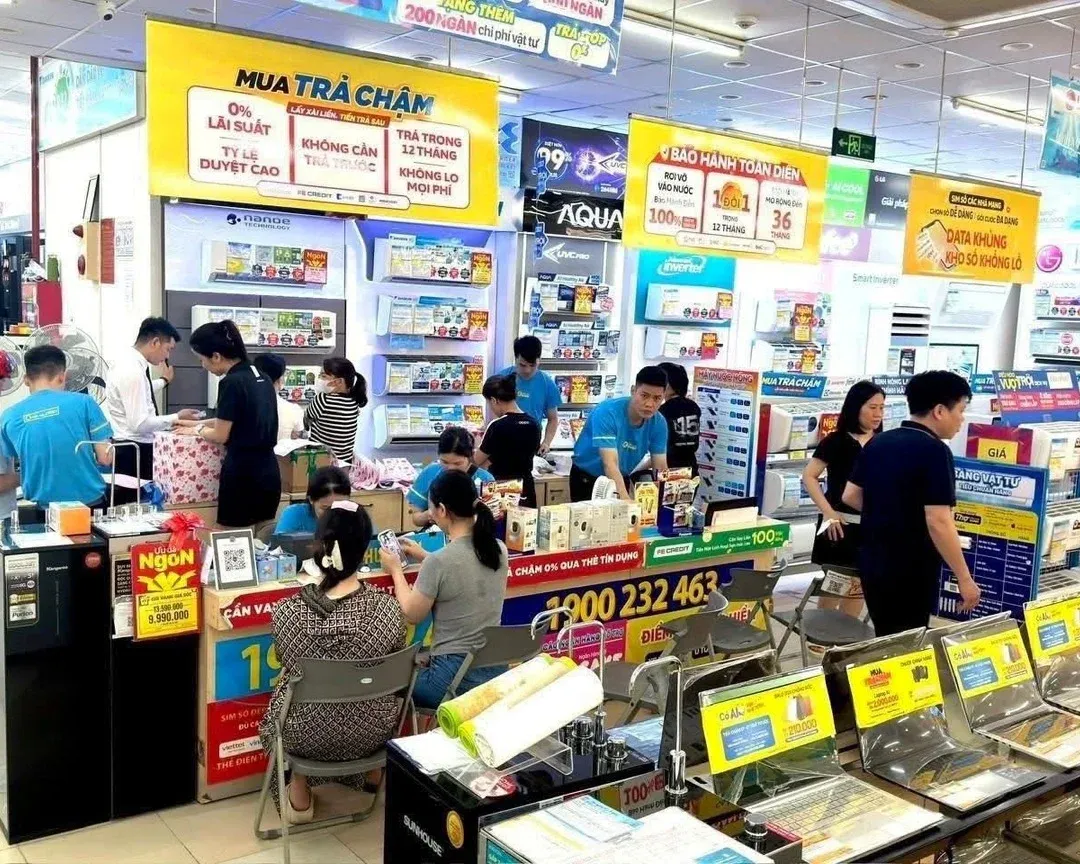

On 6 August, almost 1.27 billion DMX shares began trading on HOSE at a reference price of VND 80,000, implying a market capitalisation of about VND 101,418 billion.DMX Consumers know Điện Máy Xanh as a familiar store sign. Shareholders need a different lens: not whether stores look busy, but whether the system can repeatedly generate enough profit to justify its valuation.
The central point is straightforward. The reference price reflects a retailer that has materially improved operating productivity, but it also asks the company to sustain its margin and turn newer businesses into repeatable cash generation. The first trading session is a technical milestone. Post-listing reports will show whether the earnings expectations embedded in the price are being met.
What a DMX share actually owns
The first distinction is the asset perimeter. The listing prospectus says DMX holds the Vietnamese operations of Thế Giới Di Động, Điện Máy Xanh and TopZone. It also owns 99.99% of Thợ Điện Máy Xanh and holds a 45% interest in EraBlue in Indonesia.DMX Buying DMX therefore means owning consumer electronics retail, after-sales services and a share of the Indonesian associate.
Bách Hóa Xanh, An Khang and AVAKids are not part of this listed equity. That legal boundary has a practical effect on risk. DMX is focused on relatively high-ticket purchases, whose replacement cycles are sensitive to household income. When customers delay a new phone, television or air conditioner, this stock has no grocery business within the same perimeter to cushion essential consumption.
Concentration also offers an advantage. Revenue, costs and margins for the electronics operations should be easier to assess than they would be within the parent group's entire retail ecosystem. For new investors, this is the first guardrail against confusing a strong consumer brand with an asset that represents every business of the former parent.
First-half figures point to better productivity
The latest numbers indicate that the near-term driver was not a rapid expansion of stores. In the first half of 2026, DMX reported VND 65,280 billion in revenue, up 27% year on year, and VND 4,876 billion in net profit, up 73%. Its net margin reached 7.5%, two percentage points above the year-earlier level.DMX
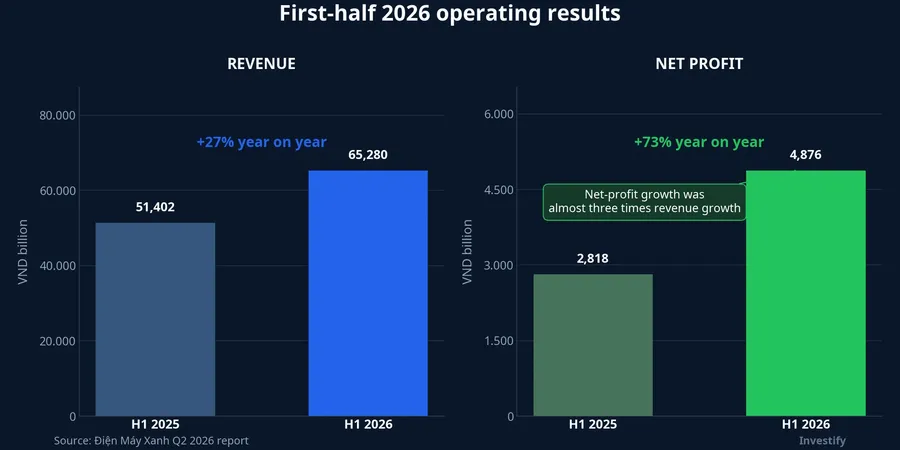
The gap between revenue and profit growth is the key signal. Same-store sales rose 32% while the network remained at 3,013 stores, down by 25 locations.DMX When sales rise on an existing network, rent, staff and logistics costs can be absorbed more efficiently. That is the mechanism behind profit growing faster than revenue, rather than merely an attractive headline percentage.
It would still be premature to treat 73% as a run-rate for the full year. Electronics retail is influenced by replacement timing, weather, sporting events, promotions and the product mix. The report demonstrates improved productivity. It does not prove that a 7.5% margin will persist in every subsequent quarter.
Services and Indonesia offer different types of growth
DMX is adding revenue streams beyond the sales floor. Instalment payments accounted for 38% of phone and electronics revenue in the first half. Thợ Điện Máy Xanh generated VND 1,892 billion in revenue, up 47%, though external customers accounted for only 10.3% of service revenue.DMX Repairs and installation now have real scale, but remain closely linked to customers already buying through the group.
The more useful measure is therefore not service revenue alone, but whether the external-customer share grows. A rising share would make the service operation more independent. If it does not, services may primarily remain a way to improve the customer experience and retention in the core retail business.
EraBlue had 261 stores in Indonesia at the end of June. Revenue rose 92% and net profit increased 154% year on year.DMX It is a growth engine worth monitoring, but DMX records only the share of earnings associated with its 45% interest. EraBlue's full revenue cannot be added to DMX consolidated revenue.
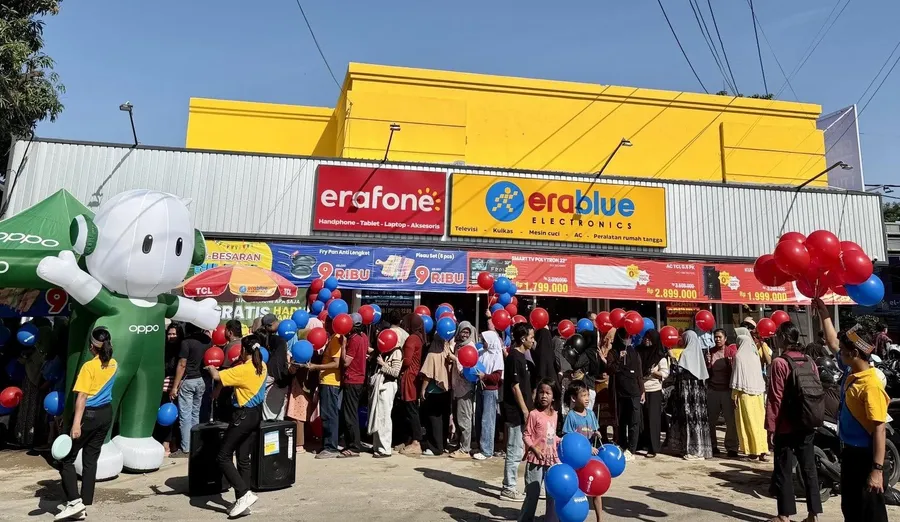
The Indonesian growth could reflect store expansion, same-store sales gains, or both. The available data does not establish each factor's contribution. It is more accurate to watch store count, the profit share recognised by DMX and margin durability together than to assume that openings alone caused the present growth rate.
One price, three earnings denominators
VND 80,000 does not by itself make DMX cheap or expensive. Its meaning changes with the earnings denominator. On approximately VND 5,800 billion of 2025 net profit, the listing valuation implies a P/E of about 17.5x. Using the 2026 net-profit target of VND 7,350 billion, the implied P/E falls to about 13.8x.DMX
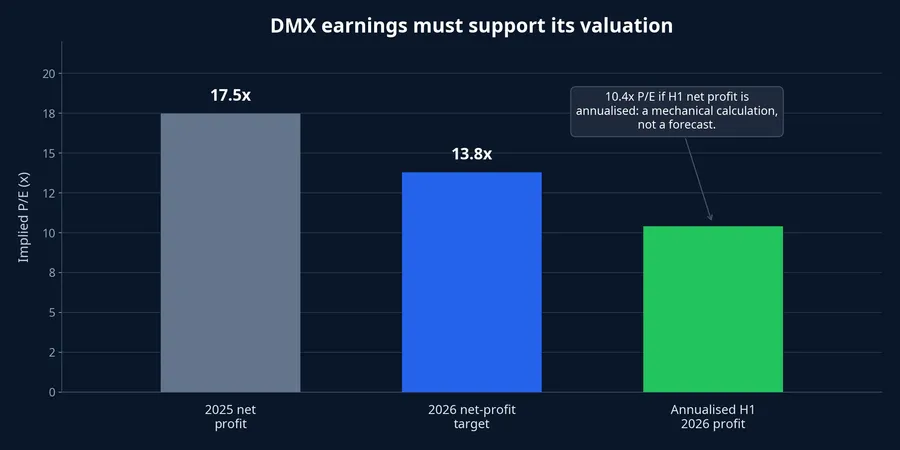
Annualising first-half profit produces VND 9,752 billion and a mechanical P/E of around 10.4x.DMX That is a sensitivity illustration, not a forecast. Seasonality and margins can change, so the fastest-growing denominator is also the one that needs the strongest evidence.
Equity at the end of June was VND 22,677 billion. Against the listing market value, that equates to a P/B of around 4.5x.DMX This places the emphasis on continued returns on capital, not simply the size of the balance sheet.
Cash and dividends do not replace execution
The IPO raised VND 13,315 billion. At the end of June, cash and short-term financial investments stood at VND 44,670 billion, or 59% of total assets.DMX DMX said IPO proceeds are intended to repay part of bank borrowing, while dividends come from retained earnings. Those are distinct cash-flow uses.DMX
The planned VND 4,000 per-share dividend represents a 5% cash yield on the reference price.DMX But shares are normally adjusted on the ex-dividend date. A dividend distributes earnings; it is not free value added on top of a purchase price.
At listing, DMX has presented encouraging evidence of better productivity and profit. Its valuation becomes more convincing only if that evidence repeats through future reports. The three signals to watch are the retail margin, the external-service revenue share and the profit contribution recognised from EraBlue. They do not overturn the case for current improvement, but they will determine whether VND 80,000 pays for earnings already demonstrated or for an expectation that still needs to be proven.