


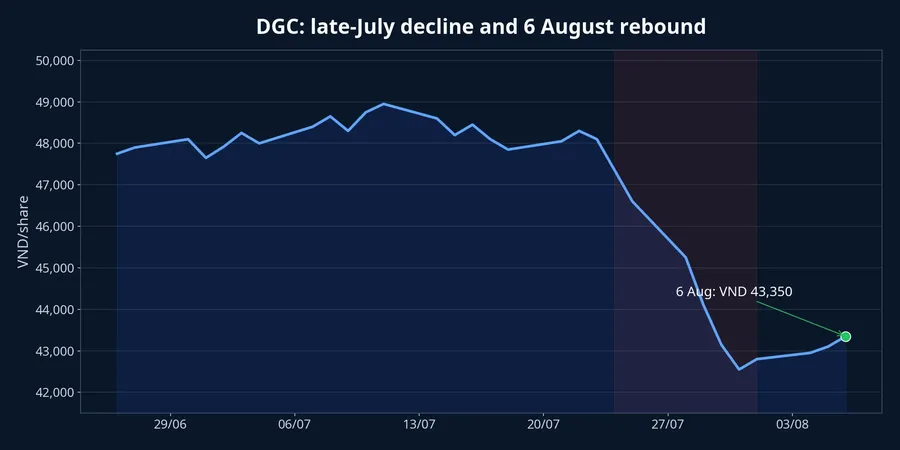
On 6 August, DGC closed at VND 43,350, up 6.91%, while the VN-Index fell 11.68 points. On HOSE, 224 stocks declined against 110 gainers. That near-limit rise makes it tempting to treat the price move as an answer to every unresolved question.VietnamBiz
That would leave out an essential layer of verification. A market price shows where buyers and sellers met in one session. It does not establish whether the board has been replenished, how post-election roles will be allocated, or whether HOSE has amended the stock’s trading status. The real risk sits in the gap between an expectation reflected in price and a process completed only through formal documents.
A strong price move is not proof of broad participation
DGC matched 575,200 shares on 6 August, equal to 70.61% of its 20-session average of 814,600 shares. This does not diminish the strength of the session, but it does not yet demonstrate broad participation either. A move higher when sellers pull back can look very similar on the screen to one led by a fresh wave of buying.
The opposite conclusion would be just as careless: below-average volume does not automatically mean weak demand. The 20-session average may have been lifted by unusual sessions around the emergence of legal information. On 23 July, DGC traded more than 3.86 million shares, far above the 6 August figure. The available data therefore cannot allocate the move precisely among new demand, reduced supply, or expectations around the proposed candidates.
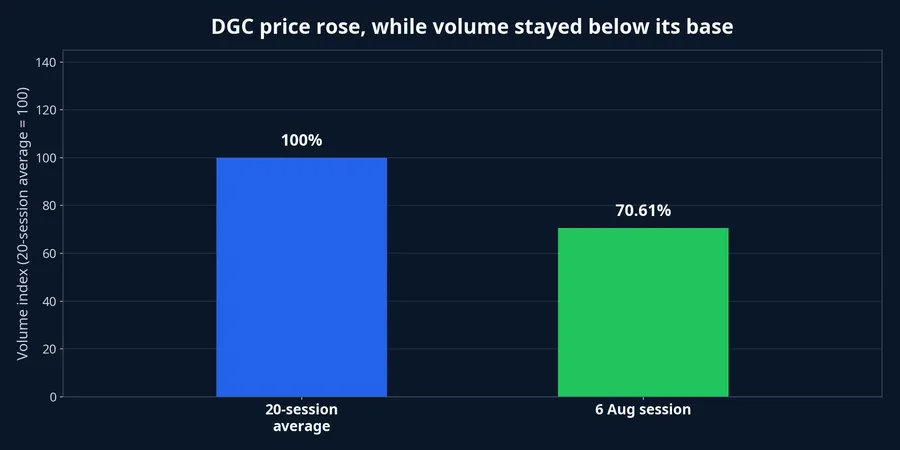
For newer investors, this is a useful distinction. Price answers where a stock traded. Liquidity indicates how widely market participants were willing to transact around that price. DGC has a notable price signal, but not enough evidence yet to call it a durable confirmation from capital flows.
The personnel filing remains at the nomination stage
On 5 August, DGC released minutes from a shareholder group meeting and nomination documents for two additional board seats.DGC The nominating group holds more than 77.24 million shares, equal to 20.34% of charter capital.Người Đưa Tin This is a concrete procedural development, not market hearsay.
The first nominee is Đỗ Văn Đông, Deputy Head of the Project Department at Duc Giang Chemicals Group Joint Stock Company (DGC); he is also Chairman of Duc Giang Chemicals - Dak Nong Single-Member Company Limited. The other nominee is Đào Đức Mạnh, Head of the Import-Export Department at Duc Giang Chemicals Group Joint Stock Company (DGC). The candidate information was reported on 6 August.Người Đưa Tin
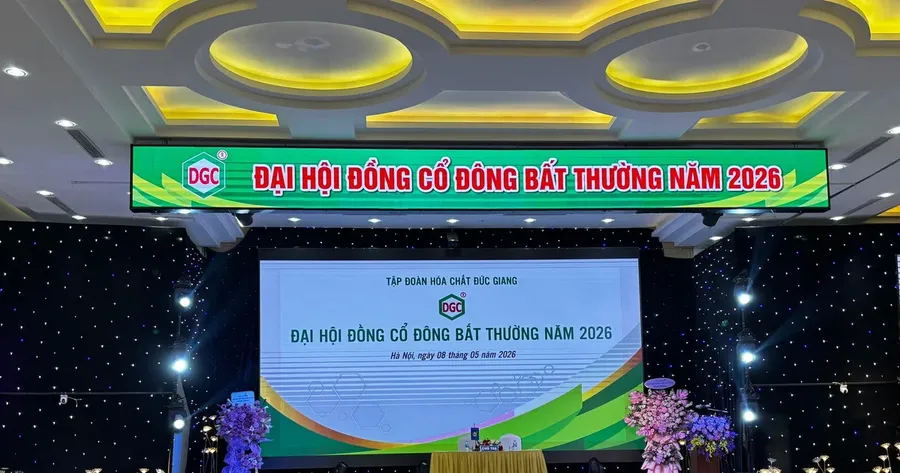
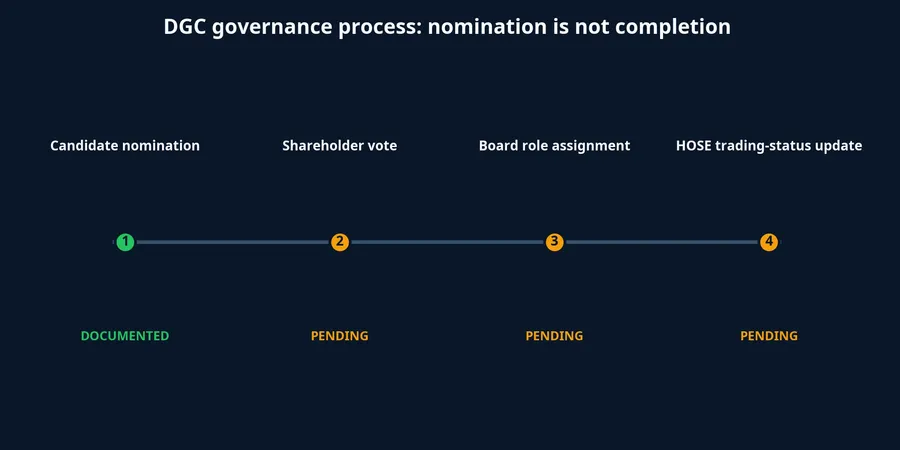
Still, “nominated” is not “elected.” The documents must go through shareholder voting authority, after which the company can announce the outcome and any subsequent role assignments. Calling this stage a completed board overhaul would change the legal meaning of the event. The reporting does not establish that outcome, and neither does a one-session price increase.
The distinction matters more because DGC’s board has three members after personnel changes.VietnamBiz The filing signals that the company is addressing part of the issue. It is not the final result, particularly while the market still needs to know who is elected and what the resulting governance structure will be.
A company filing cannot substitute for a HOSE decision
Status data updated through 5 August still place DGC under trading restrictions and ineligible for margin trading. DGC’s 5 August candidate disclosure also did not include a HOSE decision lifting any warning or trading restriction. These are separate information layers and should not be compressed into one conclusion simply because they appeared in the same week.
Personnel filings belong to internal governance procedures and shareholder authority. Trading status is determined by the exchange after it reviews the basis and remediation documents. Progress in the first process may improve expectations, but it does not automatically change the second.
Likewise, submission of audited financial statements does not by itself prove that every audit-related issue has been resolved. To say that this risk has fallen, investors need a new disclosure specifying that the qualified audit opinion has been addressed, or a competent authority’s document accepting remediation. Until then, inferring compliance status from a price color is too large a leap.
What could change this reading
The next session’s price and volume can only add evidence about trading. If DGC holds its post-rally range with volume improving from 575,200 shares on 6 August, that would support the observation that demand was not limited to one day. If the stock gives back much of the gain while volume rises, short-term expectations are being tested. Neither outcome is a governance verdict.
The decisive evidence lies elsewhere: a resolution electing additional board members, role-assignment information if any, and a formal HOSE notice on warning status, trading restrictions, or margin eligibility. Those documents can establish how far the process has advanced; a price board cannot.
The thesis is not that the 6.91% rise should be dismissed. It shows that expectations shifted faster than the wider market. At this stage, however, expectations should be called expectations. Governance risk can be said to have eased only when the election is completed and the trading status is updated through formal disclosure. That is the line worth keeping in view in the sessions ahead.