

Apollo's £5.7 billion cash proposal puts easyJet at an important juncture: this is a price for control of an operating system, not simply for aircraft and an orange logo. On 6 August, Castlelake withdrew from the contest, leaving Apollo as the remaining pursuer. Apollo still had to announce a firm intention to make an offer or walk away by 5 p.m. London time on 7 August. Calling the transaction complete would therefore go beyond the facts currently available.Cinco Días
Put simply, Apollo may be betting that a low-cost airline with an established network can generate more cash from each passenger. That thesis works only if the improvement in cash flow exceeds the purchase price, cost of capital and buffer needed to withstand a downturn. It is a more useful way to read the proposal than treating £5.7 billion alone as proof that Apollo is either overpaying or getting a bargain.
The offer price is only the starting point
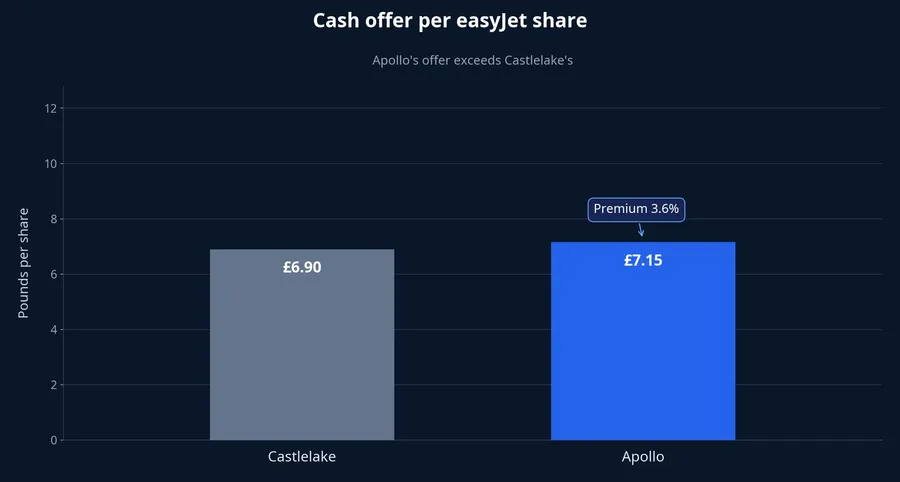
Apollo was reported to be offering £7.15 per easyJet share, 3.6% above Castlelake's £6.90 proposal. The gap says Apollo was willing to pay more than its rival in this round. It does not, by itself, show that Apollo has a better operating plan, cheaper funding or a certain route to profit after a delisting.Cinco Días
The 5 p.m. London deadline is an information milestone, not the day cash changes hands or ownership changes. Should Apollo make a formal offer, investors will have a basis to examine financing terms, approvals and operating commitments. Until then, the conservative conclusion is that Apollo is pursuing a possible acquisition, not that it owns easyJet.Cinco Días
That distinction matters because an offer price and a deal value are not the same thing. Shareholders are offered a price per share; the buyer must also assess future cash flow, debt, cash reserves and capital needed after purchase. A premium can be justified by a credible improvement plan, but it can look expensive if the underlying assumptions do not hold.
The hard-to-replace asset is the operating network
An aircraft can be bought or leased. What is much harder to recreate quickly is a convenient schedule at busy airports, a route network with returning customers, a booking system and data showing what passengers buy in each season. Those assets are not always fully visible in a single balance-sheet line, yet they shape how many seats an airline can sell and at what price.
The existence of those assets does not establish that they are the only reason Apollo is interested. The price could also reflect views on the brand, travel demand or Apollo's own ability to arrange financing. The currently verified reporting does not disclose a detailed operating plan, so these levers are possibilities to test after a formal offer rather than facts already announced by Apollo.
Cheap tickets do not mean little revenue
The base fare gets a passenger into the system. Checked baggage, seat selection, priority boarding, meals, hotels and destination services can raise the amount collected per passenger. This model lets an airline preserve a low-fare message while giving customers the option to pay more for conveniences they actually value.
Package holidays matter for the same reason: they connect the flight to accommodation and travel services. When a customer buys a package, the airline can retain more of a trip's spending rather than collecting only the seat fare. For a new owner, improving load factors on strong routes, offering relevant add-ons and removing inefficient schedules could improve cash-flow quality without expanding the fleet at any cost.
The caveat is straightforward. Ancillary sales help only when passengers still regard the total trip cost as reasonable and the service remains good enough to bring them back. If competition pushes easyJet to cut fares or fees, revenue beyond the ticket may not offset pressure on margins. This is an operating mechanism to examine, not an Apollo plan disclosed in the reporting.
Fleet efficiency meets the funding question
Aviation has substantial fixed costs. Aircraft, staff, maintenance, operating rights and control systems consume cash even when some seats are empty. That is why higher useful aircraft utilisation, fewer delays or quicker turnarounds can improve results without adding much in new assets.
More fuel-efficient aircraft can lower cost per seat. Larger aircraft on dense routes can spread costs across more passengers. These are operationally plausible directions, but not one-way gains: new aircraft need capital, larger aircraft need enough demand, and dense schedules make it easier for one disruption to cascade into later flights.
The important unknown is that the funding structure has not been detailed in the verified reporting. Investors do not yet know how much equity Apollo would use, where it would borrow, what interest rate it would pay or whether a sale-and-leaseback plan is involved. Without those terms, it is not possible to calculate the full post-deal debt burden. Financial leverage can accelerate returns to owners when cash flow improves, but it can also thin the equity cushion quickly when profit falls.
Cheaper oil helps, but it is not a shield
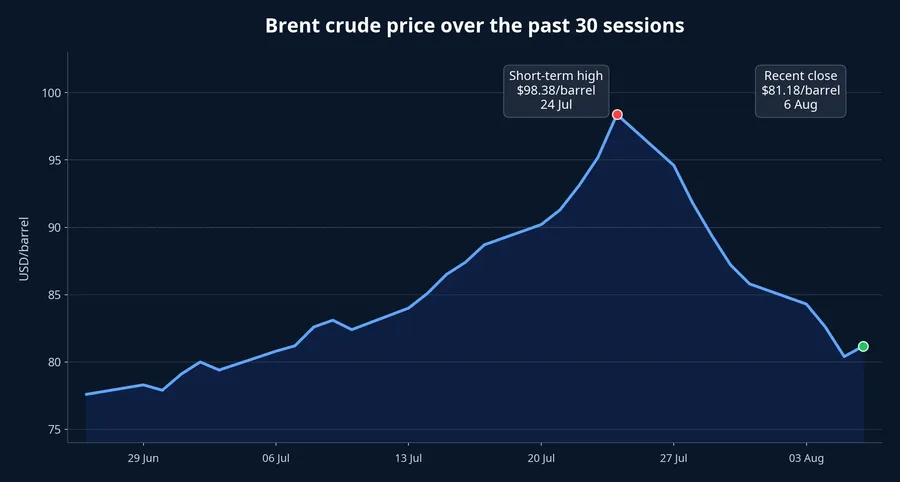
Brent closed at $81.18 a barrel on 6 August, approximately 17.5% below $98.38 on 24 July. That move may help an airline's fuel costs, but its practical effect also depends on hedging contracts, fuel-purchase timing and currency movements. A drop in spot oil today does not mean easyJet's reported cost falls immediately.
Travel demand is not a fixed income stream either. Leisure customers can defer trips when household budgets tighten; corporate customers can reduce travel budgets; rivals can keep prices low to protect market share. A favourable move in oil is therefore one part of the equation, not a substitute for selling seats, controlling costs and maintaining service.
There are also specific regulatory requirements around ownership and control of European airlines. Castlelake's withdrawal removes one bidder; it does not automatically remove the conditions needed to close a transaction. That is why a proposal that could lead to a deal should be kept distinct from one that has been signed, approved and closed.
What will test the £5.7 billion thesis?
The central thesis is that easyJet is attractive to Apollo because its cash flow could be improved in several places: the operating network, ancillary revenue, package holidays and fleet efficiency. But the offer price does not prove that thesis. It can only be tested once financing terms, regulatory conditions and operating plans are made public.
Over the coming days, investors should watch whether Apollo makes a formal offer, how debt and the cost of capital are structured, and how ownership-control and approval conditions are addressed. If that information does not emerge, or reveals too thin a financial cushion, £5.7 billion remains a striking headline number. If it shows that cash flow can improve while the business retains capacity to endure a downturn, investors will have a firmer basis to judge whether Apollo is buying a valuable platform or paying too much for expectations.