


The VN-Index fell only 0.04% on August 5, a move too small to carry much meaning on its own. Its path through the session was more revealing: it opened at 1,784.94, rose to 1,790.87, and closed at 1,776.46. That left 14.41 points of the intraday advance on the table, suggesting that late buying was not strong enough to defend the day’s higher range.This does not establish that the market has entered a correction. One session cannot prove a driver or lock in a forecast. The more useful conclusion is narrower: the VN-Index needs confirmation because the headline level has not yet been supported by market breadth. For newer investors, that means separating two questions that are often blurred together: where the index closed, and how broadly stocks actually participated.
What the intraday reversal can and cannot tell us
Four levels frame the August 5 session. The index opened at 1,784.94, reached 1,790.87, touched a low of 1,769.44, and ended at 1,776.46. The gap between the high and the close is not a buy or sell signal. It is a direct measure of the fact that buyers did not retain control through the close.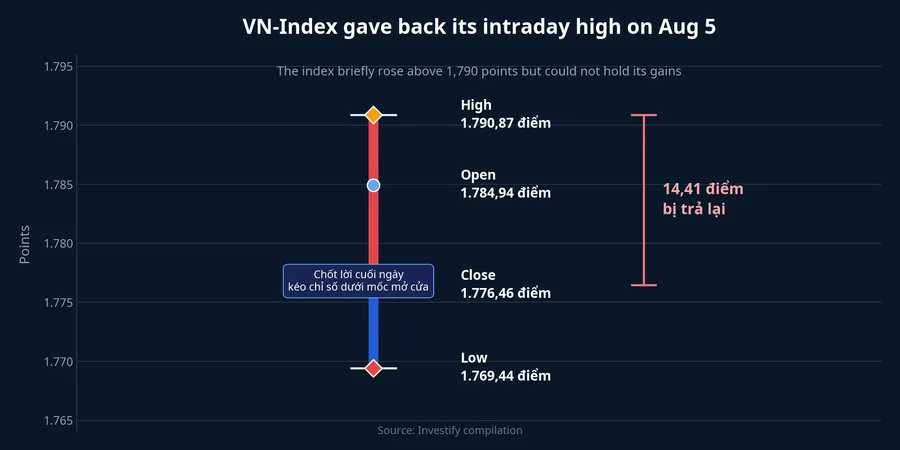
Put simply, a durable up session usually closes close to its high. When an index gives back a meaningful portion of the move, the next session must show whether that was routine profit-taking or a sign of weaker demand. A one-day pattern should not be promoted into a rule. The relevant test is whether the lost territory can be recovered and held.
The broader move since late July remains positive. The VN-Index closed at 1,735.78 on July 31 and at 1,776.46 after August 5, a gain of 40.68 points, or approximately 2.34%. The August 5 decline therefore does not erase the preceding rebound. But because that rebound has already happened, the burden of confirmation for the next leg is higher.That is an important distinction for risk management. A small daily move after a quick recovery can be a pause, a normal reduction in short-term positions, or the start of weaker follow-through. The close alone does not distinguish among those outcomes. Confirmation comes from what follows: whether buyers return at lower prices, whether they can protect the close, and whether more than a small group of names participates.
Breadth describes a different portfolio experience
There were 127 advancers and 189 decliners during the session. With roughly 1.49 declining stocks for every advancing stock, the experience across many portfolios differed from an index that fell just 0.77 points. That does not mean every stock fell sharply. It does mean that a nearly unchanged VN-Index should not be treated as a complete description of the market.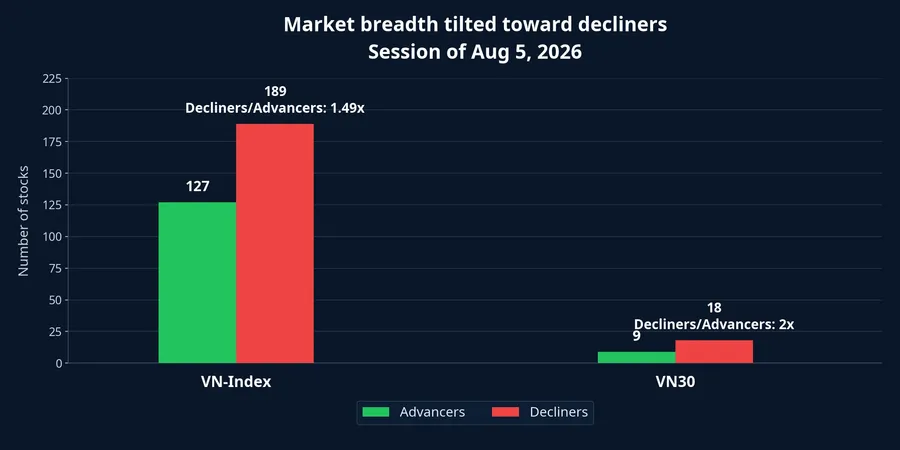
VN30 also leaned negative, with 9 gainers and 18 decliners, while the index closed at 1,916.88, down 0.54%. VN30 breadth is not identical to VN-Index breadth, but both readings suggest that large-cap stocks were not rising as a unified group. In that setting, the headline index can still be supported by a handful of heavily weighted shares even as participation remains narrow.
Breadth does not replace price. A market with many gainers but an index that loses an important closing level is not an unambiguously constructive picture. Likewise, a green index held up by a few large names while decliners dominate does not demonstrate broad demand. Read the two measures together: the close indicates who controlled the session, while breadth shows how widely that control was shared.
For an investor looking at a portfolio rather than a benchmark, this distinction is practical. A portfolio with little exposure to the few stocks supporting the index can lag the headline even on a stable day. Conversely, a weak headline can conceal resilience in the areas an investor actually owns. Breadth is therefore not a prediction tool by itself; it is a check against mistaking index performance for the full market experience.
The stocks supporting and dragging the headline
Several stocks supported the index. VIC rose 0.78% to VND 219,700, VHM added 0.46% to VND 153,600, and PNJ gained 6.91% to VND 37,900. On the other side, LPB fell 1.49% to VND 53,000 and FPT declined 1.68% to VND 70,300.CafeF CafeF CafeF CafeF
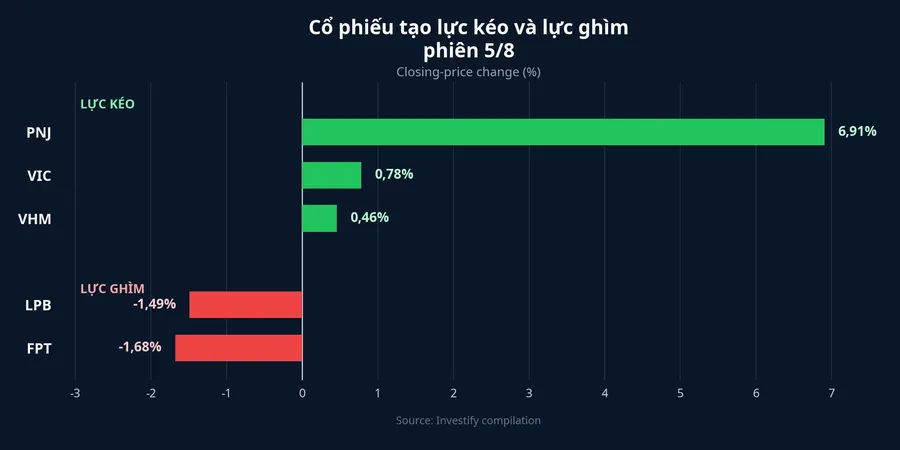
Those figures show where the index found support and drag; they do not establish a single explanation for each stock. PNJ’s increase, for example, could reflect short-term supply and demand, company-specific expectations, or position adjustments. The available source does not separate those possibilities. Assigning one definitive cause would create more certainty than the evidence supports.
That distinction matters. A rise in VIC, VHM, or PNJ may balance the index in one session, but it does not automatically show that capital is flowing broadly across the market. By the same logic, declines in LPB and FPT do not settle the outlook for banking or technology as a whole. A few visible tickers are not a substitute for a market-wide diagnosis.
The same restraint applies to explanations of the overall session. Profit-taking after the rebound, short-term portfolio adjustments, and company-specific news can all affect prices at once. The reported data support the observation that buying had not spread widely. They do not support assigning the entire session to one factor, one group of stocks, or one type of investor.
What would support a consolidation reading
A consolidation case becomes more credible if the VN-Index regains the territory lost on August 5 and closes more firmly. The 1,790.87 high is an observable test, not a forecast. Crossing it for a few minutes only shows that demand appeared. Holding the level into the close would say more about the durability of that demand.Breadth also needs to become more balanced than the 189-decliner, 127-advancer reading. If advancing stocks improve but the index fades late, the evidence remains mixed. If the index holds up but breadth stays weak, the possibility that a small set of large caps is carrying the headline remains. A stronger consolidation reading requires price and participation to improve together.

When the correction case becomes stronger
The risk case becomes clearer if the VN-Index closes below the August 5 low of 1,769.44 while decliners continue to dominate. The market would then have failed both to reclaim the points surrendered from the high and to hold the previous session’s low. That is a more coherent sequence of evidence than a focus on a single 0.04% decline.Another condition to watch is an index that remains near its latest close while breadth stays poor and VN30 does not recover. The session headline may not look alarming, even though many portfolios face broader pressure. The real risk is concentration: a few stocks hold up the index while the rest of the market fails to attract follow-through demand.
This is why the two scenarios should remain conditional rather than dramatic. A single recovery in the index without broader participation would leave the evidence incomplete. A more even balance between gainers and decliners without a better close would do the same. The useful discipline is to wait for the signals to line up instead of forcing a firm directional story from a near-flat index reading.
For now, the right conclusion is an explicit wait for confirmation, not a call to action. The central thesis remains that VN-Index breadth has not confirmed the headline level. In the next session, place three signals side by side: the ability to hold the closing range, the balance of gainers and decliners, and the breadth of leadership. If all three improve, the consolidation case gains support. If the index loses its intraday low while breadth stays tilted toward decliners, the correction case should carry more weight in a risk assessment.