

P&G has agreed to acquire Thorne for USD 3.8 billion. The headline price is not simply a bet on supplements. The assets beneath it include a brand used by health professionals, a direct-to-consumer channel with customer data, and an approach to personalised health. The deal is expected to close in 2026, subject to customary conditions and regulatory approvals.CNBCThorne
The central case is fairly specific: P&G is investing in a part of personal health care where it sees room to grow. The purchase price will only make sense, however, if P&G's distribution system can make Thorne larger without diluting the reason customers trusted it in the first place.
The brand is only the starting point
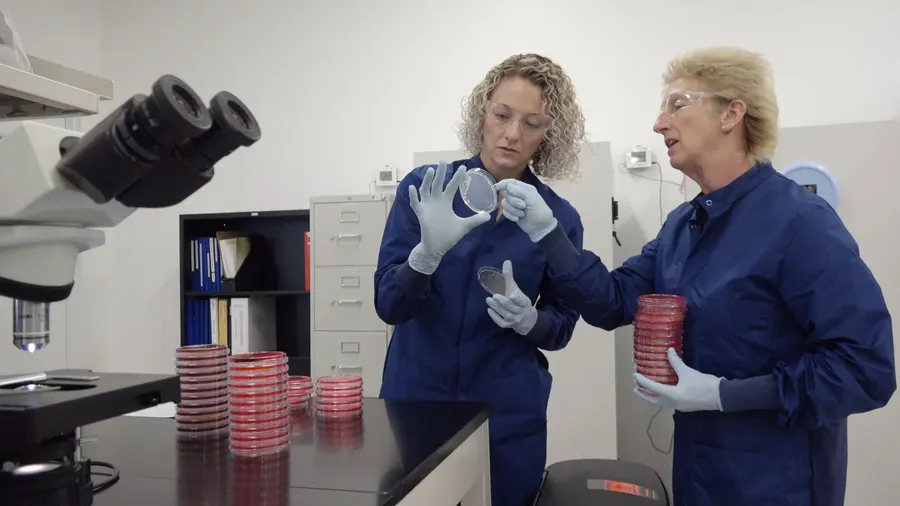
Thorne was founded in 1984, but longevity alone does not justify a premium valuation. The company says it develops products with internal physicians, researchers and scientists, while operating its own manufacturing site in South Carolina. In supplements, buyers cannot easily verify the purity or effectiveness of every ingredient. Process, transparency and professional trust can therefore be more durable advantages than an attractive advertising campaign.Thorne
The scale of that trust network is measurable, although it should not be confused with revenue. Thorne says it has reached more than 7 million consumers, is used by tens of thousands of health professionals and has relationships with more than 100 professional sports teams. Those relationships create a route to the customer beyond the supermarket shelf: a recommendation can come from a practitioner or a trusted sports figure.Thorne
The direct-to-consumer channel is especially important. CNBC reports that most of Thorne's revenue comes from consumers under 40 and that direct sales have grown quickly. For P&G, that is more than a younger customer base. It is a way to observe buying behaviour, repeat purchases and changing needs, rather than relying only on aggregate sales by retail outlet.CNBC
The gap Thorne could fill
P&G already has a health-care presence through Metamucil, Align Probiotic, New Chapter, Oral-B and Vicks. Its established strengths are mass-brand building, broad retail distribution and supply-chain execution at scale. Thorne adds a different proposition: premium products associated with research, professional relationships and a direct consumer channel.
There is a clear industrial logic, but it is not yet a proven outcome. P&G could take Thorne into more markets and improve its distribution reach. Thorne could help P&G reach consumers willing to pay more for products tied to research and a tailored experience. The risk is that overly rapid expansion or mass-market marketing weakens precisely the distinction P&G is paying to own.
Thorne's Taia, an artificial-intelligence health-advisory tool, illustrates that direction. A tool of this kind does not on its own prove a USD 3.8 billion valuation. Used carefully, it could connect customer needs with product development and post-purchase engagement. The value lies in the customer relationship loop, rather than in a stand-alone technology feature.
P&G's numbers show a divided business
The transaction is more interesting against P&G's latest operating results. In the quarter ended June 2026, volume for the overall Health Care segment declined 3% year on year and organic sales fell 1%. Personal Health Care, however, still posted mid-single-digit organic sales growth. This suggests P&G is not buying Thorne to rescue an entire segment in uniform decline. It is directing capital toward the part of a more mixed segment that still has traction.P&G
This is also where investors should avoid overreaching. There is not enough evidence to attribute the Personal Health Care performance to one factor, or to conclude that Thorne will necessarily reproduce it. Existing products, pricing, markets and distribution could all explain part of the result. Post-deal reporting should make those contributions easier to distinguish.
The price creates a burden of proof
CNBC reports that Thorne's 2025 revenue exceeded USD 500 million. Dividing the USD 3.8 billion price by that minimum disclosed revenue marker yields a rough figure of less than 7.6 times sales. It is not a standard valuation multiple: current revenue, debt, cash and profits have not been fully disclosed, and it is not clear whether the reported price is equity value or enterprise value. The figure simply indicates that P&G is paying in advance for growth and intangible assets, not buying a cheap revenue stream.CNBC
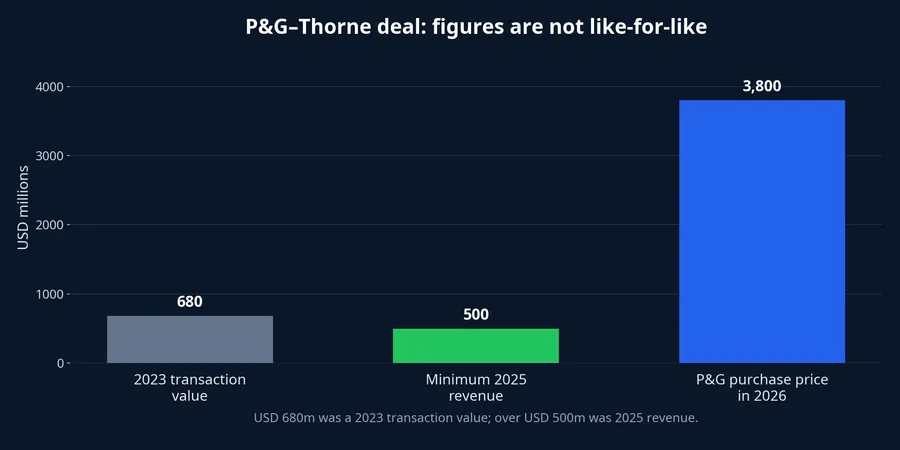
L Catterton's approximately USD 680 million transaction value for Thorne in 2023 can make for an appealing comparison. But the figures are not like-for-like. Thorne was still public at the time, while the new transaction's capital structure and assumed obligations have not been disclosed. Dividing USD 3.8 billion by USD 680 million would not establish the company's precise increase in value.CNBC
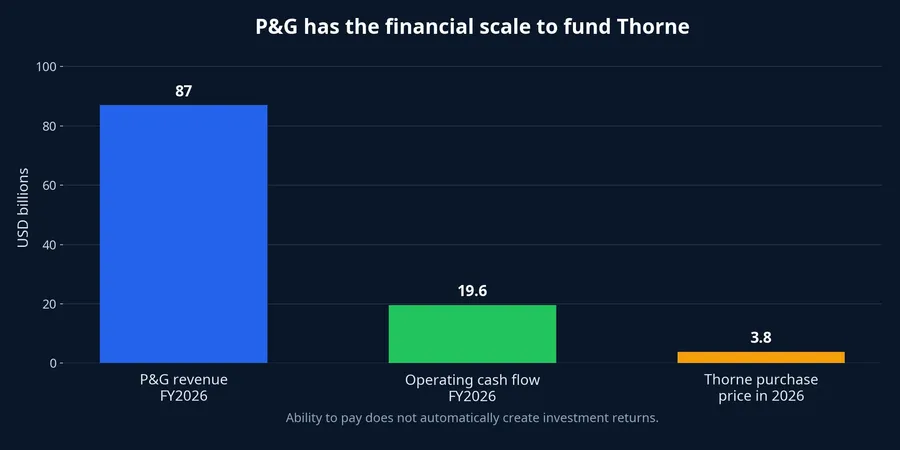
P&G has the financial scale to execute the deal. It reported fiscal 2026 revenue of USD 87 billion and operating cash flow of USD 19.6 billion. But the capacity to pay differs from the capacity to earn a return on invested capital. Investors will need more detail on funding, integration costs and the treatment of intangible assets and goodwill once the deal closes.P&G
What would validate the investment case
The first signal is closing progress and the missing transaction detail. Price structure, funding and conditions will determine whether the full financial commitment can be assessed. After that, organic sales and volume growth in Personal Health Care matter more than P&G's consolidated revenue alone. Because Thorne is much smaller than P&G, its contribution can easily disappear in group-level figures.
The next signal is the quality of growth. More markets or retail doors only create value if the direct channel, professional relationships and repeat purchase behaviour remain intact. Revenue driven by promotion or rapid distribution while trust deteriorates would be a poor trade-off: P&G could buy short-term growth while eroding a long-term asset.
The present conclusion is not that P&G has bought a guaranteed success. The evidence supports a narrower proposition: P&G is acquiring a differentiated growth platform in personal health care. That thesis holds only if the brand preserves trust as it scales. The first post-closing reports, especially organic sales, volume growth, integration costs and any impairment charges, will show whether that platform is being amplified or diluted.