

The word “dividend” can make an investment sound reassuring. It suggests companies that reliably share cash with shareholders, calmer share prices, and an extra cushion for a portfolio. That is only half the picture. A dividend is one component of investment return; it does not turn equities into a safe asset.
VCAM GROWTH VNDIVIDEND ETF is a useful case study. The fund tracks VNDIVIDEND, an index built and managed by the Ho Chi Minh Stock Exchange, so it is an index equity fund. Its offering follows a late-July launch event.Vietstock The useful question is therefore not whether a dividend fund is safe, but how the index chooses shares and what unitholders actually receive.
Dividend describes the stock-selection process
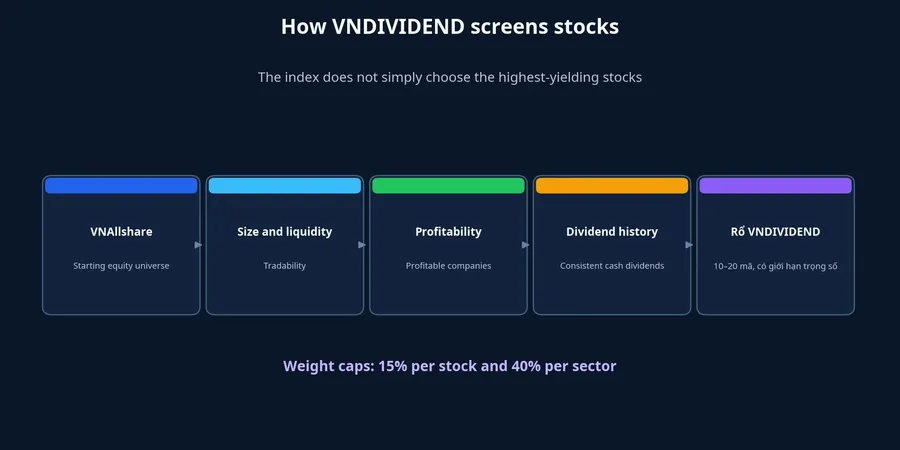
VNDIVIDEND does not simply rank stocks by dividend yield and take those at the top. It starts with the VNAllshare universe, then applies filters for listing history, market capitalization, liquidity, profitability, and cash-dividend history. Eligible companies must have positive net profit in recent periods and a continuous cash-dividend record over the three financial years used in the review.Index rules
That distinction matters for new investors. Dividend yield is the dividend per share divided by the share price. When a share price drops sharply without an increase in the dividend, its yield can suddenly look high. In that situation, the appealing number may be a signal of business or valuation risk rather than a bargain.
The index rules try to avoid that trap by looking at profitability and payment history together. The basket contains 10 to 20 stocks, caps a single stock at 15%, and caps a sector at 40%.Index rules This makes it harder for trouble at one company to dominate the result, compared with holding just a few individual names.
Yet weight caps reduce concentration risk; they do not remove market risk. If equity valuations fall broadly or several sectors come under pressure, a dividend ETF can still decline. A passive fund also does not move to cash simply because conditions are unfavorable. Its job is to track the published basket.
Price data does not guarantee stability
On August 5, VNDIVIDEND's price index stood at 888.93 points, down 9.00% from 976.87 points at the start of the year. Over the same period, the VN-Index declined 0.67%, from 1,788.40 to 1,776.46 points. These are pre-verified market-database price-index figures; they do not include reinvested dividends.
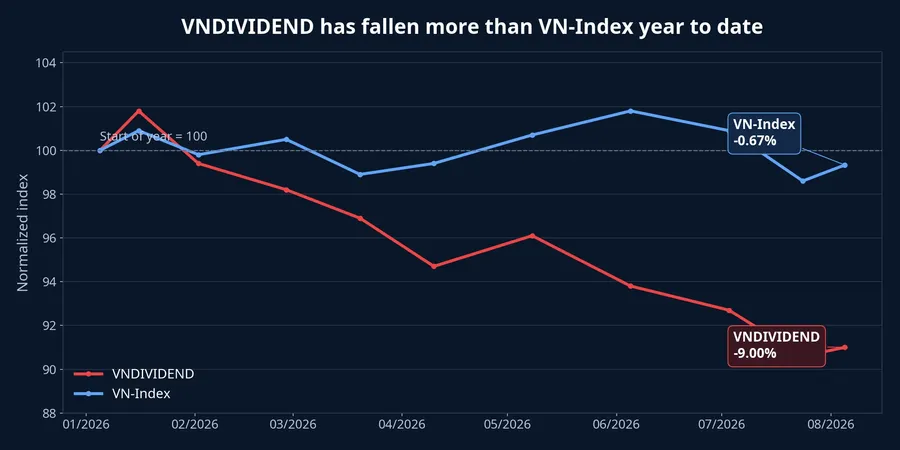
This comparison does not prove that dividend investing always lags the broader market. A year-to-date window captures only one period, and outcomes can change with interest rates, valuations, and sector composition. Nor is it the total return delivered to an index holder: a total-return index includes reinvested dividends.
Still, the figures disprove a common shortcut. Putting “dividend” in an index name does not make price swings disappear. Holders remain exposed to the wider market, the sector mix, and the valuations of the underlying shares. Dividends may offset part of the outcome, but there is no mechanism requiring that offset to exceed a share-price loss.
Company dividends are not automatic cash payments to fund holders
This is the second frequent misunderstanding. When companies in the basket pay dividends, that cash becomes part of the fund's assets and is reflected in NAV. It does not mean that fund certificate holders receive a corresponding cash payment each time an underlying company pays one.
The prospectus says the fund may distribute income in cash or in fund certificates, subject to fund policy and approval by the Investors' General Meeting. The NAV must also continue to meet the relevant financial conditions after a distribution. In other words, “dividend” in the fund name chiefly describes the index's stock-selection approach, not a scheduled payday for investors.Prospectus
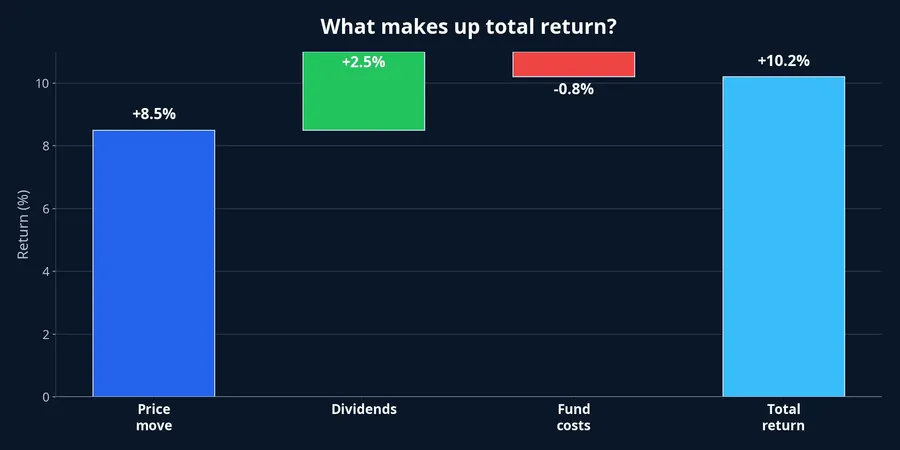
Total return is broader than dividends. It combines the price movement of the portfolio and the dividends it earns, then subtracts costs. The management fee is set at 0.8% of NAV per year, alongside custody, supervision, administration, index-operation, NAV-calculation, and trading expenses.Prospectus A fund's realized result can therefore diverge from its benchmark even when it follows the intended strategy.
The initial offering is different from buying an ETF on the exchange
During the initial offering, subscriptions run from July 28 to 3:00 p.m. on August 24, 2026. One creation unit consists of 100,000 fund certificates, and subscriptions are primarily made with the designated securities basket plus any balancing cash.Vietcap This is not the familiar retail experience of buying a few ETF certificates with a small cash amount.
Once listed on HOSE, the certificates can trade on the exchange like other securities. Their market price is set by supply and demand and can sit above or below NAV per certificate. Creation and redemption mechanisms help narrow that gap, but they do not guarantee that it will always be zero.

For a new fund, there is no live trading record yet to assess volume, bid-ask spreads, deviations from NAV, or tracking difference. The index's history does not automatically answer those implementation questions. The index shows how a strategy has behaved; the fund still needs time to demonstrate tracking quality and exchange liquidity.
A practical way for new investors to read the product
Rather than treating “dividend” as a safety promise, use it as a clue to the screening method. Start with the index rules. Then compare both the price index and the total-return index to see how much dividends have offset price movement. Finally, examine stock and sector weights, because diversification does not make market risk disappear.
After listing, NAV, the exchange price, bid-ask spread, trading volume, and tracking difference need to be read together. They are more useful evidence than a defensive-sounding name. The central conclusion is straightforward: VCAM GROWTH VNDIVIDEND ETF can offer access to a systematically screened basket of equities, but it remains an equity investment. “Dividend” explains how the basket is constructed. It does not guarantee stable prices, positive total returns, or a regular cash income.