


Palantir is no longer only a story about U.S. government contracts. The second quarter of 2026 delivered a measurable change: global commercial revenue almost matched government revenue. The important issue is not how far the shares moved after the report; it is whether a new source of demand has become large enough to change how the company should be assessed.
The central case is straightforward. Commercial customers have become Palantir's second growth engine. That does not settle the valuation debate: the company still needs to turn contracted work into revenue, and revenue into cash flow, quarter after quarter. For newer investors, those conversions are more useful than an excited after-hours price move.
The two revenue businesses are nearly even
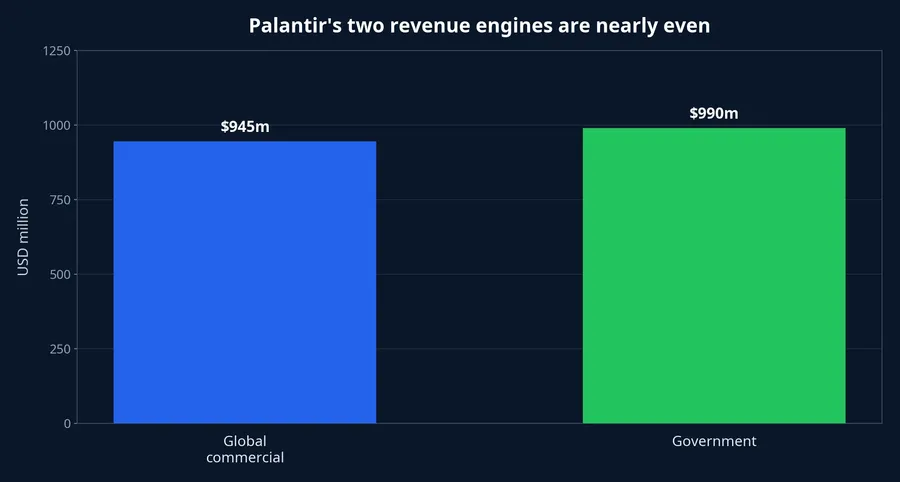
Palantir reported second-quarter revenue of USD 1.94 billion, up 93% year on year and 19% from the prior quarter. Global commercial revenue was USD 945 million, versus USD 990 million from government customers. A gap of just USD 45 million means commercial activity is no longer a supporting act to the public-sector business.Palantir
In the United States, commercial revenue was USD 764 million and government revenue was USD 809 million. That does not make the two businesses identical in quality or predictability. Government contracts tend to follow budgets, procurement procedures and large programs. Corporate customers can begin with one use case and expand across functions when the software produces operational value.
The more important implication is diversification. When both customer groups are growing, Palantir is less dependent on a single budget-approval cycle. This is a structural change in the growth model, rather than merely an attractive quarterly headline.
There is an important limit to that interpretation. Near parity in one quarter does not guarantee that the commercial mix will remain near parity in every future period. Government programs and enterprise spending can follow different calendars. The report establishes the scale of commercial demand today; the next reports must establish its persistence.
Revenue grew much faster than the customer base
Palantir had 653 U.S. commercial customers, 35% more than a year earlier. Revenue from that group rose 149% over the same period. The large gap between those rates means that new logos alone cannot account for the whole increase in revenue.Palantir
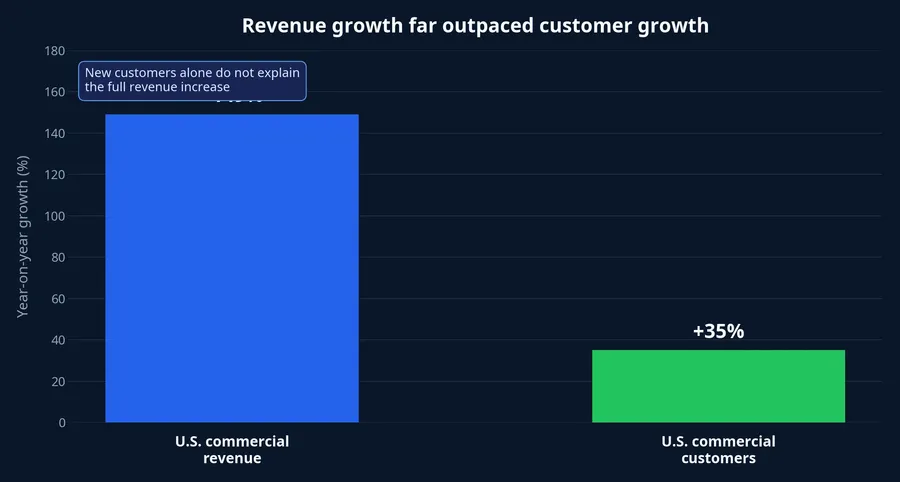
The evidence best supports a combination of new customers, larger contracts and broader use by existing customers. Palantir signed 220 deals worth at least USD 1 million in the quarter, including 98 worth at least USD 5 million and 73 worth at least USD 10 million. U.S. commercial total contract value reached USD 2.13 billion, up 153% year on year.Palantir
Company-wide net dollar retention was 157%. In simple terms, existing customers generated materially more revenue than in the earlier period. Yet that figure covers Palantir as a whole, not U.S. commercial customers alone. It would therefore go beyond the evidence to say that most growth came solely from expansion by existing users, or solely from new customer additions.
The image below represents the government business, which remains an important customer base. Commercial acceleration does not erase that role. It makes the revenue mix more balanced.

Contract value is not recognized revenue
Remaining deal value in U.S. commercial reached USD 6.24 billion, up 124% year on year and 27% sequentially. That is encouraging because it indicates a growing pool of signed work still to be performed. Investors should not, however, add the USD 6.24 billion directly to revenue in future quarters.Palantir
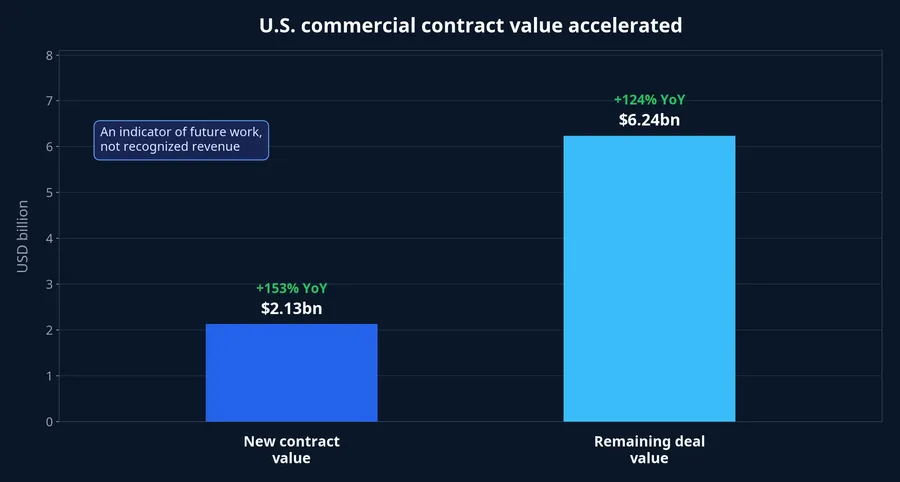
In its business update, the company notes that remaining deal value can include unexercised renewal options. Many contracts can also be terminated by customers for convenience. It is therefore an indicator of demand and future execution, not revenue already recognized or cash already collected.
That distinction is especially useful for new investors. Contract value resembles orders in a book; revenue is the portion delivered under the contract terms. Cash flow is a further test: has the company actually collected cash while preserving its operating efficiency?
This is also why headline contract numbers should be read alongside revenue recognition. A company can win a large agreement without recognizing the entire value immediately, and contractual options are not the same as exercised options. The relevant question is not whether the backlog looks large in isolation, but whether its conversion remains visible in reported revenue and cash generation.
Profit and cash flow are supporting the growth
The second quarter was not just about contracted work. Palantir generated adjusted free cash flow of USD 1.22 billion, equal to 63% of revenue. U.S. GAAP operating income was USD 912 million, a 47% margin, and net income was USD 1.06 billion.Palantir
Those figures support the view that growth has reached operating results, rather than residing only in future promises. It is also necessary to read the GAAP column. Adjusted operating income was USD 1.19 billion, with a 62% margin, because that measure excludes stock-based compensation and related payroll taxes.Palantir
Neither number is wrong; they answer different questions. The adjusted figure helps assess operating efficiency before certain items. GAAP results provide a fuller view of costs, including shareholder dilution. Reading both avoids treating the adjusted margin as the entirety of profit available to shareholders.
The comparison matters because high-growth software businesses can look very different depending on the metric selected. A reader who sees only the adjusted number may miss an economic cost borne by shareholders. A reader who ignores cash flow may miss how much of the reported expansion is already translating into liquidity. Palantir's current report is stronger precisely because the revenue, profit and cash-flow indicators all point in the same direction.
The valuation test lies in the next quarters
Management forecasts full-year revenue of USD 8.150 billion to USD 8.158 billion. U.S. commercial revenue is expected to exceed USD 3.424 billion, at least 134% above the prior year, while adjusted free cash flow is forecast at USD 4.5 billion to USD 4.7 billion.Palantir
This is company guidance, not reported performance. Still, it creates a concrete scorecard for subsequent reports. If commercial revenue stays fast, remaining deal value keeps growing and cash flow remains commensurate, investors will have stronger evidence that the second engine is durable. If any link slows, elevated expectations will need to be reassessed.
The analysis should not assign all of the commercial increase to a single driver. Larger deals, wider deployments among existing users and additions to the customer base can all contribute, while the company has not provided a detailed allocation among them. That restraint is useful: a compelling growth narrative becomes investable only when its operating drivers remain observable rather than assumed.
The stock rose by about 12% in after-hours trading following the report, a sign that the market welcomed the result at the time of publication.CNBC A short-term move is not evidence of durable growth. The three signals worth monitoring in the next reports are U.S. commercial revenue, the conversion of contract value into revenue, and cash flow as a share of revenue.
The conclusion is not that Palantir has solved its valuation question. It has demonstrated a real shift in its growth mix: the commercial business now stands close to the government business. Expectations still require repeated proof across several quarters, but that does not overturn the current thesis unless revenue, contracts or cash flow begin moving in the opposite direction.