
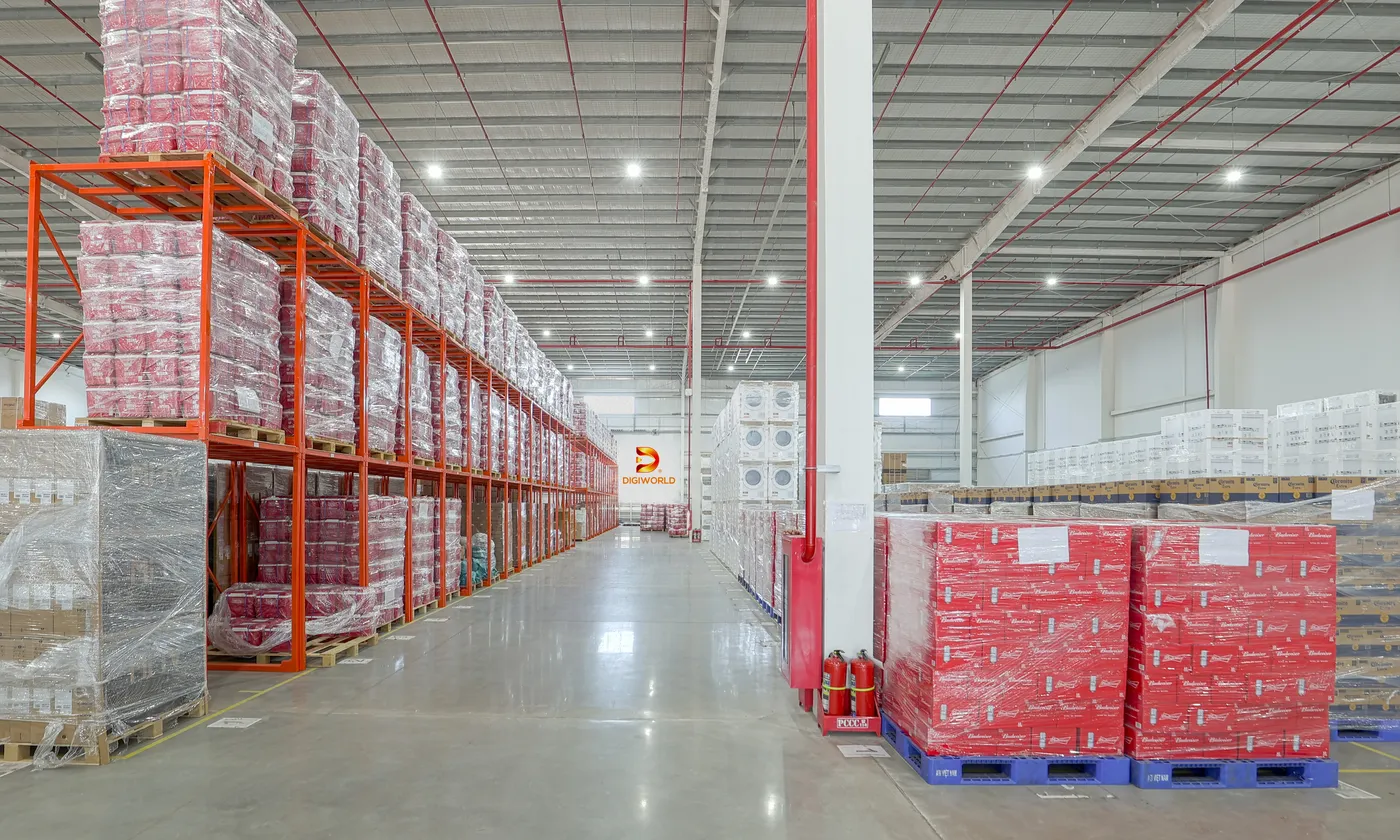

DGW closed at VND 39,600 on 4 August, up 6.88%, while the VN-Index gained only 0.82%. The move says investors are paying attention to Digiworld’s second-quarter results. It does not, on its own, say how lasting that optimism should be. For a distributor, the more useful questions are what created the profit lift and whether goods now sitting in warehouses can be turned into cash at an attractive margin.
The first-half numbers are encouraging. Digiworld has completed 50% of its revenue plan and 77% of its profit plan for the year. Profit is running well ahead of revenue, which points to more than a simple increase in selling prices. Still, one quarter of unusually strong gross margins is not automatically the new baseline.
Profit is moving faster than revenue
Second-quarter net revenue reached VND 7,273.3 billion, up 26.9% year on year. Gross profit was VND 943.2 billion, almost double VND 487.3 billion a year earlier, and gross margin widened from 8.50% to 12.97%. Profit attributable to the parent’s shareholders reached VND 309.3 billion, up 167%.Digiworld
For the first six months, net revenue was VND 15,773.5 billion, up 40.2%, while profit attributable to the parent reached VND 509.5 billion, up approximately 130%. The company said those results represented 50% of its annual revenue target and 77% of its annual profit target.Digiworld That gap is the key detail: Digiworld did not merely move more goods. It retained more profit from each unit of revenue.
Gross margin matters especially for a distributor. Input-cost inflation can lift sales in nominal terms, while squeezing margins if the company cannot pass costs through. A gain of more than four percentage points suggests that product mix, pricing and cost management all worked in Digiworld’s favour during the quarter. That is a confirmed outcome, not a forecast.
Computer demand was not just a price story
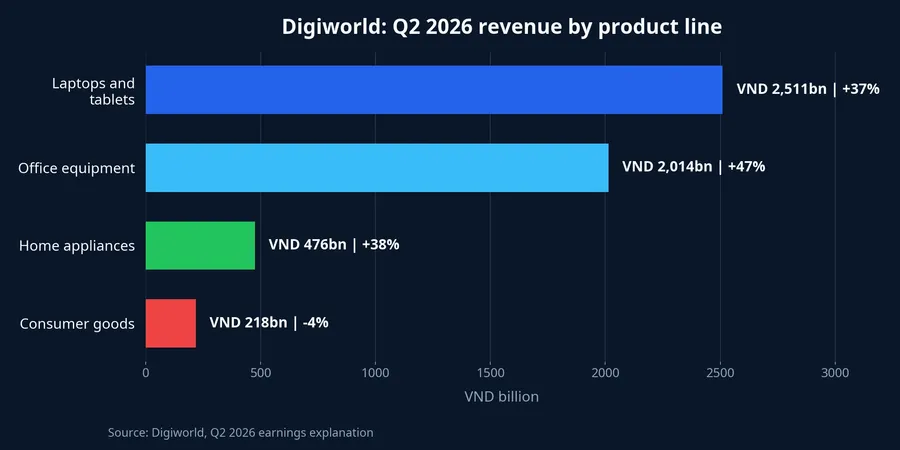
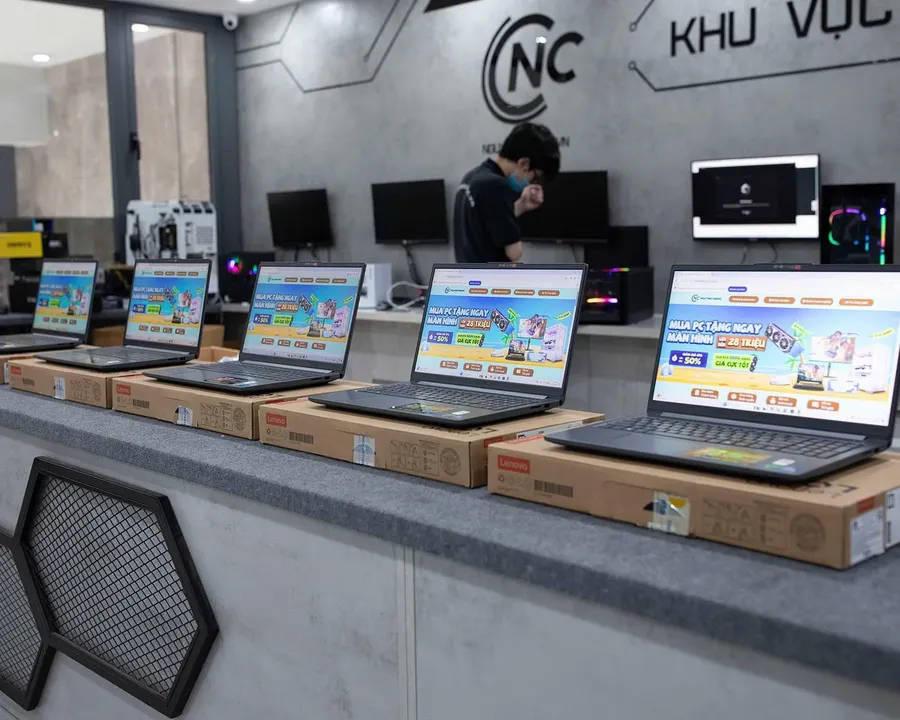
Laptops and tablets generated VND 2,511 billion of second-quarter revenue, up 37% year on year. In its earnings explanation, Digiworld linked roughly 20% higher selling prices to elevated memory and semiconductor component costs. Consumers and businesses also brought purchases forward ahead of potential further price adjustments.Digiworld
The story is not solely inflation in ticket prices. GfK data cited by Digiworld show that the laptop market’s value rose 28.7% year on year and unit volume rose 14.5%.Digiworld Average selling prices clearly played an important role, but actual demand rose as well. Digiworld’s computer revenue outpaced the market’s value growth, making market-share gains a reasonable possibility. The disclosure does not provide the company’s unit sales, so it cannot precisely allocate growth among price, volumes and market share.
That distinction is important for newer investors. A higher-priced laptop can make revenue look strong even when unit growth is modest. The increase in market volumes indicates that demand was not purely a price effect. The next test is margin durability: when lower-cost inventory has been sold and new, more expensive stock enters the income statement, the current benefit could narrow even if revenue remains high.
The revenue mix has another support leg
Office equipment produced VND 2,014 billion in quarterly revenue, up 47%. Digiworld attributed the increase to investment in technology infrastructure, data centres, servers, networking equipment and IT solutions.Digiworld This matters because mobile phones, traditionally a major category, grew only 5% in the quarter.
Home appliances contributed VND 476 billion, up 38%, while consumer goods declined 4% to VND 218 billion.Digiworld Computers, office equipment and appliances therefore shared the burden of growth. But they should not all be treated as long-duration drivers. Hot weather and television demand around the World Cup are seasonal factors, while early buying can transfer sales from a later quarter into the current one.
The available evidence supports the view that Digiworld has more than one growth engine. It does not establish that every engine will sustain the same pace. The office-equipment line in particular needs another few quarters of evidence to distinguish enduring investment demand from the timing of large orders.

Working capital is the necessary next check
Growth at a distributor requires cash to buy products before revenue is recorded. At the end of June, Digiworld held VND 5,731.1 billion of inventory, up 29.2% from the start of the year. Short-term receivables were VND 3,497.6 billion, only approximately 2.3% higher.Digiworld Inventory rising faster than receivables suggests that most incremental capital is tied up in goods ready for sale rather than in a matching expansion of customer credit.
Net cash from operating activities was VND 167.1 billion in the first half, a substantial improvement from an outflow of VND 555.4 billion a year earlier. It was nevertheless below the VND 510.9 billion of net profit recorded in the same period. Inventory growth absorbed VND 1,284.6 billion of cash, while higher payables provided VND 613.2 billion of operating funding.Digiworld
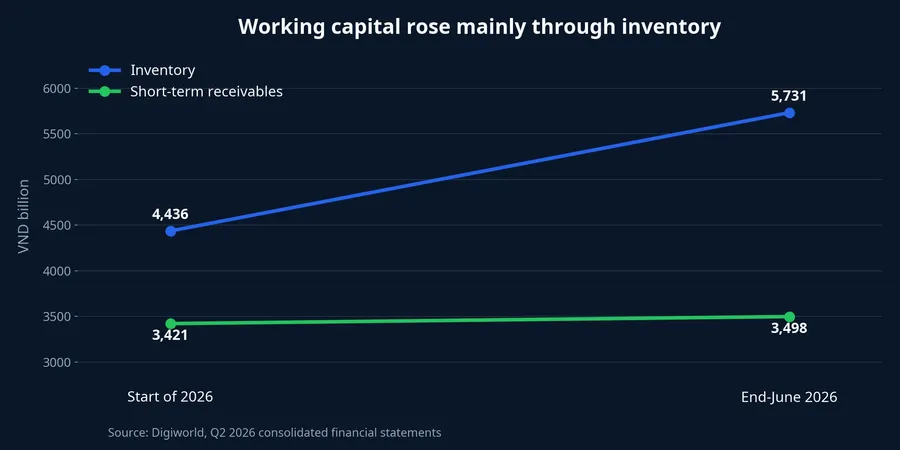
High inventory is not automatically a negative signal. Digiworld may be building stock for a peak season or buying before supplier price increases. It creates value only if sales remain fast enough and the inventory does not require deep discounts to clear. If early purchases have already drawn demand forward from later quarters, a slower stock turn would make the working-capital burden more visible.
There is also a useful distinction between an inventory-led cash need and a receivables-led one. The first can be a deliberate commercial choice when management expects the products to sell; the second more often raises questions about collection discipline. Digiworld’s balance sheet currently points more to the former. That is not a clean bill of health, because product obsolescence and markdown risk still sit with inventory, but it clarifies where the next quarterly evidence should be sought.
For investors, the sequence matters. Reported earnings arrive first; cash conversion confirms their economic substance later. That confirmation is particularly valuable when component prices and seasonal demand are both moving at once.
Conclusion: better growth quality, with a clear proof point ahead
The central conclusion is that Digiworld’s current growth looks healthier than a pure top-line surge. Market computer volumes rose, office equipment added a second source of support, and gross margin expanded sharply in the second quarter. Together, those factors explain why profit is ahead of revenue against the annual plan.
The risks do not overturn that conclusion; they define what must happen for it to hold. The next quarterly report should show three things: gross margin does not contract sharply as newer-cost inventory is recognised, inventory falls or at least does not rise faster than revenue, and operating cash flow moves closer to accounting profit. None of these measures needs to improve in a perfectly straight line. Distribution is seasonal and order timing matters. But a sustained divergence between earnings and cash conversion would weaken the argument that this is an improvement in underlying quality. If the three conditions are met, the first-half profit increase will have a firmer foundation than a single-day movement in the share price.