

What state is VND 220 trillion actually in?
VND 220 trillion sounds like a very concrete number. In lending, though, the same amount can mean very different things depending on where it sits in the process. Put simply, a bank reserving shelf space for a programme does not mean that money has already reached the borrowers who need it.
At the Government’s regular press briefing on August 3, Phạm Thanh Hà, Deputy Governor of the State Bank of Vietnam, said Agribank, BIDV, Vietcombank and VietinBank had registered a combined VND 220 trillion for concessional loans to small and medium-sized enterprises.Báo Chính phủ It is a meaningful signal on the supply side: four state-owned commercial banks have earmarked lending capacity for a defined borrower group. The accurate description, however, is registered or allocated funding, not money already disbursed.
That distinction is more than semantics. Treating the registration as cash already flowing into businesses makes it easy to assume that production has received an immediate boost, or that bank interest income will rise by a corresponding amount. The available evidence supports neither conclusion yet.
For newer investors, this is a useful habit beyond this particular announcement. Headlines often use a large number because it conveys scale quickly, while the operational status of that number receives less attention. Before connecting a credit package to an industry, a bank’s earnings or economic growth, check whether it is a target, an approved limit, a signed loan, a disbursement or an outstanding balance. Those labels describe different facts.
From commitment to cash received
Registered funding must pass through several gates: implementation guidance, eligibility criteria, documentation, appraisal and approval. Each gate answers a separate question. Guidance tells borrowers who can participate and under what mechanism; appraisal asks whether the business can repay; disbursement is the point at which cash actually reaches its account.
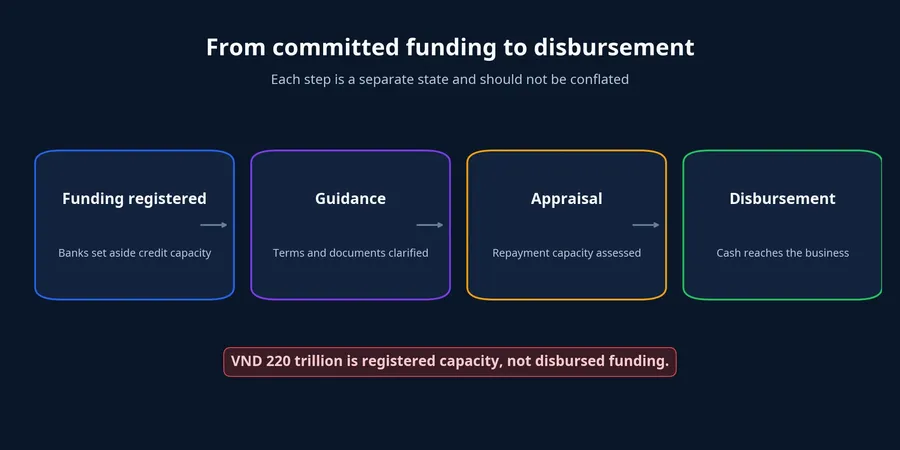
The State Bank said it is preparing detailed guidance so the programme can be implemented in the coming days.Báo Chính phủ “Preparing” matters: it is not an issued document, and it is not yet an effective set of terms. There is consequently no official information on interest rates, loan tenors, each bank’s allocation, the number of approved applications or the amount disbursed.
It is also useful to separate loan disbursements from outstanding credit. Disbursements measure the total amount lent during a period; outstanding credit is the balance still owed at a point in time. A borrower can receive a loan and repay it quickly, lifting disbursements without an equivalent increase in the period-end balance. Reading the two measures together is the only way to see how funding is actually moving.
The sequence also matters for timing. A policy can be announced today, guidance can follow days later, and bank branches may need more time to absorb the terms and process applications. A market reaction that assumes the final step has happened at the first announcement skips the practical work between policy intent and a borrower receiving funds.
Why available funding does not automatically mean easy borrowing
Concessional funding does not replace credit-risk assessment. A bank still needs to know what the business will use the money for, which cash flows will repay it, whether the business plan is viable and what its credit history says. Collateral can matter, but it is not the whole story.

Think of a loan application as a concise explanation of a business’s money-making engine. Invoices, accounts, bank-account cash flows and a plan for the funding give a lender evidence of repayment capacity. Clear information gives the appraisal process more to work with. If a business cannot demonstrate its repayment source, even earmarked funding may not turn into a loan.
This is also why it is premature to attach an attractive interest rate to the VND 220 trillion programme. Official sources have not announced a specific rate or tenor.Báo Chính phủ For any credit product, a quoted rate only becomes meaningful alongside eligibility rules, tenor, related charges and the borrower’s real ability to access it.
System-wide data cannot prove this programme is working
Credit across the economy is still expanding. At the briefing, the authorities reported total outstanding credit of VND 20.15 quadrillion as of July 29, up 8.38% from the end of 2025.Báo Chính phủ That is a system-wide picture, not a progress report for the new SME programme.
It would therefore be wrong to use the 8.38% increase as proof that the VND 220 trillion package is already working. The figures sit at different evidentiary levels: one describes all credit in the economy, while the other is the capacity banks have registered for a targeted programme. Assessing the programme requires data from the programme itself.
The same discipline applies to bank shares. Profit does not rise through a simple multiplication of VND 220 trillion by an assumed rate. It depends on the proportion disbursed, the timing of disbursement, realised lending rates, funding costs, repayment performance and provisioning. Concessional lending can deepen customer relationships, while a lower lending rate can also narrow the interest margin.
The impact will differ across small businesses
The programme may be most useful to businesses with real operations and reasonably clear operating data. A workshop with orders, invoices and properly recorded cash flows gives the bank a clearer basis to assess both loan purpose and repayment. That does not guarantee approval, but it is a stronger foundation for entering the appraisal process.

Conversely, a business without financial statements, with hard-to-verify cash management or without a defined use of funds may still face hurdles. The more important question is not only how large the package is, but whether the final criteria help banks assess cash flow, invoices and operating data more clearly. If the process is too difficult for most small businesses to prepare for, disbursement can remain slow despite available capacity.
It would be premature to claim that any one factor will decide the outcome. Disbursement may reflect the guidance, businesses’ ability to complete applications, each bank’s risk appetite and seasonal funding demand at the same time. Until operating data are available, there is not enough evidence to assign the contribution of each factor precisely.
The data needed to assess the programme
The central thesis is straightforward: VND 220 trillion is a commitment to make credit available, not evidence of economic impact. The next step is not a rushed forecast; it is waiting for verifiable data.
First, investors need to see how the capacity is allocated among banks and what the precise borrowing terms are. Next come applications received, applications approved and actual disbursements. Once the programme has operated for longer, period-end outstanding credit, realised rates, the number of beneficiary businesses and overdue-loan trends will show whether funding is reaching the intended group without weakening lending discipline.
Those indicators separate a statement of resources from a policy that is producing results. The implementation guidance and the first progress reports are the two milestones worth watching in the days ahead. Until they arrive, the most accurate reading is simple: the funding has been registered, while its real-world impact awaits disbursement data.