
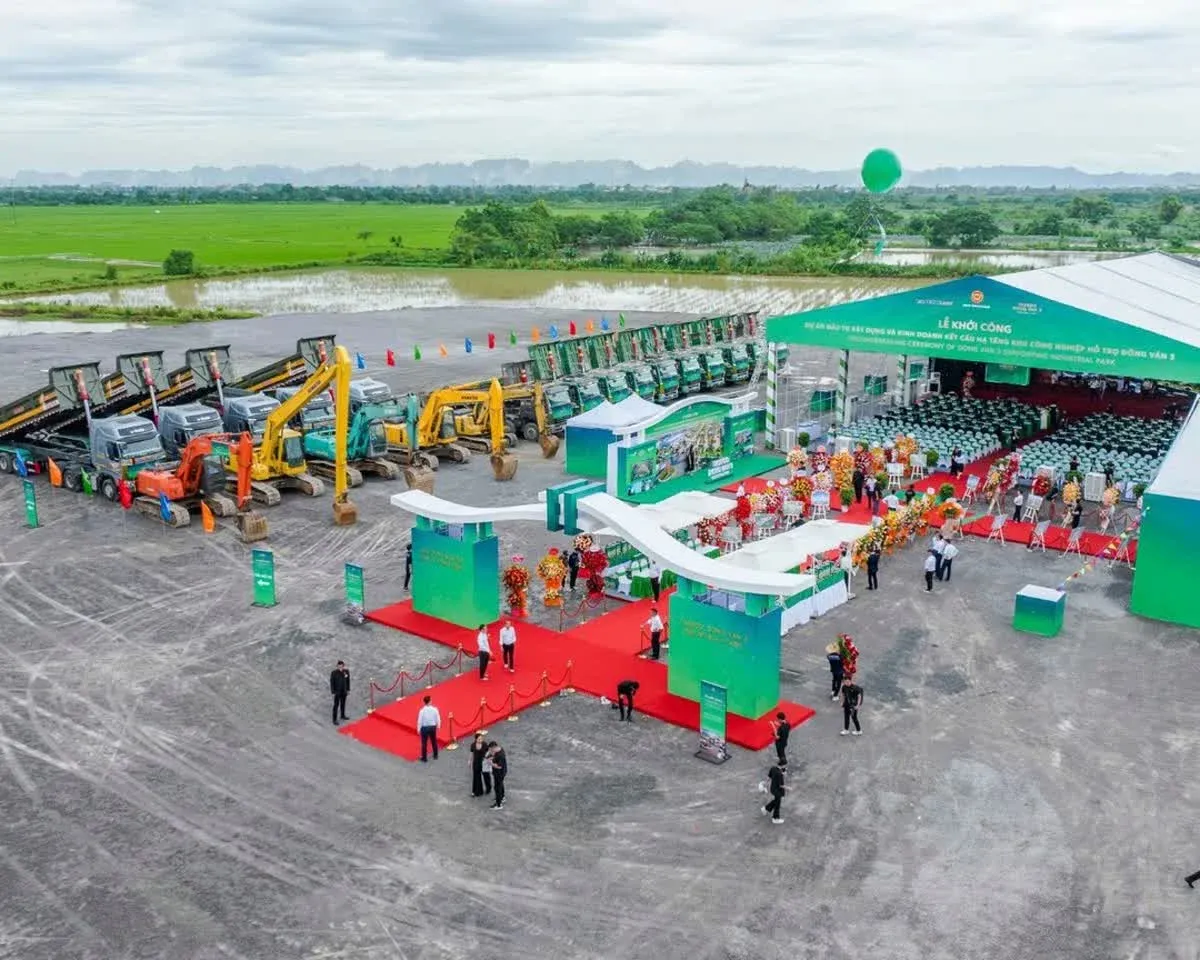

Taseco Land has placed another building block in its industrial-park strategy. Its VND 220 billion contribution to form Kim Bang Industrial Park Infrastructure Investment JSC shows that the company has earmarked capital and an operating vehicle for this direction. For new investors, though, the key is not to confuse a newly formed company with a revenue-generating project.
Put simply, a legal entity is the framework through which a project can begin to operate. It can sign contracts, hire staff, prepare filings and mobilize resources. That framework does not, by itself, create cleared land, completed infrastructure or rental income.
VND 220 billion buys control, not revenue
Under the disclosed board resolution, Kim Bang is expected to have VND 400 billion in charter capital. Taseco Land will contribute VND 220 billion, or 55%, giving it control if the formation is completed. The contribution is expected to be made within 90 days after the new company receives its enterprise registration certificate.CafeF
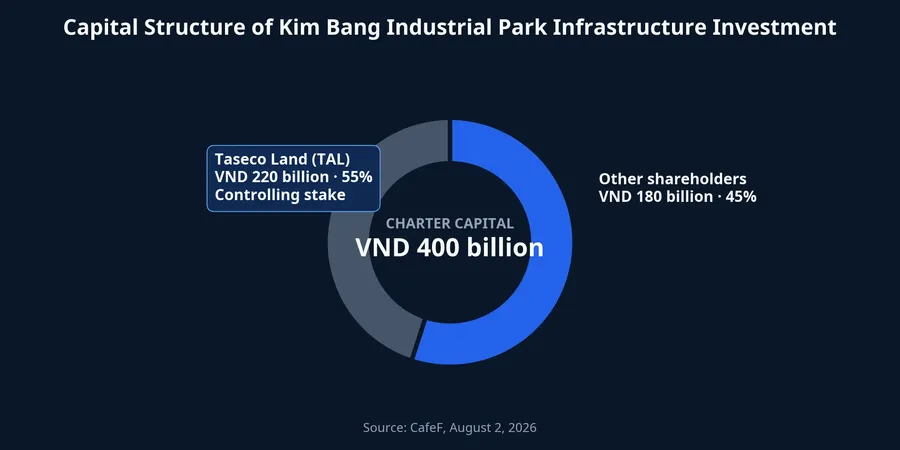
That 55% is a statement about control, not a profit margin. A majority stake can allow TAL to consolidate the subsidiary and direct its major decisions. It is useful organisational capacity if the company secures a suitable project in Ninh Binh or nearby areas.
The current disclosure, however, does not identify a project for Kim Bang, its land area, total investment, site-clearance schedule or prospective tenants. “Industrial park” in a company name indicates an intended line of business. It does not mean that Taseco Land has been allocated land or obtained implementation rights for an industrial park called Kim Bang.
The distinction matters. Charter capital is what shareholders commit to a company. Revenue arises only after it delivers goods or services and meets recognition criteria. Profit is what remains after land, construction, interest, operating, administrative and tax costs. Those are different stages of a long process, not different labels for the same announcement.
Plaschem makes the strategy easier to see
Kim Bang by itself is still a preparatory story. The picture becomes more concrete beside TAL's planned transaction involving Ha Tang Plaschem. TAL plans to acquire 2.625 million Plaschem shares, equivalent to 75% of its charter capital.VietnamFinance
The VND 262.5 billion figure in the disclosure deserves careful reading: it is the par value of those shares. The actual transfer price and payment method have not been disclosed. It would therefore be inaccurate to add VND 262.5 billion to the VND 220 billion contribution and conclude that TAL will necessarily spend VND 482.5 billion. The figures describe different things.
Plaschem differs because it is linked to Yen Son Industrial Park in Bac Ninh. The disclosed project covers approximately 154.48 hectares, with planned investment of VND 2,157 billion and VND 350 billion in investor equity.VietnamFinance Those details do not guarantee cash flow, but they do give readers a concrete basis for assessing timing and funding needs.
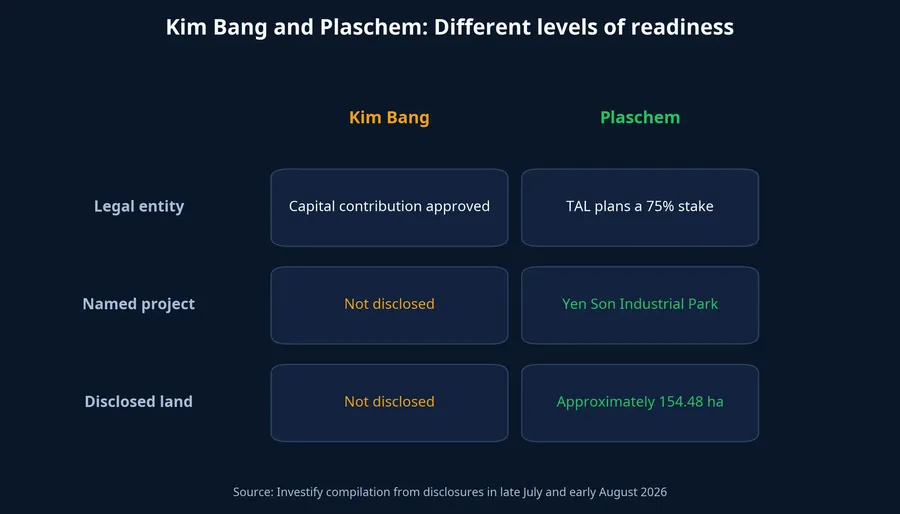
Viewed together, TAL is pursuing two parallel routes. Kim Bang adds a new legal platform to capture future investment opportunities. Plaschem, if the transaction closes, would bring TAL closer to a named project. That supports an industrial-property expansion strategy, but it is not evidence that a new profit contribution is ready to be recognised.
The milestones between a legal entity and cash flow
Industrial property cannot be assessed from a company name or its initial capital alone. For Kim Bang, the first milestone is a specific project: location, scale, land bank and the new company's role. Until those details are available, investors cannot responsibly estimate revenue or payback timing.
Next comes implementation authority. An industrial park commonly requires investment-policy approval, land-related documentation, compatible planning and environmental procedures. Depending on the project, site clearance can determine the entire delivery timetable. At this stage, the accurate description is that TAL is contributing capital to establish a company, not that it already owns an industrial park with completed approvals.
Infrastructure follows. Internal roads, power, water, wastewater treatment and deliverable plots are prerequisites for attracting secondary investors. Even a lease contract may not produce immediate revenue; timing depends on handover terms and the developer's completed obligations. That is why a large plan may not immediately appear as operating results in financial statements.
For Yen Son, the disclosed schedule calls for construction to start in September 2026 and for efforts to attract secondary investors from April 2027.VietnamFinance This is a plan, not an achieved outcome. If TAL completes the acquisition, site clearance, construction and lease-signing milestones will offer a more meaningful test of whether control can become cash flow.
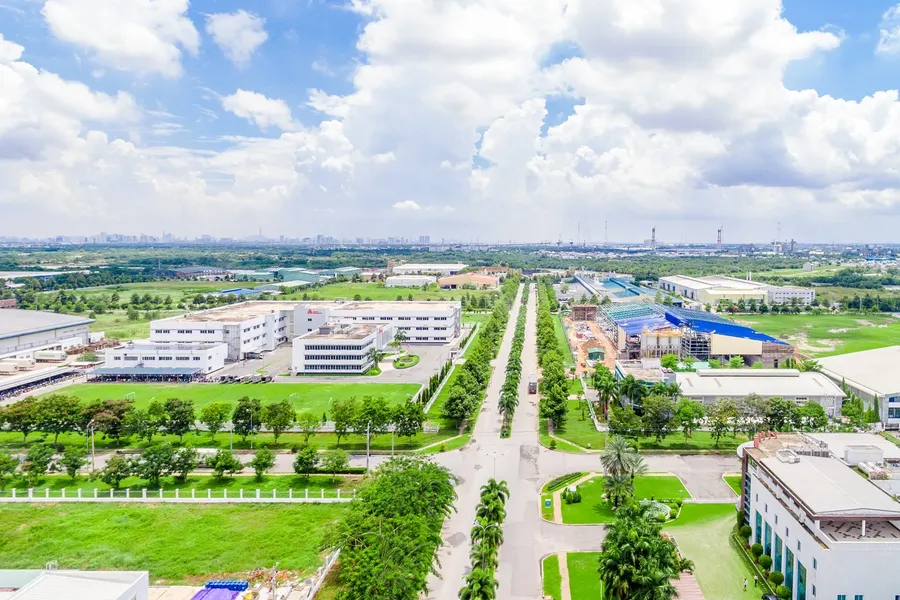
How to read TAL's announcement today
The constructive point is that Taseco Land's industrial-park effort now has concrete actions behind it: capital set aside for a new entity and a planned controlling position in another infrastructure developer. This could broaden its project pipeline in future years and reduce reliance on residential-property handovers. The conditional wording matters because outcomes remain project-specific and execution-dependent.
The practical risk lies in funding needs beyond the initial contribution. An industrial park requires far more capital for land, construction and operations than an entity's charter capital alone. Yen Son illustrates the gap: planned investment totals VND 2,157 billion, while investor equity is VND 350 billion; the remainder is expected to be mobilised from credit institutions and other lawful sources.VietnamFinance
There is not enough evidence to assign TAL's intraday share-price movement to the company-formation decision alone. The price may simultaneously reflect corporate news, overall market liquidity and investor sentiment. What investors can verify is the next set of disclosures on projects, approvals, funding plans, infrastructure progress and tenants.
The central thesis is therefore straightforward: VND 220 billion is preparatory capital for execution capacity, not profit waiting to be booked. The next useful signals are whether Kim Bang receives a disclosed project and land bank, and whether Plaschem meets its stated timetable. Once those facts emerge, TAL's new growth narrative can be quantified rather than merely anticipated.