


On August 3, FPT closed at its daily ceiling of VND 71,700 per share, up 6.86%, with more than 16.18 million shares changing hands. The move was strong enough to bring Vietnam's largest listed technology company back into focus, especially after the stock rose from VND 62,200 on July 27. Yet the useful question for investors is not where the price may trade over the next few sessions. It is whether artificial-intelligence infrastructure is becoming a new earnings stream that can justify a different quality of valuation.
The central view here is straightforward: the ceiling move clearly demonstrated demand, but the available evidence still fits a strong rebound better than a confirmed re-rating. That conclusion changes only when FPT can connect computing capacity, delivered contracts, cash collection and profit margins. A share price can move ahead of disclosure, but a durable valuation eventually needs verifiable earnings power.
A strong session, with more than one driver
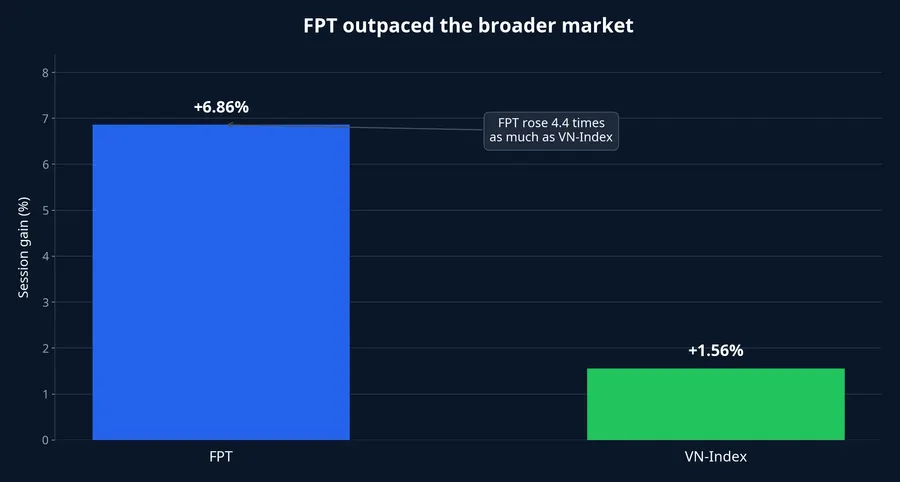
The August 3 numbers show that FPT's 6.86% gain outpaced the VN-Index's 1.56% advance. That gap points to buying interest that was stronger than the broader market. At the same time, the VN-Index closed at 1,762.84 points, with 266 gainers and 82 decliners. FPT did not rise against a weak market backdrop; widespread positive sentiment was part of the setting.
That makes it unsafe to assign the entire move to one fundamental development. Expectations around AI are a plausible explanation because the theme has attracted market attention. A rebound in large-cap shares, price positioning after a decline and broad-session flows are also plausible explanations. One trading day does not provide enough evidence to allocate the contribution of each factor precisely.
Turnover adds another important detail. More than 16.18 million FPT shares traded on August 3, more than twice the volume of more than 8.06 million shares on July 31. Higher liquidity indicates greater participation; it does not, by itself, establish the buyers' motivation. A high-volume session may begin an accumulation process, but it can also be the meeting point of short-term traders and investors reshaping portfolios.
Why AI infrastructure does not automatically command a higher valuation
Put simply, a busy computing centre is not necessarily a high-profit business. This kind of infrastructure needs substantial upfront investment, alongside depreciation, electricity, operations and technical staffing. If revenue rises while service pricing remains competitive or system-running costs stay high, the incremental profit may still be too small to change the earnings quality of the technology division.
What investors need is a more detailed layer of disclosure than consolidated results can provide. They need to see what services capacity supports, how revenue is recognised and how much profit remains after infrastructure costs. Without those measurements, treating AI expectations as already-established profit would go beyond the disclosed evidence.

This distinction separates two growth models. Traditional technology services primarily sell delivery capacity and engineers' time. Efficient computing infrastructure can serve multiple customers from the same platform. The appeal of the second model is the potential to grow revenue without matching the same pace of staffing costs. That potential, however, must appear in margins and cash flow, not merely in a capacity narrative.
The three links investors should watch
The first link runs from server capacity to delivered revenue. A signed contract signals demand, but it is not revenue already booked. Implementation schedules, acceptance conditions and service scope determine when revenue enters reported results. Contract growth therefore becomes fully meaningful only if subsequent periods show a corresponding rise in delivered revenue.
The second link runs from revenue to profit. If AI-related revenue rises while depreciation and operating costs rise faster, the technology division's margin may not improve. Conversely, once revenue per unit of computing capacity rises and fixed costs are spread over a larger scale, the new profit pool begins to matter for valuation. This is why revenue should be read alongside margins rather than as a stand-alone indicator.
The last link runs from accounting profit to collected cash. A technology project can recognise revenue before it receives full payment, while infrastructure investment often requires meaningful cash early on. Operating cash flow and receivables therefore test the quality of growth. When revenue, profit and cash collection improve together, the case for a new earnings driver becomes much more credible.

These are not unusually demanding tests for FPT. They are the normal way to assess any new infrastructure investment, from a data centre to a factory. AI attracts exceptional attention, though, so the gap between expectation and disclosed data can be wider. The more expectation is reflected in a share price, the more carefully investors need to separate technical capability from financial results.
That discipline is especially useful for newer investors. It shifts the discussion away from a single chart pattern or headline and toward the evidence that can be tested again in the next set of results.
Three scenarios for the next reporting periods
The favourable scenario emerges if FPT provides data showing that new infrastructure is producing recurring revenue and an observable profit contribution. The relevant signs are continued technology-revenue growth, stable or improving margins, and cash flow that does not weaken under operating funding needs. In that case, the market would have grounds to see AI as an additional growth layer rather than a strategic project still being proven.
The neutral scenario is that AI activity expands without yet materially changing the technology division's profits. That would not mean the investment has failed. It could indicate that scale benefits need more time, or that the new service supports the existing ecosystem. Under this scenario, valuation would remain more dependent on the health of FPT's traditional technology operations.
The cautious scenario is that the share price moves ahead while reporting does not provide more separated data. The stock would then be more exposed to market conditions, flows into large caps or short-term shifts in sentiment. This is not a forecast that it will happen. It is a reason not to use one ceiling session as a substitute for operating evidence.
Conclusion: wait for data to turn expectations into evidence
FPT had a very strong session, and its 15.3% gain from July 27 to August 3 shows that buying demand has returned clearly. But a rising share price and a stronger earnings model are different propositions. The evidence currently supports the view that the market is reassessing prospects; a durable re-rating still requires confirmation in later reports.
The indicators to watch are delivered revenue from technology operations, technology-division margins, operating cash flow and the detail of AI-infrastructure disclosure. If all four improve together, the case for a new valuation driver strengthens. Until then, the August 3 session is best read as a signal of demand, not a final conclusion about the economic value of AI at FPT.