


Vietnam’s total retail sales and consumer-service revenue rose 13.1% at current prices in the first seven months of the year. That is encouraging evidence of domestic demand, but it is not a ready-made forecast for the profit of any individual company. A consumer spending more does not mean that the extra money reaches a particular chain, a particular category, and eventually its shareholders.
Think of the macro number as the size of the consumer-spending pie. A company’s financial statements tell us whether it captured a slice and how much remained after costs. The central point is straightforward: stronger demand creates a favourable backdrop, while the quality of earnings must be tested company by company. For newer investors, those are two separate reading exercises.
What the 13.1% figure actually measures
In the first seven months of 2026, total retail sales of goods and consumer-service revenue were estimated at VND 4,555.8 trillion, up 13.1% year on year at current prices. After excluding price effects, growth was 7.5%.Thời báo TC That gap is a useful reminder that nominal sales can rise because prices are higher, not only because households are buying a greater volume of goods.
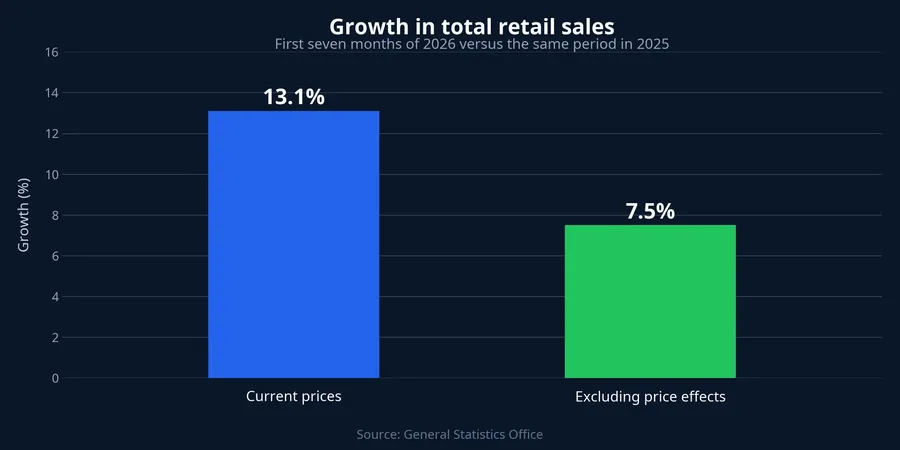
The difference does not provide an inflation rate for any individual retailer. Every business has its own product basket, customer base and pricing power. It does, however, rule out a tempting shortcut: a 13.1% increase in economy-wide retail sales does not mean every retailer sold 13.1% more units.
The statistic also covers far more than listed retailers. Goods retailing totalled VND 3,441.2 trillion and represented 75.5% of the aggregate, while the remainder included accommodation, food services, travel and other services.Thời báo TC More restaurant traffic does not automatically benefit an electronics chain. Pharmacy revenue, similarly, may be shaped more by healthcare demand than by everyday discretionary spending.
Before looking at a ticker, start with a basic question: which part of consumption is growing, and does this company actually sell what consumers are buying? That discipline keeps very different business models from being lumped together under the single label of retail.
Revenue can rise for very different reasons
A company can grow sales by opening stores, raising prices, gaining market share or moving more units. Those drivers are not interchangeable. A larger network can lift revenue while adding rent, payroll and inventory needs. Higher prices can improve the headline sales number even when volumes barely change.
DGW offers a useful example of why those layers should be separated. In the second quarter, the company reported revenue of nearly VND 7,300 billion, up 27% year on year, and net profit of VND 309 billion, up 167%. Laptop and tablet revenue increased 37%, above the market’s 29% growth rate, while average selling prices rose by approximately 20%.Vietstock
In plain English, this was not only a case of selling more units. Higher prices and an improved market position may both have contributed. The available data show those factors moving together, but do not allow an exact allocation of their respective contributions. It is better to preserve that distinction than to assign the whole result to one unproven cause.
Once revenue is up, the next useful metric is same-store sales or revenue per outlet, where a company reports it. That gets closer to the more important question: are established stores serving customers better? If sales grow only because the network is larger, expansion can conceal unchanged operating productivity.
Profit is what remains after costs
Revenue is the first line of an income statement, not the amount available to shareholders. Cost of goods, selling expenses, administrative expenses, finance costs and tax all sit between sales and profit. Growth is therefore more meaningful when gross margin is stable or expanding and operating costs rise more slowly than revenue.
MWG illustrates a quarter in which sales and efficiency improved together. Consolidated second-quarter revenue was nearly VND 48,800 billion, up nearly 30% year on year. Gross margin increased from 20.1% to approximately 22.2%, while quarterly net profit was about VND 3,300 billion, double the prior-year level.Vietstock When each dong of sales retains a larger gross-profit share, revenue growth carries more persuasive information about operating performance.

Still, a strong quarter does not turn margin into a promise for future quarters. Promotions, product mix, competition and input prices can all change it. A careful reader compares margins with both the prior quarter and the same period last year, then checks whether selling expenses are moving in step. One data point can create more certainty than the evidence warrants.
FRT suggests another useful yardstick: outlet productivity. In the first half, consolidated revenue reached VND 30,743 billion, up 33%, and profit before tax was VND 1,038 billion. Long Châu generated average monthly revenue of VND 1.3 billion per pharmacy; at the end of June, the network had 2,639 pharmacies and 236 vaccination centres.VietnamFinance That average helps separate momentum at existing outlets from growth produced simply by having a larger footprint.

These numbers should not be used to rank DGW, MWG and FRT directly. They sell different products through different distribution models and cost structures. Their value here is as a reminder that the right test changes with the business model; one macro number cannot do the job for an entire sector.
A simple framework for newer investors
Start with four questions. First, which segment is contributing to consumption growth: essentials, electronics, healthcare, food services or other services? Second, is company revenue rising because of price, volume, market share or store count? None of those answers is automatically good or bad, but each implies a different set of risks.
Third, are gross margin and selling costs moving in a sensible direction? A company can grow sales through deep promotions and still make less on each dong sold. Fourth, do inventory and operating cash flow support the revenue narrative? Inventory rising faster than revenue might prepare a business for a selling season, or it might signal slow-moving stock. It should be read alongside inventory turnover and cash flow, not in isolation.
This is not a formula for buying or selling a stock. It is a way to order the questions so that an appealing headline does not do the thinking for us. The next quarterly report becomes more useful once you know what to look for: revenue per outlet, gross margin, costs and cash conversion.
Stronger domestic spending is a supportive foundation for many consumer businesses. The benefit is neither evenly distributed nor automatically converted into profit. For retail stocks, the useful thesis is not how much aggregate retail sales grew, but which companies can turn demand in their own segment into well-margined revenue and more durable cash flow. Those signals, rather than a single macro headline, determine the quality of an earnings story.