


News involving AstraZeneca and Bristol Myers Squibb has drawn attention, but the most important point is also the easiest to miss: the companies are reported to be discussing a possible combination. There is no joint announcement, no bid price and no set of terms for shareholders to assess. For newer investors, this is a useful moment to separate an exploratory conversation from a transaction with defined terms.
Put simply, M&A is not a switch that is either on or off. Before an agreement exists, companies must still decide whether one acquires the other or whether a different structure is used, whether consideration is cash or stock, what premium shareholders receive, who controls the combined group and how debt is handled. Early contact can advance, linger for months or end without any deal. The central point is therefore straightforward: the current report signals a pharmaceutical industry looking at strategic options, not proof that AstraZeneca and Bristol Myers Squibb will merge.
Start by naming the stage correctly
The initial report says the companies have discussed a possible combination in recent months. That is very different from a formal offer. It does not disclose the transaction structure, a share-exchange ratio, financing or closing conditions. Any large headline number attached to the story should therefore not be treated as an amount AstraZeneca has agreed to pay.
A transaction commonly moves through recognisable stages. It may begin with strategic contact, progress to a non-binding proposal, then enter due diligence and negotiations before signing and regulatory review. Each stage can fail over valuation, financing or competition concerns. Investors do not need to forecast the ending from the first report; the more productive task is to identify which stage the news actually describes.
That distinction matters especially in pharmaceuticals. The value of a drug portfolio, trial data or intellectual property can vary sharply with its remaining protection period and approval prospects. Until investors know who would control the company, which assets would be included and what shareholders would receive, assigning a transaction value creates false certainty.

Why drugmakers continually need their next revenue stream
A major drugmaker is not valued solely on medicines that sell well today. Investors also look at how long those medicines remain protected, the potential for generic or biosimilar competition and the research programmes that could generate future sales. As exclusivity fades, an older product can come under pressure on both price and market share. A development pipeline is therefore a revenue-replacement system, not a decorative add-on.
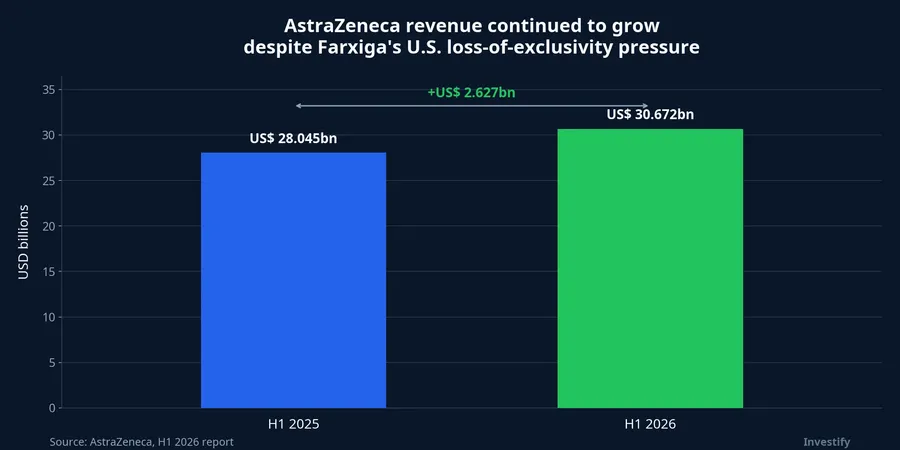
AstraZeneca still has a growth platform of its own. In the first half of 2026, it reported revenue of US$30.672 billion, up from US$28.045 billion a year earlier; at constant exchange rates, revenue grew 6%. The company said oncology and rare-disease medicines partly offset the impact of Farxiga losing exclusivity in the United States and pressure in China.Investegate
That result does not prove that AstraZeneca needs a deal. Instead, it shows why even a growing company may explore M&A as a way to broaden its portfolio, research capability or commercial reach. Neither company has publicly stated the reason for the reported discussions, so a plausible business backdrop should not be turned into a confirmed motive.
For Bristol Myers Squibb, the source article highlights the continuing need to replace older revenue with newer medicines. This is a familiar pharmaceutical-industry challenge: a successful product today does not guarantee the growth profile of the next few years. A company may have promising research assets while still having to balance trial costs, development timelines and the possibility that a programme fails to meet expectations.
Placed side by side, the companies invite several plausible interpretations. They may be looking for marketed assets, seeking additional research capability, or simply testing a strategic idea that is not compelling enough to advance. Public evidence is insufficient to assign a weight to any one explanation. “Could” is more accurate than claiming that either party is compelled to buy the other.
Scale does not create value by itself
When two large companies appear in the same story, the natural instinct is to add revenue, medicines and headcount, then assume efficiency rises in step. That arithmetic skips the hardest question: whether the assets genuinely complement each other. Two programmes may target the same disease population, compete for trial budgets or require sales teams in the same markets.
If portfolios are complementary, a combined company could have more options for capital allocation and broader access to hospitals. If overlap is substantial, management may need to decide which projects continue, which end and which teams remain. Those choices affect more than cost. They can influence research speed, the stability of specialist teams and the timetable for medicines at important stages.
In other words, scale makes a deal notable; it does not establish that a deal would create value. Investors should look beyond claims about a larger group and ask for a specific account of added revenue, achievable cost savings and programmes that could overlap.
The constraints before talks can become a deal
The first constraint is financial structure. A cash transaction requires funding capacity, borrowing headroom and an acceptable premium for shareholders of the company being acquired. A predominantly stock transaction shifts attention to the exchange ratio, dilution and ownership in the combined group. Until those variables are known, claims about which side is getting a better price are premature.
The second constraint is competition review. Regulators do not simply see two companies in the pharmaceutical sector. They may examine individual diseases, treatment mechanisms, marketed medicines and development-stage assets to judge whether a combination would reduce choices for patients. Meaningful overlap could lead to asset sales or discontinued programmes, changing the economics that initially made a deal appealing.

The final constraint is execution. Drug research requires long time horizons, rigorous scientific standards and clear accountability. Combining two large organisations may reduce some administrative expense, but it can also slow decision-making. There is no public evidence that would allow investors to conclude in advance that any savings would outweigh integration costs.
A short checklist for the next update
The first meaningful signal would be a direct announcement from AstraZeneca or Bristol Myers Squibb. If one arrives, it should answer at least three questions: whether this is an acquisition or another structure; whether shareholders receive cash, stock or both; and how the parties expect to handle overlapping assets. Without those details, the story remains a strategic possibility.
After an announcement, the focus should move from headline scale to evidence. Which revenues are genuinely incremental? What assumptions support the projected cost savings? Which assets might competition authorities require to be sold? Answers to those questions will say far more about long-term value than the fact that two well-known companies have held discussions.
The conclusion need not be dramatic. The current report is notable because it reflects the pharmaceutical sector's pressure to keep replenishing medicine portfolios, while AstraZeneca continues to report first-half revenue growth. But the evidence is not sufficient to commit to a transaction outcome. The milestones to monitor are a formal announcement, economic terms and a credible plan for competition review. Until then, this is a lesson in reading M&A news accurately, not a basis for assuming the ending.