

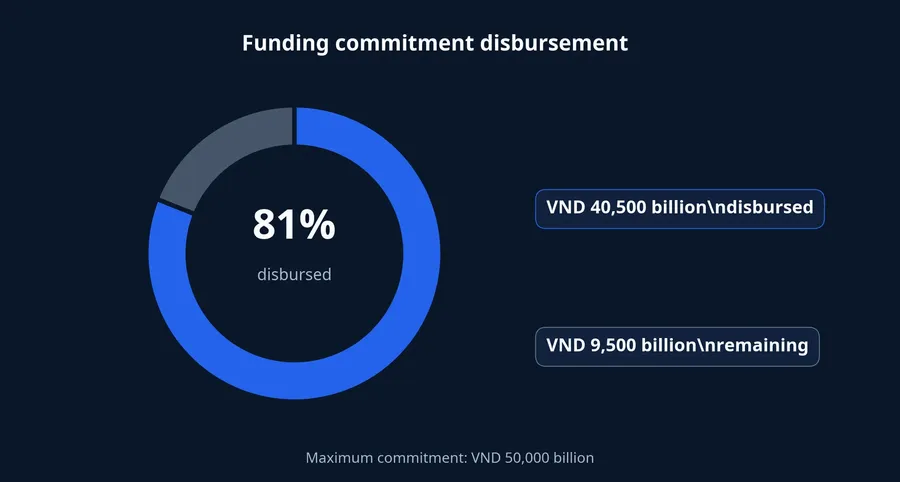
VND 40,500 billion has been disbursed under the maximum VND 50,000 billion non-refundable funding commitment to VinFast. That means most of the committed capital has reached the company, and shifts the next question into focus: how quickly can the automaker improve its ability to generate cash as the remaining support becomes smaller? Data reported in early August put the disbursed portion at approximately 81% of the commitment.Người Quan Sát
This is not simply a story about whether VinFast has funding. The company is expanding production, markets, and its sales network, so external capital is part of its stated strategy. Investors need to separate three distinct layers: non-refundable owner support, loans from the parent group, and cash generated by selling vehicles. Only the third directly answers whether the operating model is becoming self-sustaining.
Most of the commitment has now been disbursed
Pham Nhat Vuong, Chairman of the Board of Directors of Vingroup Joint Stock Company (VIC), committed up to VND 50,000 billion in non-refundable funding for VinFast. VND 28,000 billion had been disbursed by the end of 2025, rising to approximately VND 33,000 billion after the first quarter of 2026. A VND 7,500 billion contribution in the second quarter took the cumulative total to VND 40,500 billion.Người Quan Sát
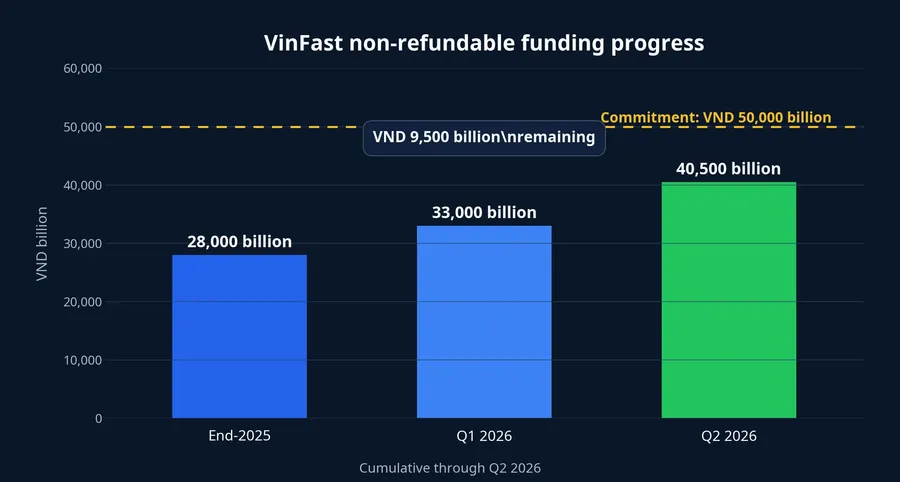
The favourable point is that execution has become more tangible than a promise of capital. Against the VND 50,000 billion ceiling, approximately VND 9,500 billion remains. That is still meaningful financial capacity, but it also means the coming quarters will be watched more closely for additional funding needs and alternative sources of capital.
This does not mean VinFast must become cash self-sufficient the moment the commitment is exhausted. Electric-vehicle manufacturers often require substantial capital while they scale output and enter new markets. Yet as a large commitment approaches completion, the focus should move from disbursement speed to the return on that funding: are rising sales accompanied by better gross margins, and is customer cash collection beginning to cover operating outlays?

A grant and a loan tell different financial stories
One common reading error is to bundle every source into “funding injected.” That shortcut obscures the obligation attached to it. A non-refundable contribution is, in substance, owner capital and does not create a repayment obligation in the way debt does. It can therefore add resources without increasing borrowings by the same amount.
Vingroup’s support has another form. The group had planned new loans of up to VND 35,000 billion for VinFast through November 12, 2026; outstanding borrowings under that program stood at VND 10,376 billion at the end of 2025.VietnamBiz Loans improve near-term liquidity, but they remain obligations to be managed under their terms, maturities, and funding cost.
That difference matters for shareholders in VIC and VFS. Equity capital absorbs risk more effectively than debt during a period of heavy investment. If future funding leans more heavily on borrowing or new share issuance, investors should separately assess interest expense, financial leverage, and dilution. The same conclusion should not be applied to all three forms of capital.
Available liquidity is not the same as cash on hand
The next potentially misleading term is “available liquidity.” As of December 31, 2025, VinFast reported approximately VND 78,299 billion of total available liquidity. The total was not just cash and cash equivalents; it also included resources the company could access, such as undisbursed funding, unused credit facilities, and a standby equity arrangement.VietnamBiz
In plain terms, available liquidity is closer to a set of funding drawers than the balance in one bank account. Each drawer has different conditions, costs, and certainty. An undrawn facility is not cash; neither is the unused portion of a commitment the same as cash collected from customers. Separating these buckets prevents an overly generous view of immediate payment capacity.
When new financial statements arrive, three lines should be read together. The first is cash and cash equivalents. The second is borrowings and obligations falling due. The third is net cash flow from operating activities. Only by putting those lines side by side can an investor form a complete view of liquidity.
Higher deliveries are an operating signal, not a cash conclusion
VinFast reported 128,662 global electric-vehicle deliveries in the first half of 2026, up 78% year on year.Người Quan Sát The larger delivery base matters because it can spread fixed costs across more vehicles. It can also support revenue, after-sales services, and a supply network that benefits from scale.
But deliveries and cash generation are different measures. Revenue may be recognized before full cash collection, while spending on components, warranty work, sales, service infrastructure, and market entry has already occurred. Pricing, incentives, and payment terms can also make sales growth diverge from cash collection. Delivery growth alone should therefore not be used to conclude that operating cash flow has turned positive.
This is also where causal discipline matters. Higher deliveries may support scale efficiency, but currently available reporting does not let us attribute any future cash-flow improvement to one factor alone. Average selling prices, model mix, material costs, factory productivity, and international expansion spending can all move the result. The cash-flow statement and gross margin are where these hypotheses should be tested.
Four indicators belong on the same page
First, follow net cash flow from operating activities. If its deficit narrows or it moves toward breakeven while deliveries keep rising, that would indicate improving expansion quality. If it remains deeply negative, external funding remains an essential part of the capital structure.
Second, track gross profit and gross margin. High revenue is insufficient if every additional vehicle expands gross losses by a similar amount. An improving gross margin would suggest that additional revenue is increasingly able to cover fixed costs.
Third, examine the composition of cash resources. Cash on hand should be distinguished from undrawn facilities and conditional arrangements. This is not a more pessimistic framework; it simply avoids counting the same financial capacity twice.
Fourth, watch the need for new capital as the unused commitment declines. A planned funding contribution is not, by itself, a negative signal. The relevant question is whether that need falls as vehicle scale rises, or remains larger than the improvement coming from operations.
Conclusion: funding is clearer, cash-flow quality is the test
The central point is straightforward: disbursement progress reduces the risk that the funding commitment will not be delivered, but it does not replace evidence of self-generated cash. The VND 40,500 billion extends VinFast’s financial runway; it is not the finish line for operating performance.
The newly reviewed data does not yet allow an independent conclusion that operating cash flow has reached balance. The appropriate framing is to wait for the next financial report rather than infer it from a funding disbursement. The signals to monitor are operating cash flow, gross margin, cash actually on hand, and new funding needs. If all improve together, the story can gradually shift from growth supported by capital to growth financed by cash created by operations.