
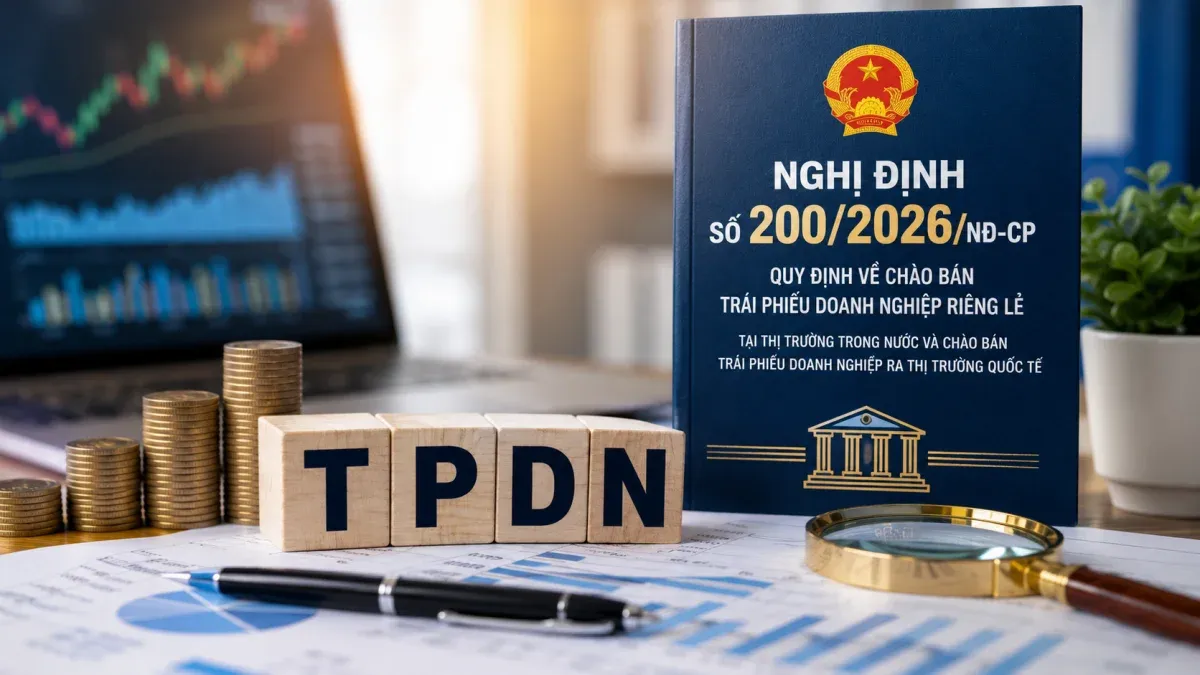

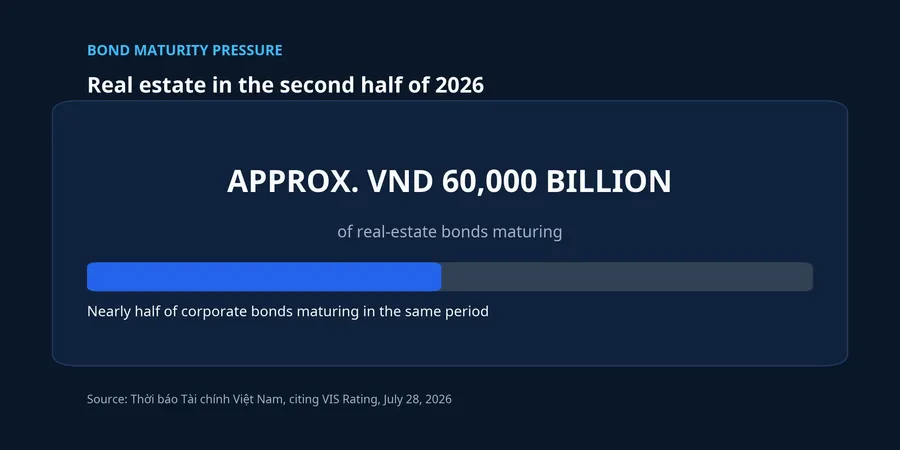
About VND 60,000 billion of Vietnamese real-estate bonds will mature in the second half of 2026. That is large enough to make bondholders look again, but it is not a verdict on every property developer. The more useful questions are: which legal entity borrowed the money, what cash flow will repay it, and what rights does the bondholder have if that plan slips?
Put simply, buying a bond means lending to a particular company. The “real estate” label signals shared sector risks, but it does not describe the financial health of every borrower. The core point is straightforward: the maturity wall is a prompt to screen issuers one by one, not a reason to assume all property bonds carry the same risk.
A large number is only the starting point
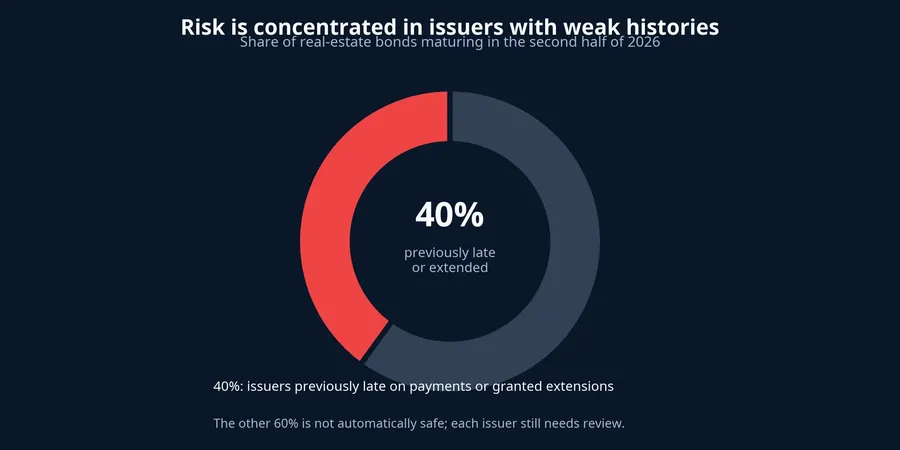
VIS Rating estimates that real-estate bonds maturing in the second half are close to half of all corporate bonds due over the same period. About 40% belong to issuers that had previously paid late or extended bond terms in 2023–2024.Thời báo Tài chính
That 40% does not make the remaining 60% safe. It says only that visible risk appears more concentrated in borrowers with a weak repayment record. For a new investor, this separates “there is risk” from “there is evidence of risk.” Those are related, but they should not be blurred simply because the issuers operate in the same sector.
An issuer with no past late payment can still come under pressure if a project faces legal delays, receivables arrive late, or principal repayments cluster in a short period. Conversely, a past extension is a serious warning, yet the next question remains how much has been repaid and whether the money came from real sales, asset disposals, or new borrowing. A market-wide number tells investors where to look first; it cannot replace the documents for the bond under review.
Start with the legal borrower on the documents
A familiar project name or a prominent parent brand can feel reassuring. Legally, however, the repayment duty begins with the issuer named in the disclosure and bond terms. Unless a parent or related party has provided a binding payment guarantee, a group’s reputation does not automatically become money owed to bondholders.
First, record the exact legal entity, bond code, and maturity date. Then find that entity’s financial statements, unusual disclosures, principal-and-interest payment notices, and earlier bond issues. HNX’s corporate-bond disclosure portal is one useful place to compare payment notices and related documents. Missing, late, or vague disclosures are themselves information that deserves weight.
One signal should not become an automatic conclusion. A past late payment warrants closer scrutiny, not a claim that every future obligation will certainly fail. The opposite is also true: one payment made on time does not prove that every future debt is sound. The sensible approach is to read the chain of evidence, from payment history to the remaining amount due and the exact timetable.
Cash flow answers the question of principal and interest
A developer can hold a substantial land bank or report sizeable assets on its balance sheet and still lack cash on the maturity date. Land, units under construction, and receivables do not always convert into cash quickly. Instead of stopping at “the company has many assets,” connect the payment timetable with project approvals, sales launch, customer collections, and handover.
A credible repayment plan answers two questions: where does the money come from, and when does it arrive? A project that cannot yet be sold, keeps postponing handover, or lacks completed legal procedures makes projected cash flow less certain. When most principal is expected to be repaid with a new bond issue or loan, the issuer depends on refinancing. That is an assumption to test, not cash already in hand.

The VIS Rating data cited by the source put average first-year coupons on real-estate bonds issued in the second quarter at approximately 11.5–12% a year, while floating-rate bonds commonly carried 13–15% a year.Thời báo Tài chính A higher rate may help an issuer raise funds, but it also raises the interest burden when project progress does not generate matching cash flow. In plain terms, the coupon is the price of risk and time, not a promise that principal will be repaid.
Read debt alongside its timing, not as isolated ratios
Debt-to-equity is a useful starting point, not an answer. Two companies with the same ratio can have very different repayment capacity: one may have cash and projects nearing handover, while the other faces debt concentrated in the coming months. Investors should set cash and near-cash assets beside debt falling due, operating cash flow, and interest expense.
Accounting profit also needs to be read alongside cash flow. Profit can rise when revenue is recognised, even as customer cash has not arrived. With bonds, timing cannot be skipped: cash expected next year cannot pay an obligation maturing this month.
The same restraint applies to access to new funding. A market that remains open for issuance does not mean every developer can borrow on comparable terms. Project quality, payment history, collateral, and lender confidence can create very wide differences between issuers.
Collateral and covenants are the final layer of protection
Collateral is not cash. Recovery value depends on the asset type, ownership, priority of claims, legal status, time needed for enforcement, and the price actually achievable when the issuer is distressed. Shares in the issuer or rights tied to an unfinished project may lose value precisely when bondholders need protection most.
Under Decree 200/2026/ND-CP, private-placement bond issuers borrow and repay on their own responsibility, and funds raised must be tracked separately and used for their disclosed purpose.Vietnam Government Portal The legal framework matters, but an investor’s practical protection still depends on the terms of each bond and on enforcement when a breach occurs.
So do not ask only whether a bond is secured. Ask what the asset is, who owns it, whether it already secures another obligation, when enforcement starts, and what the bondholder representative can do. Check repurchase rights, limits on additional borrowing, and requirements to add collateral as well. These less conspicuous clauses shape what a bondholder can demand in a downside scenario.
Conclusion: screening matters more than the headline coupon
The approximately VND 60,000 billion maturity figure does not require investors to avoid every real-estate bond. It requires a better sequence of questions: identify the borrower first, test the source and timing of repayment cash flow next, then consider the coupon and collateral. A late-payment record, delayed project execution, or heavy reliance on new borrowing strengthens the case for that discipline.
Over the coming months, on-time payment notices, legal and handover progress at projects, and the funding plans of individual legal entities will be the signals to watch. They do not guarantee an outcome, but they help separate an attractive coupon promise from a repayment capacity that can be examined. For bonds, the most useful caution is not reacting to a sector label; it is knowing exactly who owes you money.