

OPEC+ has reached the final stretch of a multi-year process: returning the voluntary supply cuts it once withheld from the market. Seven core members agreed to raise their production targets by 188,000 barrels per day from September. That is an important decision, but it is not a direct answer to where oil prices go next.OPEC
For Vietnamese investors, a headline saying “higher production” can invite a quick conclusion: more supply must mean cheaper oil. It skips the long path between a quota table and a barrel delivered to a buyer. The useful distinction has three layers: what a country is allowed to produce, what it can actually pump, and what it can ultimately export.
The final stage of a quota roadmap
September’s decision is not an abrupt policy turn. After a period of weaker oil prices, OPEC+ used several layers of cuts to support the market; the reductions from late 2022 through 2023 totalled nearly 6 million barrels per day. Some were collective commitments, while others were voluntary curbs by a core group of members.New Indian Express
From 2025, the group began returning the voluntary cuts gradually instead of unwinding every restriction at once. After the United Arab Emirates left the alliance on May 1, 2026, Saudi Arabia, Russia, Iraq, Kuwait, Kazakhstan, Algeria and Oman continued the monthly adjustments. The September increase of 188,000 barrels per day should therefore be read as the close of one part of the roadmap, not as proof that OPEC+ has abandoned supply management altogether.New Indian Express
Separating these layers of cuts matters. VietnamBiz, citing Reuters, reported that the group may still retain roughly 2 million barrels per day of broader cuts after September while members discuss how to allocate additional supply. “Fully restored” therefore refers to the voluntary tranche currently on the roadmap; it does not mean every OPEC+ supply valve is wide open.VietnamBiz

A quota is permission, not output
Think of a quota as the number of seats an airline is allowed to sell. Extra seats do not guarantee enough aircraft, crew, fuel, or runway capacity to launch more flights immediately. Oil works the same way. A quota is the permitted level under an agreement; actual output still depends on wells, maintenance, equipment, labour, infrastructure security, and the ability to move crude out of the producing region.

Russia illustrates how wide the gap can be. Its recent output was around 9 million barrels per day, compared with a target near 9.8 million. The roughly 0.8 million-barrel-per-day difference does not establish one single cause. It may reflect later compensation for earlier overproduction, but it may also be connected to operating capacity and disruptions to oil infrastructure.New Indian Express
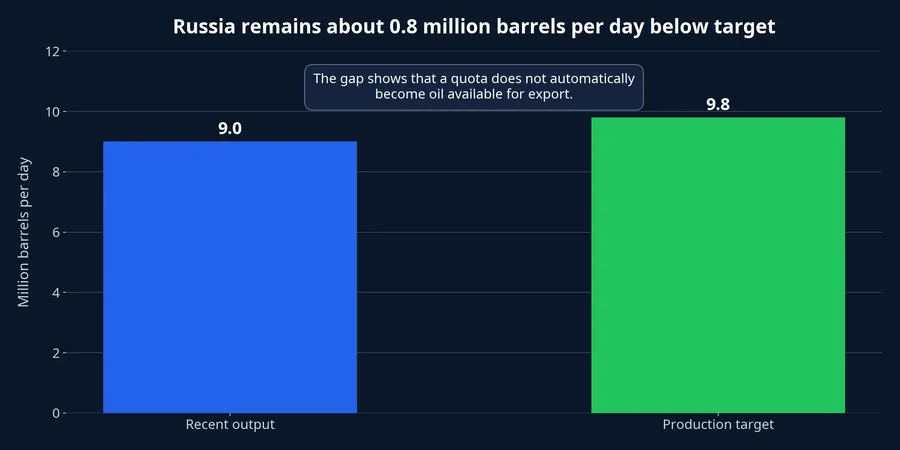
That is why it is misleading to add each country’s higher target mechanically and call the entire sum “new supply.” A country that produced above its target earlier may need to compensate with lower output later. The August 2 communiqué also reiterated the requirement for members to fully compensate for excess production since January 2024.OPEC Net supply to the market is the combined result of new quotas, operational capacity, and those compensation obligations, not a single number announced after a meeting.
The journey from wellhead to port is a separate test
Even pumped crude is not necessarily supply available to buyers. It must move through pipelines, storage tanks, ports, and shipping lanes. With traffic through the Strait of Hormuz not yet back to normal after the West Asia conflict, Gulf producers’ export capacity can become a bottleneck separate from their ability to pump crude.New Indian Express
Two outcomes can coexist. Targets and even production may rise, while cargoes leave port more slowly; consumers then receive no matching increase in supply. Or shipping may normalise while producers have spare capacity ready, allowing exports to grow much faster than a single monthly quota adjustment suggests. These are mechanisms, not certain price forecasts.

For that reason, tanker tracking, port loadings, and inventories at consuming hubs can be more useful to the short-term picture than a communiqué alone. Each series answers a different question: was the oil pumped, did it leave the producing country, and did it reach the place where it is needed? When all three improve together, the case for additional physical supply is much stronger.
There is an important practical distinction for readers following a daily market move. A production-target announcement changes the set of possibilities: it tells the market that the group is willing to allow more supply. A loading report is closer to evidence that those possibilities are becoming barrels available to refiners. Inventory data then help show whether that additional supply is outrunning consumption. None of these measures is perfect on its own, and their reporting calendars do not line up neatly. Still, treating them as a sequence is more informative than treating the headline quota as the finished story.
Oil prices do not react to one communiqué alone
Brent closed at USD 88.61 per barrel on July 31, according to internally verified market data. It should not, however, be treated as a price response solely to the August 2 meeting. Before the decision, the market was already weighing the prospect of higher OPEC+ targets, shipping risk, and expectations for oil demand.
This is also where causal discipline matters. OPEC+’s decision and Brent’s movement occurring close together do not show that one factor caused the entire price move. Flows through Hormuz, each member’s ability to respond, inventories, and demand in major economies can all matter. The evidence supports a narrower conclusion: a quota is a policy signal, while a durable price reaction must be tested against physical barrels.
The effect on Vietnamese investors is uneven
For equities, one move in Brent does not produce the same outcome for every business. Producers are generally more sensitive to the selling price of oil. Airlines, transport operators, plastics makers, and chemicals companies pay closer attention to fuel or feedstock costs. Refiners also depend on the spread between product prices and crude prices. A move in Brent alone cannot settle the outlook for either the energy group or fuel-consuming companies.
For domestic inflation, international crude prices must still pass through exchange rates, taxes, transport costs, and Vietnam’s fuel-price adjustment cycle before appearing in retail petrol prices. That lag helps explain why a sharp one-day move in global oil does not necessarily show up immediately in commuting costs or local consumer prices. The bigger picture is a multi-stage transmission chain, not an on-off switch.
The article’s central thesis is straightforward: OPEC+’s September quota increase alone is insufficient to create downward pressure on oil prices. That view would change only if actual output, barrels leaving port, and inventories all rise over the same observable period. Until then, a headline about capacity should be treated as an opening condition rather than proof of a supply glut. Ahead of the group’s next meeting on September 6, those are the three signals worth watching.OPEC