

From 24 to 31 July 2026, the US Dollar Index, or DXY, fell 1.21%, from 101.39 to 100.16. Over the same window, USD/VND slipped only 0.22%, from VND 26,325.5 to VND 26,267.5 per dollar. Those figures are not contradictory. They describe different markets, so they need not move by the same amount even when the dollar is the common reference point.
Put simply, DXY is a compass for global dollar conditions; USD/VND is the local price paid in Vietnam. A compass can show that the wind has shifted, but it does not steer the boat. The central takeaway is that DXY is an important external signal, while USD/VND needs to be read through domestic foreign-exchange flows, the policy reference rate and dong liquidity.
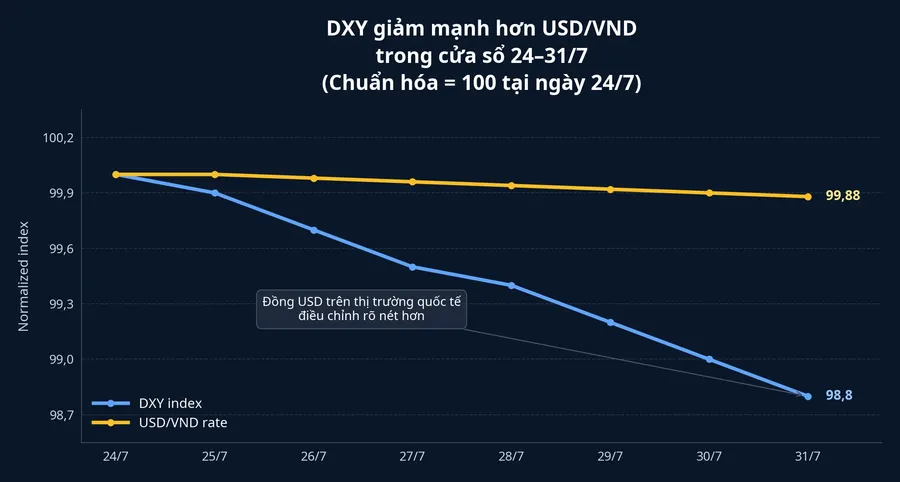
DXY is not the USD/VND exchange rate
DXY measures the dollar's relative value against a basket of major currencies. The euro carries the largest weight in that basket, while the Vietnamese dong is not a component.ICE DXY can therefore fall because the euro or yen strengthens against the dollar even if Vietnam's own foreign-exchange balance has not changed in step.
USD/VND, by contrast, is a bilateral rate. For an importer, it is much closer to the actual cost of dollar-denominated materials, machinery or services. Exporters need a fuller picture: the date of collection, imported inputs and hedging policy all matter. A company that sells abroad does not automatically benefit from a higher USD/VND rate when a large part of its inputs is also priced in foreign currency.
That distinction is why a DXY move cannot simply be applied to USD/VND. Export proceeds, FDI, remittances and corporate dollar sales create supply. Import payments, foreign-currency debt service and capital transfers create demand. These flows follow their own payment calendars; they do not necessarily arrive on the day global markets move.
Three domestic filters
The first filter is actual supply and demand. An importer settling a shipment can raise demand for dollars while DXY is falling. A wave of exporter dollar sales to banks can ease quoted bank rates without any further DXY decline. The same global news can thus produce different local effects at different times.
The second filter is Vietnam's central exchange-rate mechanism. Commercial banks trade within a band of plus or minus 5% around the reference rate published by the State Bank of Vietnam.Znews That is a policy framework, not a live copy of DXY. The central rate therefore incorporates more than a single session in the global dollar market.
The third filter is dong liquidity. Interbank rates indicate how urgently banks need dong funding across different tenors. They do not determine USD/VND by themselves, but they affect the system's ability to manage funding and foreign-exchange positions. It is better to treat them as an additional filter than as a one-factor explanation for the exchange rate.
When exchange-rate channels diverge
On 31 July, the State Bank of Vietnam published a central rate of VND 25,338 per dollar, up VND 18 from the previous day. The corresponding ceiling was VND 26,604 per dollar.VnEconomy This is an operating reference, not the final buy or sell price for every customer.
On the same day, commercial-bank dollar bid and ask rates both fell by VND 20. Across 27 to 31 July, the central rate rose VND 45 while bank rates fell VND 50 on both sides.VnEconomy The divergence does not mean the data are wrong. It shows that each channel captures a different slice of the market.
The informal market reacted more visibly that week: the buying rate fell from VND 26,400 to VND 26,250 per dollar, while the selling rate declined from VND 26,420 to VND 26,280.VnEconomy Informal prices are more sensitive to cash demand and sentiment; bank quotes reflect formal transactions and each bank's foreign-exchange position. The useful question is not which rate is “right,” but where the change has reached and whether channels are converging.
Overnight rates are not the whole story
At the close on 30 July, the overnight interbank borrowing rate was 0.7% per year. One-week, one-month and three-month rates stood at 4.5%, 6.9% and 7.6%, respectively.VnEconomy The wide gap across tenors suggests that very short-term liquidity may be easier, while funding for longer periods is still priced much higher.
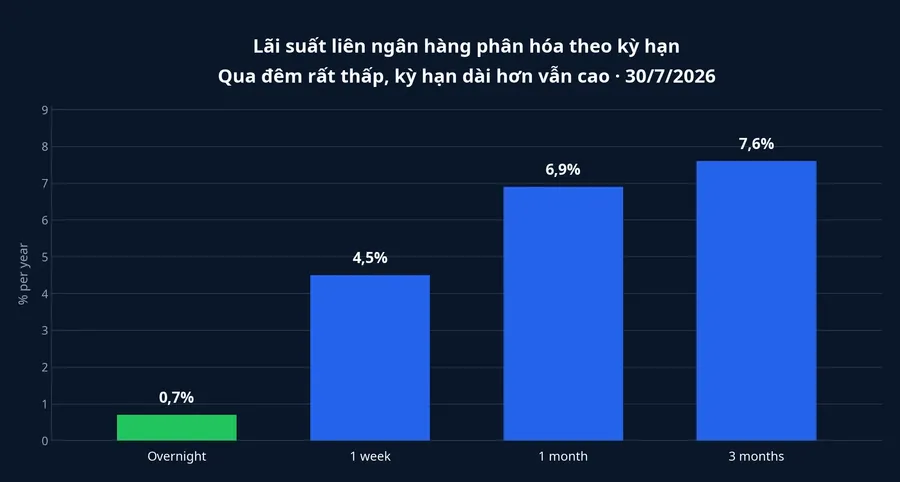
It would therefore be too quick to use the 0.7% overnight rate alone to declare that the dong is about to strengthen or weaken. Lower overnight rates can ease immediate funding conditions. USD/VND still needs to be assessed alongside real dollar demand, bank quotations and how the market absorbs flows over the following days.
Consistency matters more. If the central rate, bank quotations and informal-market prices all fall for several sessions, the easing signal is broader. If one channel falls while others remain high, the market is diverging rather than delivering a single conclusion.
From exchange rates to portfolios
The exchange rate reaches companies through several channels. Importers are affected fairly directly by the bank dollar rate when they make payments. Exporters require more careful reading because foreign-currency revenue is only one side of the equation; imported inputs, borrowings and hedges can change the outcome. Labeling an entire sector as a “beneficiary of FX” is often too simplistic.
For equities, USD/VND also affects capital-flow sentiment, inflation expectations and room for interest-rate management. But foreign investors' net selling does not mean every dong is immediately converted into dollars and transferred out of Vietnam. Block trades, portfolio rebalancing and the timing of subsequent deployment can all create lags. The available evidence supports observing these moves together, not assigning every stock-price change to the exchange rate.
This is a common analytical trap for newer investors. A falling DXY does not mean import costs will drop immediately; a small USD/VND rise is not automatically negative for the entire market. The better starting point for each company is its foreign-currency revenue share, imported inputs, debt and timing of cash flows.
A short dashboard for next week
Start with DXY to see whether external dollar pressure is rising or easing. It is a useful backdrop, especially when the dollar moves broadly against major currencies. Then compare the central rate with commercial-bank quotations and informal-market prices. Three lines falling together mean something very different from only one moving lower.
Next, monitor overnight rates alongside the one-week, one-month and three-month tenors. The purpose is not to forecast USD/VND from one number, but to separate temporary liquidity from a more durable change in the cost of dong funding. Finally, set those signals against the real economy's foreign-currency demand, from trade flows to corporate payment schedules.
This week's conclusion is not that the dong has entered a new trend. The evidence only shows that external dollar pressure eased more than USD/VND did, while domestic exchange-rate channels remained split. DXY deserves attention, but only confirmation from banks, the informal market and dong liquidity can support a broader conclusion that exchange-rate pressure has genuinely eased.