


Late-July market reports about possible US support for the yen matter for more than a number scribbled on a notepad. They revive an old financial-market story: when the currency used for cheap funding rises quickly, the risk does not stay in foreign exchange. It sits inside portfolios that used the yen as their funding source. The bigger picture is that this is a signal to monitor, not proof that broad deleveraging is already under way.
The central argument is straightforward: yen strength becomes a problem for risk assets only when it persists and arrives with evidence of asset sales or capital repatriation to Japan. One volatile session cannot establish that. Investors should read the transmission chain rather than react to a headline.
What is known and what still requires confirmation
A Reuters photograph of a notepad in front of US Treasury Secretary Scott Bessent of the US Treasury Department showed a plan to buy yen. That is evidence of a plan visible in the image; it is not a Treasury communiqué and does not confirm the size of a completed transaction. Keeping those two layers separate matters because markets often move before public authorities disclose details.
On the operational side, the United States has an Exchange Stabilization Fund that holds US dollars, foreign currencies and special drawing rights. The fund may buy or sell foreign exchange with the Treasury Secretary’s authorization, while the Federal Reserve Bank of New York acts as the government’s fiscal agent for transactions.US Treasury Foreign-exchange intervention therefore does not automatically mean an immediate sale of US Treasuries or the creation of new dollars.
History shows that intervention follows the risk of the moment
In 1998, the United States and Japan jointly sold dollars to buy yen while the currency was weakening amid the Asian financial crisis. Federal Reserve records put the US share of the operation at USD 833 million and show a sharp exchange-rate reaction during the rest of the New York session, although part of the gain later retraced.Federal Reserve The lesson is that intervention can change expectations quickly, but it cannot replace economic fundamentals.
The picture reversed in 2011. After the Tōhoku earthquake and tsunami, the yen rose rapidly as markets feared capital repatriation. The United States and its G7 partners sold yen and bought dollars to curb the move; the New York Fed announced that the US operation totalled USD 1 billion.New York Fed It was still yen intervention, but the 2011 objective was to prevent an excessively rapid appreciation, not to support the currency.

The common thread is not a single “correct” exchange rate. Authorities react when the speed of a move risks destabilising the system. That is why a stronger yen alone cannot determine one outcome for equities or bonds.
Yen borrowing is the first link in the chain
Yen-funded investing rests on the gap in funding costs. Investors borrow a low-rate currency, convert it into another currency and buy assets with a higher expected return. As long as the yen does not appreciate sharply, the repayment cost in the investor’s operating currency can remain manageable.
When the yen strengthens, that debt becomes more expensive in the currency used for investment. Leveraged investors may sell assets, convert the proceeds into yen and repay their borrowing. The BIS notes that the unwinding of positions funded in low-cost currencies can amplify exchange-rate reactions after policy changes.BIS This is a conditional mechanism, not evidence that every yen-funded position is currently being closed.
At least three explanations can coexist behind a rise in the yen: official-market activity, investors closing positions on their own and changing expectations for Japanese or US interest rates. A single session cannot allocate the contribution of each factor. It would therefore go beyond the evidence to call yen strength the direct cause of an equity decline.

Bonds can follow two opposing paths
Bonds are where this story is most often oversimplified. One path begins with risk aversion: investors buy government bonds or other high-quality assets, pushing prices higher and yields lower. The other appears when Japanese yields become more attractive, or when a stronger yen makes foreign assets less attractive after currency conversion. Japanese investors may then sell foreign bonds to bring capital home, lowering bond prices and raising yields.
The International Monetary Fund notes that Japanese investors reallocating toward domestic assets can create spillovers in global bond markets.IMF The two forces can coexist. It is therefore unsafe to assume that falling equities must mean falling US Treasury yields.
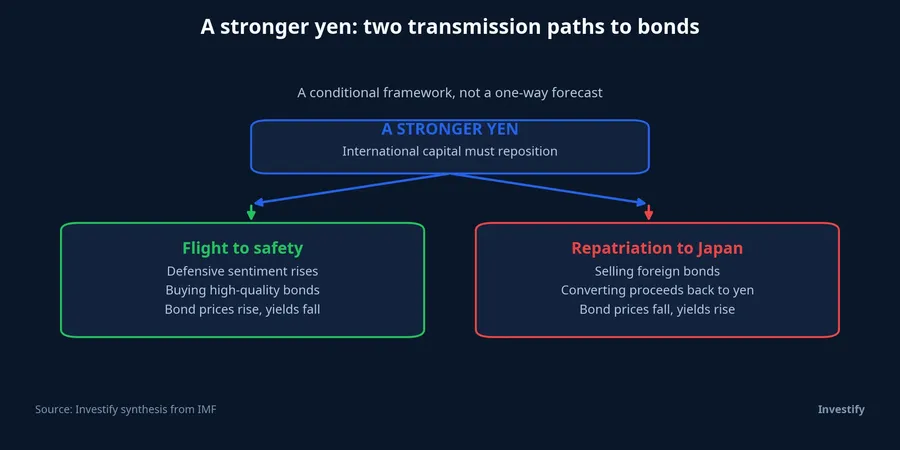
Reading the signals together gives a clearer picture. If the yen rises while equities weaken and US Treasury yields fall, the market may be leaning toward a flight to safety. If the yen rises while Treasury yields also rise, the possibility of foreign-bond selling or Japanese repatriation deserves more attention. This distinguishes mechanisms; it is not a certain forecasting rule.
From international moves to a Vietnamese portfolio
Vietnam’s market does not automatically take a direct hit because the yen rises in one session. A more plausible route runs through sentiment toward risk assets, global deleveraging and then changes in international investors’ allocations. Each link can weaken or break before the effect reaches Vietnam.
That is why investors need not turn a foreign-exchange headline into a forecast of a sell-off. Instead, monitor the yen across several sessions, the breadth of weakness in global equities and the direction of US Treasury yields together. If only one indicator turns, the evidence remains thin. If the indicators confirm one another over time, the risk of deleveraging deserves greater attention.
Thanh Hà’s conclusion is clear: the yen story is currently a warning about international liquidity conditions, not a verdict on a portfolio. That thesis changes only if the yen continues to strengthen and equities and bonds show signs of defensive flows or repatriation.