


Situational Awareness, an AI-focused hedge fund, has sold most or all of its public-equity portfolio to Citadel, depending on how different reports describe the scope of the transaction. The important point is not that a Wall Street name has run into trouble. It is the reflex many new investors have: if a product says “fund,” someone else must have already dealt with the risk.
Put simply, a fund is a container for pooled money, not a shield. Its safety depends on what sits inside that container, how much borrowing is used to buy it, how readily the assets can be sold, and the rules governing investor withdrawals. This episode does not establish that Situational Awareness has closed or gone bankrupt. It is a useful illustration of how liquidity pressure can force a manager to act before a long-term investment thesis has had time to play out.
The event is not a verdict on every fund
Reporting agrees that the fund sharply reduced its public-equity exposure after AI-related bets came under pressure. It does not provide a complete public account of the assets Citadel acquired or of the fund’s other holdings. Calling this a liquidation of the whole fund, or claiming that a particular margin call directly caused it, would go beyond the available evidence.
That distinction matters for new investors. A public stock portfolio is only a snapshot. A fund may also hold cash, private assets, short positions or derivatives. When disclosure is incomplete, the responsible response is not to fill the gap with a dramatic story. It is to stop at what can be confirmed: the fund materially reduced its listed-equity holdings during a period of losses.

That makes the lesson narrower than “fund investing is dangerous.” A fund neither creates nor removes risk by itself. It organises risk through its mandate, portfolio and operating rules. Investors need to know which structure they are joining.
Why a fund may have to sell
Leverage is the most intuitive place to start. It means using borrowed money or instruments that create exposure larger than the capital actually committed. If prices move in the intended direction, returns on capital can be amplified. If they move the other way, losses expand faster as well. The U.S. Securities and Exchange Commission notes that leverage can turn an otherwise relatively conservative investment into a high-risk position.SEC
Imagine a fund buying shares with both investor capital and debt. A falling share price does not shrink the debt automatically, but it does thin the equity cushion. The lender may ask for more collateral. If the fund cannot provide cash or other assets, it must reduce borrowing by selling positions. At that point, whether the business still looks attractive over the next three years may no longer determine today’s trade.
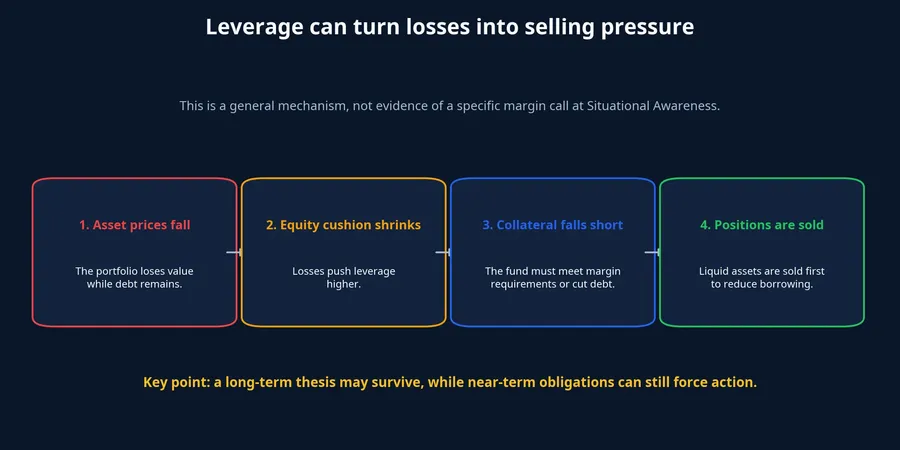
This is a general mechanism, not a claim that Situational Awareness received a specific margin call. Beyond leverage, there are at least two plausible explanations for selling pressure: the portfolio may have been concentrated in assets that reacted together to changing expectations for AI, and the fund may have sold its most liquid holdings first to raise cash quickly. Public evidence is not sufficient to assign an exact share of the pressure to each cause.
The important timing mismatch is between a long-term thesis and short-term obligations. The thesis may still have merit, while debt maturities, collateral requirements and redemption schedules arrive much sooner. If the assets are not liquid enough at that moment, a manager can be forced to sell even when they would prefer to stay invested.
Hedge funds, open-end funds and ETFs have different structures
It is a mistake to take one hedge fund and put every fund certificate in the same bucket. Hedge funds generally serve eligible investors, may use more flexible strategies and disclose less to the public. Their withdrawal rights can also be periodic or restricted by the fund terms.
The open-end funds most Vietnamese individual investors encounter operate differently. Investors buy or redeem fund certificates under the fund’s rules and at net asset value. Fund assets are held in custody, while the management company operates under a charter, reporting requirements and supervision. None of this makes an open-end fund immune to volatility: its NAV still falls when the shares or bonds it holds decline. But the disclosure, operating limits and redemption path are different questions from those posed by a hedge fund.
An ETF is also a fund, but its certificates trade on an exchange during market hours, much like shares. Its trading price can deviate from NAV during the session; the creation and redemption mechanism is designed to narrow that gap, not to remove market risk. Vietnam’s State Securities Commission explains that ETF holdings, NAV and tracking deviation from the reference index are disclosed for investors to follow.SSC
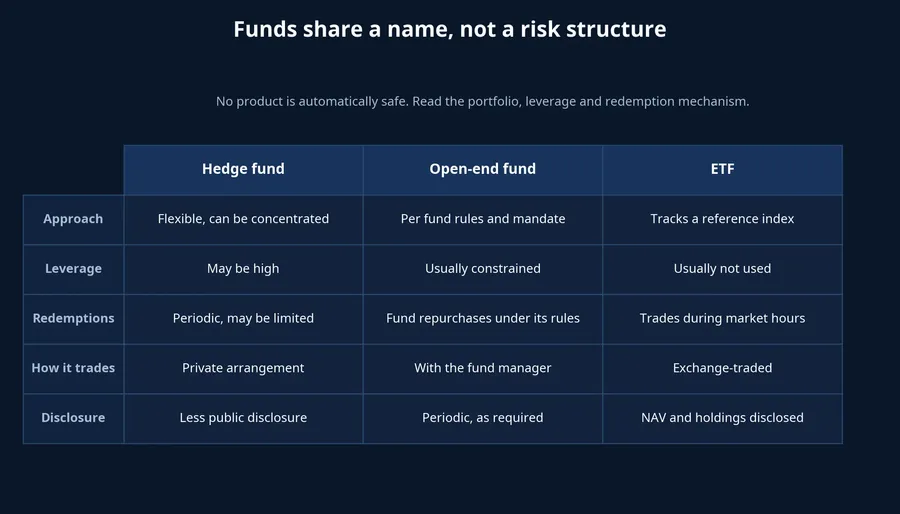
The distinction is not about declaring one category good and another bad. An ETF can be concentrated if its index gives large weights to a few stocks. An open-end fund can fall in a market decline. Conversely, leverage does not automatically make every hedge fund fail. The more useful question is whether the level of risk fits the assets’ saleability, the redemption promise and the investor’s understanding.
Read the structure before the name
For a new investor, a prospectus can look long and technical. You do not have to begin with every line. Start with the type of fund: an open-end fund, ETF, closed-end fund or a product for professional investors. That answer tells you where it trades, when you can receive money back and what information should be disclosed.
Next, look at the actual portfolio rather than the product name. What is the largest holding? Do the holdings depend on the same driver, such as interest rates, property or technology? A portfolio with many tickers is not necessarily diversified if those tickers all fall for the same reason.
Then look for borrowing and derivatives policies. For public funds, limits and valuation methods are usually set out in the charter, prospectus or periodic reports. If it is difficult to find basic information on assets, fees, redemption timing or risk limits, that information gap is itself a risk to consider.
Finally, check the exit route. For an open-end fund, examine redemption rules, settlement time and circumstances in which dealing may be suspended. For an ETF, look at the gap between the trading price and NAV, as well as trading liquidity. None of these answers guarantees a profit. They do help you identify the risk you are accepting before committing money.
A practical conclusion for new investors
Situational Awareness does not prove that handing money to a fund is a mistake. It does show that a manager’s skill cannot override the arithmetic of leverage, concentration and liquidity. That is the thesis worth keeping: the word “fund” is not compensation for not understanding a product.
For open-end funds and ETFs available to individual investors, the priority should be products whose portfolio, NAV, fees, redemption schedule and borrowing limits you can check. Market risk remains, but it becomes easier to see. The relevant signal is not a dramatic overseas headline. It is whether the information on a fund you are considering is clear enough for you to explain it back in your own words.