
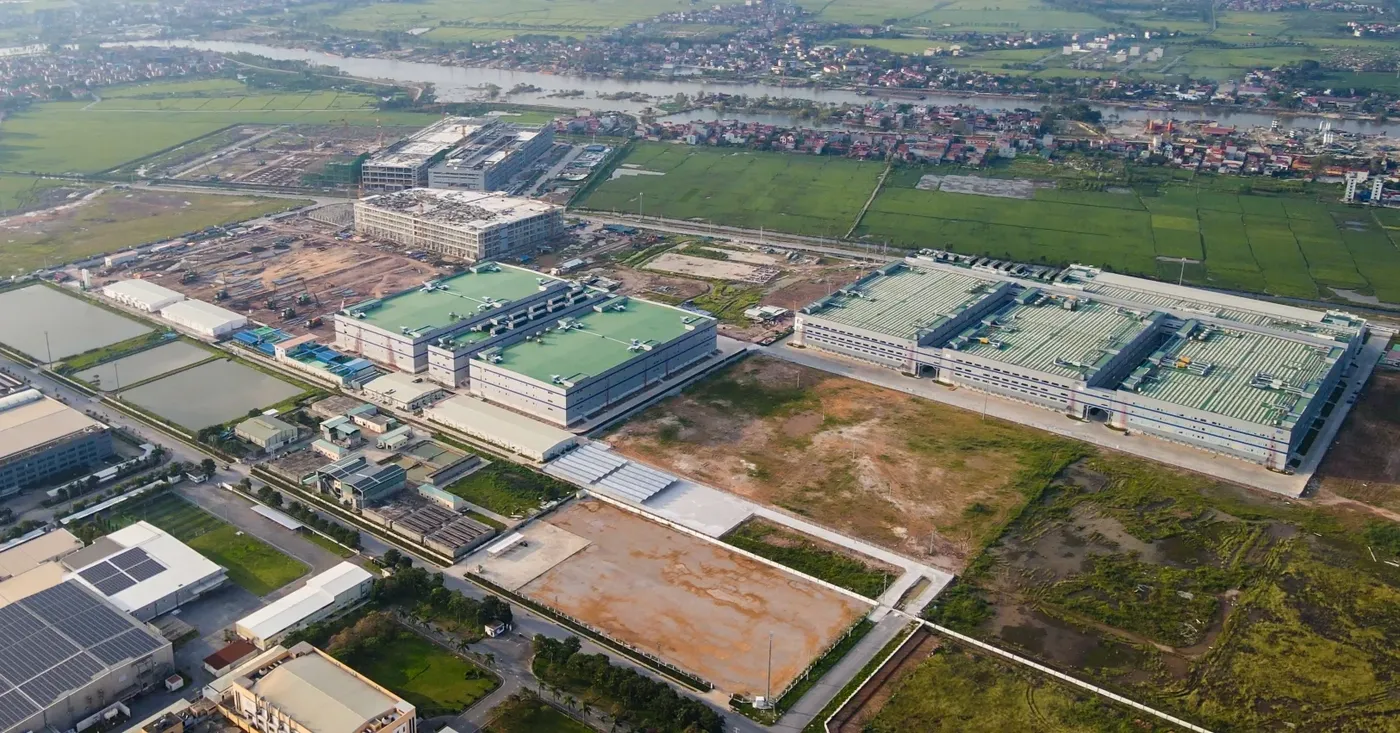

A signed industrial-park land lease can support expectations for revenue, but it is not revenue in itself. For Kinh Bac City Development Holding Corporation (KBC), that distinction is unusually clear in the second quarter of 2026: the company says contracts covering more than 170 hectares have been signed, yet the land has not been handed over. Until handover is complete, that value cannot automatically enter the income statement, even if demand has already been demonstrated by a signed agreement.
That is the right lens for KBC today. The evidence does not say that the 170-plus hectares will certainly rescue the full-year result, nor does a weak quarter prove that the broader opportunity has disappeared. It says that delivery timing, and the return of capital from projects, will decide when contractual expectations become recognised profit.
Revenue rose while profit moved the other way
KBC reported Q2 net revenue of VND 588.72 billion, up 15.52% year on year. Gross profit, however, fell 62.85% to VND 199.88 billion, while consolidated net profit reached VND 34.49 billion, down 91.41% from Q2 2025.KBC The comparison illustrates a basic point: revenue alone does not describe the quality of a reporting period. The mix of delivered work and its associated cost base determine how much revenue reaches the profit line.
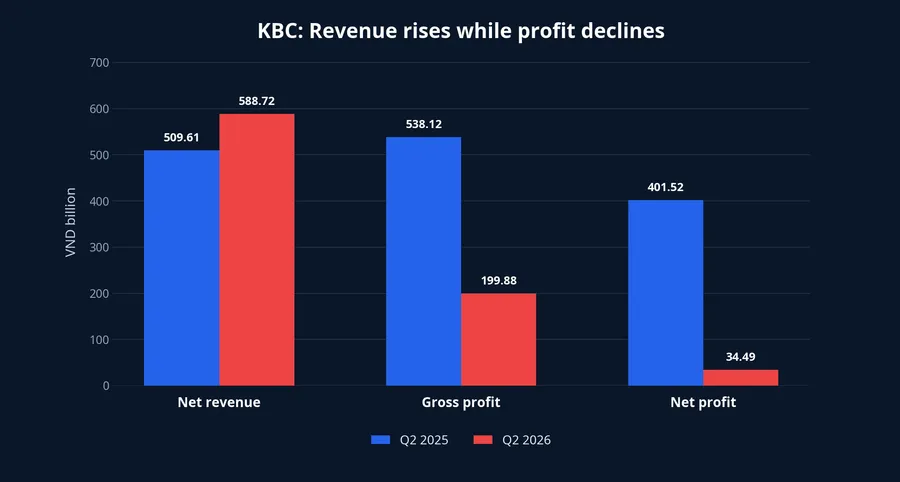
The gap between revenue and gross profit is the more meaningful signal. Revenue increased, yet gross profit declined sharply, indicating that the revenue recognised this quarter did not carry the same economics as a year earlier. The report does not establish one project or one cause as the full explanation. What it does establish is that recognised revenue did not produce a comparable margin.
Financial items did not offset that pressure. Financial income rose from VND 163.40 billion to VND 431.34 billion, while financial expenses climbed from VND 111.45 billion to VND 304.00 billion. Interest expense alone was VND 289.44 billion, 193.02% higher year on year.KBC When funding costs rise this quickly, financial income is not a durable substitute for profit generated by handing over industrial land.
A signature and a handover are different milestones
The cycle of an industrial-park project does not end with a customer signature. KBC describes a chain that includes investment approvals, site clearance, infrastructure construction, product completion and handover. One such cycle may take more than 12 months.KBC Put simply, a signature signals demand and a commercial commitment; handover is the operating milestone that opens the path to revenue.
KBC says that the more than 170 hectares under contract remain in the compensation process and are expected to be recognised late in the year.KBC “Expected” matters. It communicates management’s plan, rather than a firm promise on timing, because documentation, site clearance and infrastructure must still reach handover-ready status. It should not be rewritten as “the 170 hectares will be recognised next quarter,” nor should every hectare be assumed to have the same schedule.
The July 30 disclosure does not break the area down by project. That limits the inference readers can make. Signed contracts can be treated as a potential source of future revenue, but the current evidence is not enough to allocate revenue, margin or recognition timing precisely to each parcel. Progress on clearance, infrastructure status and handover terms are the data points to await in later disclosures.
This also rules out a simple causal claim from 170 hectares to year-end profit. Timing of delivery, contract mix, cost of sales and financing costs can all influence the result simultaneously. The filing confirms land that has not been handed over, but it does not isolate the contribution of each variable to future earnings.
Cash flow reveals the cost of waiting
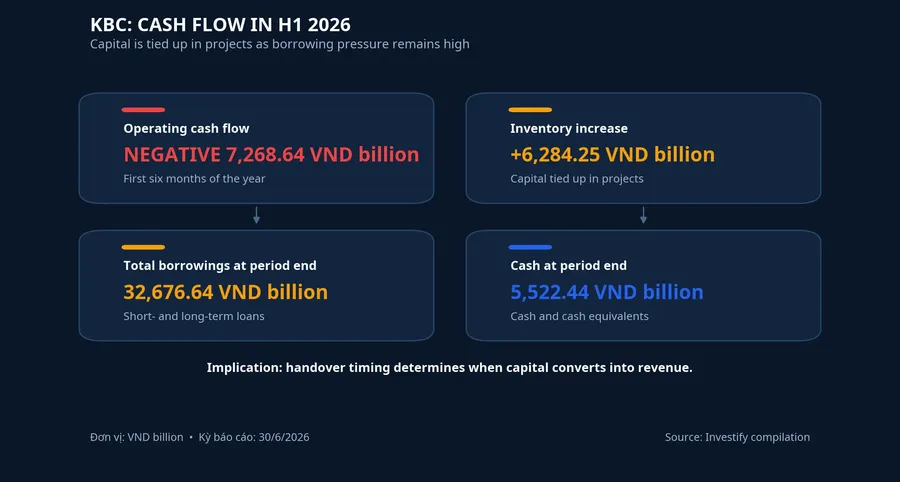
If the income statement shows which value has been recognised, cash flow shows where capital is being held. KBC’s net operating cash flow was negative VND 7,268.64 billion in the first half. Inventory increased by VND 6,284.25 billion, taking the June-ending balance to VND 33,357.37 billion.KBC For an industrial-park and urban developer, this largely represents land, compensation, infrastructure and projects under development: capital already spent but not yet converted into revenue.
Short-term customer advances increased from VND 1,572.49 billion to VND 1,811.15 billion.KBC That indicates continuing customer payments, but it is not enough to conclude that revenue will be recognised immediately. Advances, inventory and revenue are separate stages in the capital cycle. Reading any one of them in isolation can create more certainty than the facts support.
Funding pressure is visible on the balance sheet as well. KBC paid VND 637.20 billion of interest in six months, while total short- and long-term borrowings at the end of June were VND 32,676.64 billion, up 14.22% from year-end 2025. Financing cash flow was positive VND 4,100.25 billion, mainly through additional borrowing, yet cash and cash equivalents declined from VND 8,368.53 billion to VND 5,522.44 billion.KBC
The relationship is direct. When handover is delayed, capital remains in projects and interest costs keep accruing. Once handover is completed, revenue may be recognised in large land parcels. Before that point, however, funding costs deserve attention as a variable that can weaken results, rather than treating signed area alone as a future reward.
What to watch through the rest of the year
First, watch actual handed-over area. A disclosure that identifies hectares, the relevant project and recognition timing will be more useful than an aggregate contract number. It is the most direct connection between tenant demand and revenue.
Second, watch inventory, customer advances and operating cash flow together. If inventory stops rising rapidly, customer payments continue and operating cash flow becomes less negative, the evidence of project progress becomes more persuasive. If inventory keeps growing rapidly while operating cash flow remains deeply negative, capital is still tied up in execution.
Finally, place borrowings and interest expense beside real delivery progress. Debt used to complete infrastructure can be consistent with a project nearing handover, but only if subsequent reporting shows revenue and cash flow following through. The two measures should not be assessed in isolation.
The appropriate conclusion is conditional: KBC has contracted land that has not yet been handed over, and that is potential value rather than current profit. The constructive case becomes stronger only when handed-over area, operating cash flow and funding costs all indicate a transition. The next quarterly reports should show whether value now held within projects crosses the handover milestone and becomes recognised earnings.