

America's latest GDP release invites a quick conclusion: second-quarter growth slowed to an annualized 1.5%, from 2.1% in the first quarter. Beneath that headline, however, domestic demand remains resilient and inflation is still well above the Federal Reserve's target. That makes a rate cut a decision that needs more evidence, not an automatic response to a weaker growth print.
The central case is straightforward: the Fed has more reason to hold than to cut immediately. Slower GDP has narrowed its room for manoeuvre, but private demand and price pressure have not weakened enough to make growth support the overriding priority.
What the second-quarter GDP number actually says
The 1.5% figure is an annualized rate, a convention that scales one quarter's pace to a full year for comparison. Quarter on quarter, the US economy expanded 0.4%. The Bureau of Economic Analysis' advance estimate shows positive contributions from consumption, investment and exports. Lower government spending, higher imports and weaker parts of investment weighed on the aggregate number.BEA
That distinction matters. Higher imports subtract from GDP accounting even when those goods support domestic consumption or production. Inventories can also move quarterly growth sharply. Investors should therefore look beyond the headline and ask which parts of the economy are actually losing momentum.
Business investment offers a mixed answer. Equipment and intellectual-property products rose, supported by industrial machinery, transport equipment, information-processing equipment, software and research. Private inventories and non-residential structures declined. The evidence does not support treating all corporate investment as weak.
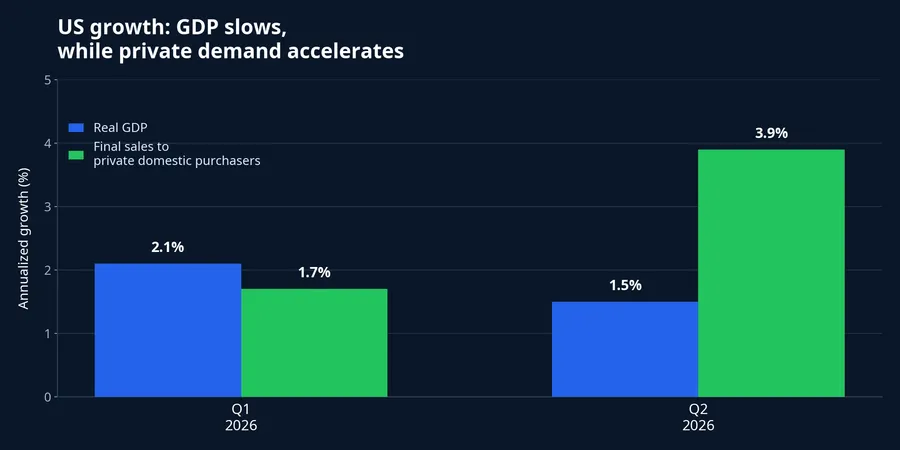
Final sales to private domestic purchasers, which combines consumption and private fixed investment, is a cleaner gauge of underlying demand. It accelerated to an annualized 3.9% in the second quarter, from 1.7% in the first.BEA In plain terms, households and firms have not yet retrenched together.

That is the source of the Fed's dilemma. A central bank can react more quickly when growth weakness is broad, unemployment is rising and consumers are simultaneously pulling back. This report does not describe that economy. It describes slower headline growth with enough strength in key areas to keep price pressure alive.
Monthly cooling is not yet inflation victory
The June income-and-outlays report supplies the other half of the policy equation. Headline personal consumption expenditures prices fell 0.1% month on month, while core PCE, excluding food and energy, rose 0.1%. At the monthly frequency, that is encouraging evidence that inflation momentum may be cooling.BEA
The Fed cannot base policy on one month alone. On a year-over-year basis, headline PCE inflation was still 3.7% and core PCE was 3.3%, both materially above the FOMC's 2% inflation goal.BEA That gap explains why a softer-than-expected GDP result does not, by itself, reverse the policy direction.
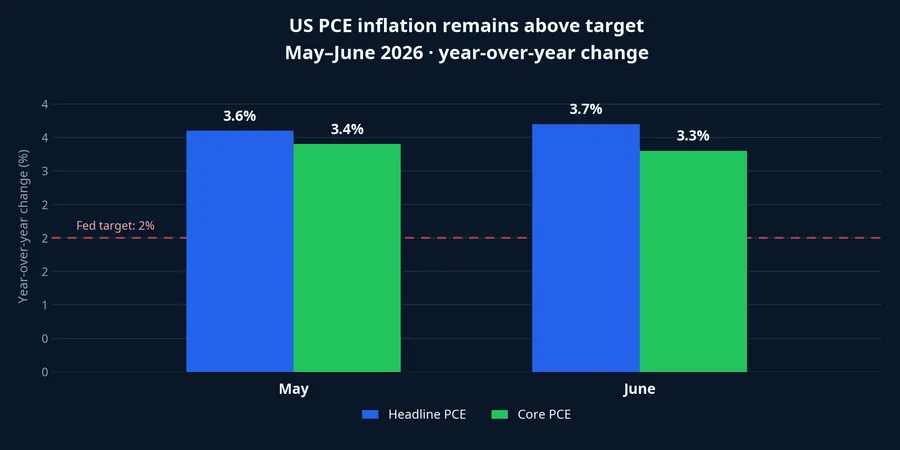
The gap between monthly and annual readings is critical. One softer month can begin a better trend, but it can also reflect temporary moves in energy or goods prices. Before cutting rates with conviction, the Fed needs further reports showing that core inflation is continuing lower rather than merely pausing.
An early cut would risk reviving demand before the effort to return inflation to target is complete. Holding rates high for too long carries costs as well: credit remains expensive, interest-sensitive investment slows and labor-market damage can accumulate. This trade-off is the narrow policy corridor the Fed is now navigating.
What the July decision signals
On July 29, the FOMC kept the federal funds target range at 3.5% to 3.75%, with nine votes in favor and three dissents. The three regional Fed presidents preferred a 0.25 percentage-point increase, not a cut.Federal Reserve This does not forecast the next meeting, but it does show that concerns over incomplete inflation progress remain present within the committee.
In its official statement, the Fed said economic activity was continuing at a solid pace, capital investment was strong, employment was keeping pace with labor-force growth and unemployment had changed little.Federal Reserve Initial jobless claims rose to 197,000 for the week ending July 25, but remained low by recent historical standards.AP
None of this means the US economy is free of risk. GDP growth has slowed and investment is uneven. It also does not establish a causal chain from slower GDP to inevitable rate cuts. Private demand is still growing, while the labor market has not shown broad-based layoffs.
Three policy paths and their triggers
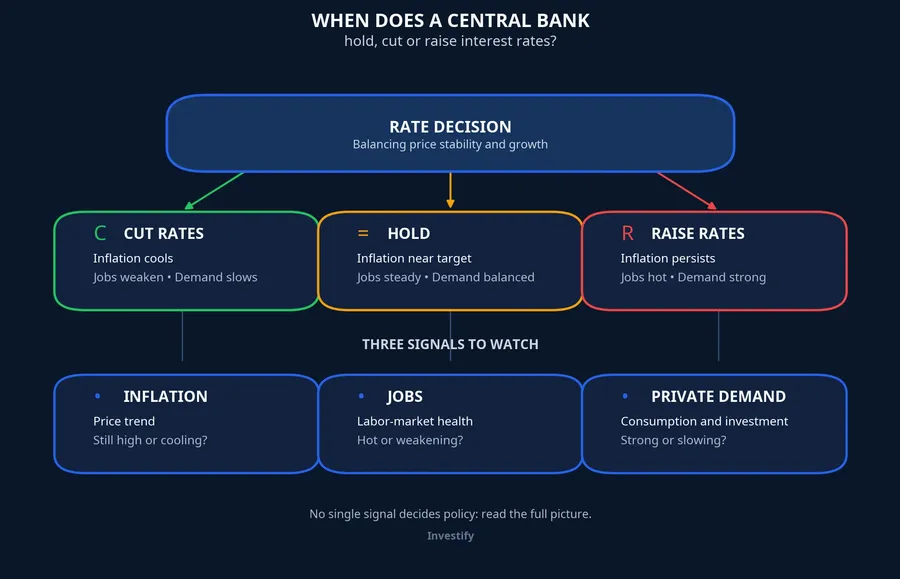
The case for cuts strengthens if two sets of data turn together: headline and core PCE inflation continue to ease, while labor conditions weaken visibly through slower hiring, higher unemployment or persistently rising jobless claims. The inflation cost of easing would then be lower, while the cost of holding rates high would rise as the economy needs more support.
The hold path, currently the base case, fits an economy where inflation declines only gradually, private demand continues to expand and the labor market cools without breaking. This can frustrate markets because the waiting period lengthens. Short-term Treasury yields may not fall much, the dollar is often supported by relatively high rates, and equities that depend on lower discount rates remain vulnerable.
Another hike is not the central scenario, but it cannot be dismissed. It would require renewed inflation pressure alongside consumption, investment and hiring strong enough to absorb higher borrowing costs. There is an important counterargument: if prices rise because of a supply shock, higher rates mainly restrain demand and may not be the appropriate remedy. The Fed could still hold if it judges that monetary policy cannot solve the source of that inflation.
Vietnam feels the signal through FX and capital flows
For Vietnamese investors, the Fed does not move every stock through a single direct channel. The nearer transmission route runs through US Treasury yields, the dollar, the exchange rate and then domestic monetary-policy room. The latest internal market data place USD/VND at VND 26,339 per dollar. Higher US rates for longer can make domestic easing more cautious by adding pressure to the exchange rate.
That should not be treated as a one-way conclusion. The exchange rate also depends on the trade balance, foreign-currency supply, capital flows and Vietnamese policy. The same Fed decision can produce different market effects depending on domestic liquidity and growth. The US data matter greatly, but they are not the only variable.
Conclusion: wait for confirmation from prices and jobs
The point is not that 1.5% GDP growth is good news. It is that the number alone is insufficient to conclude that Fed cuts are imminent. Private domestic demand is still expanding at an annualized 3.9%, core PCE is still up 3.3% year over year and some members sought a rate increase in July. Taken together, those facts tilt the balance toward a longer hold.BEA
That assessment changes decisively only if inflation continues to cool while the labor market weakens at the same time. The three signals worth watching in coming weeks are core PCE, employment data and private demand. They will show whether slower GDP marks the start of broad economic weakness or simply a quarter pulled down by trade and inventory effects.