


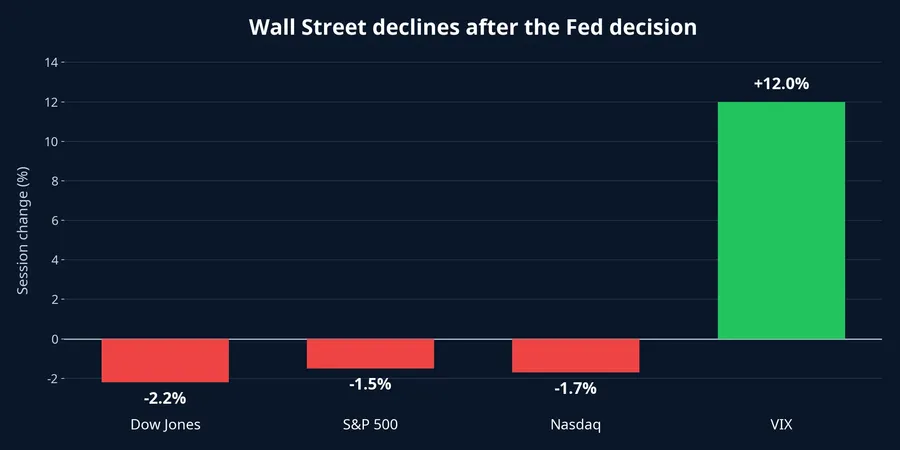
The Fed left interest rates unchanged in July, yet the trading session that followed did not look like relief. On July 29, the Dow Jones fell 2.2%, the S&P 500 lost 1.5% and the Nasdaq declined 1.7%.AP The VIX volatility index rose 12.0%.AP For newer investors, it is a useful reminder: “unchanged” describes what the Fed just did; it does not capture everything markets are pricing for the period ahead.
The central conclusion is straightforward. This decision was not a signal of monetary easing. Division within the FOMC, inflation anxiety linked to energy and a reassessment of technology expectations all weighed on equities, although each worked through a different channel. Rather than force a single explanation for the sell-off, it makes more sense to read the episode through rates, the yield curve and the expectations already embedded in share prices.
Holding rates is not a path to cheaper money
The FOMC kept its target range at 3.50% to 3.75% in a 9–3 vote. Three members dissented in favor of a further 0.25-percentage-point increase, while the statement said inflation remained above the Fed’s 2% objective.Fed That is more than a procedural detail. It shows that tighter policy remains a live option in the committee’s deliberations, rather than a consensus that the inflation fight is over.
Investors often use a simple rule: rate increases hurt stocks, and a hold is less negative. That is only partly true. A hold because inflation has convincingly cooled means something very different from a hold while part of the committee wants to tighten further. In the latter case, markets must allow for capital costs staying high for longer, or rising again if price data deteriorate.
The dissents should not be read as a promise of another rate increase. The Fed has not announced one. They do, however, change the balance of risks for equity holders. Companies whose cash flows lie further in the future are usually more sensitive because the present value of those cash flows declines as the discount rate rises.
The yield curve carries the more useful signal
After the decision, the 2-year US Treasury yield slipped from 4.26% to 4.24%, while the 10-year yield rose from 4.61% to 4.68%.AP That divergence matters more than a headline about the policy rate. Two-year yields tend to be highly sensitive to near-term policy expectations; 10-year yields also carry views on inflation, growth and the risk premium demanded over a longer horizon.
The numbers do not necessarily show that investors expect an immediate hike. The modest drop in the short yield points the other way. But the rise in the long yield says investors want more compensation to hold long-dated bonds in an unsettled environment. For equities, that is a material distinction: a static policy rate does not prevent the long-term valuation benchmark from becoming more demanding.
It would therefore be too neat to attribute the entire Wall Street decline to the Fed. The yield curve aggregates many inputs, including inflation, Treasury supply and demand for protection. The evidence supports viewing higher long yields as part of the valuation pressure, but it does not allow a precise allocation of the day’s losses across individual indices.
Oil makes the inflation equation harder
Brent crude rose 7.3% to USD 88.09 a barrel in the same session as fighting involving Iran resumed and revived concerns about global oil flows. During the month, Brent had traded between USD 72 and USD 102 a barrel.AP For the Fed, this is not merely an energy-sector story. More expensive energy can feed into freight, production costs and household budgets, making the return to the inflation target more difficult.
The equity impact is uneven. Some energy producers may benefit from higher selling prices, while fuel-intensive businesses and companies reliant on consumer purchasing power face the opposite pressure. Oil is therefore one link in the inflation-and-yields picture, not a complete explanation for a market-wide decline. The relevant question is whether the move persists long enough to alter inflation data or proves to be a short-lived shock.
Technology faces an expectations test
Technology had its own story. Nvidia fell 3.6% and KLA dropped 10.8% despite reporting revenue and profit above expectations; KLA had gained nearly 150% in the first half of the year.AP Once a share price has risen sharply, an earnings beat may still fall short of the growth that investors had already built into it.

Put simply, markets do not compare a company only with the previous quarter or the prior year. They also compare actual results with the expectations embedded in the valuation. Higher long-term yields make that test more exacting, but they do not prove that the Fed directly caused every technology decline. Earnings, the outlook for artificial-intelligence spending and profit-taking after a strong rally are all plausible explanations that can coexist.
A practical framework for Vietnamese investors
The wider picture is that investors should not stop at the words “hike,” “cut” or “hold.” Start with the policy level and the vote split to gauge the true degree of consensus. Then read how the Fed describes inflation and growth. Finally, watch 2-year and 10-year yields: together they help distinguish a near-term policy concern from a longer-term valuation risk.
For Vietnamese investors, this is not a direct buy-or-sell signal for any sector. It is a framework for following exchange rates, global yields and the sensitivity of growth businesses to capital costs. The central point remains that a stationary Fed is not enough to create an easing environment. Pressure would ease more convincingly only if inflation data, energy prices and long-term yields improve together; those are the signals worth monitoring in the weeks ahead.