


VN-Index closed July 29 at 1,704.68 points, up 24.06 points or 1.43%. It reclaimed 1,700 and finished just 0.63 points below the day’s high. That is a constructive close, but it is not yet proof that the whole market has returned to a durable uptrend.
For newer investors, a round-number break is best treated as the start of an inspection, not the end of one. Did buyers retain control into the close? Was the advance broad enough? Did trading volume support it? And how much of the index gain came from a handful of large companies? Those four questions distinguish a broadening recovery from a narrowly driven session.
The close showed buyers held their ground
VN-Index opened at 1,682.72, fell to 1,675.19, then rose to an intraday high of 1,705.31 before closing at 1,704.68. The index gained 21.96 points from the opening to the close. In practical terms, buying did not fade after a brief burst; it preserved most of its advantage through the final bell.
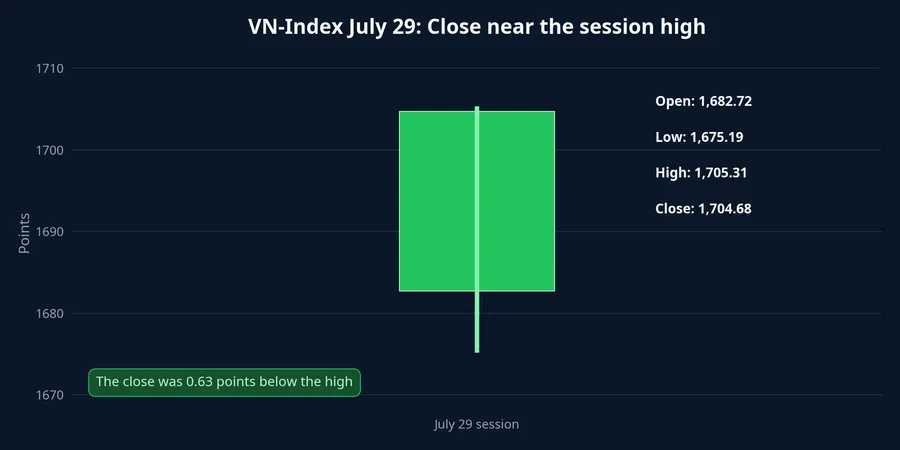
The 0.63-point gap between the close and the high matters. It suggests late profit-taking was not strong enough to pull the index meaningfully away from the top of its range. It is a positive intraday signal, particularly after VN-Index rose only 11.61 points to 1,680.62 on July 28.VTV
Still, a close near the high does not automatically turn 1,705.31 into a tested technical resistance level. A price area earns that status only after the market has reacted around it more than once. For now, it is better viewed as a July 29 reference point: the next sessions will show whether buyers are prepared to transact at this level.
Breadth favored buyers, without a decisive majority
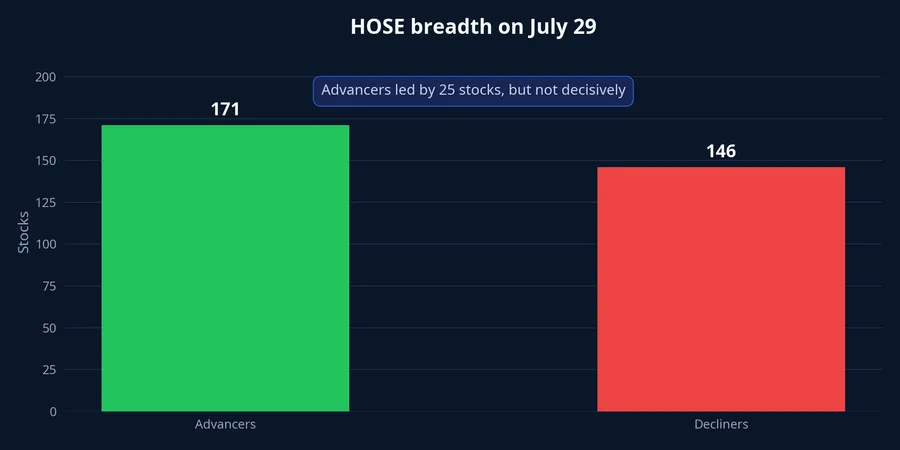
HOSE recorded 171 advancing and 146 declining stocks on July 29, a difference of 25. This was a clear improvement from July 27, when only 77 stocks advanced while 239 declined. Yet 171 versus 146 is not the sort of overwhelming breadth that would make most portfolios likely to move in line with the index.
That distinction explains why an investor’s portfolio can feel different from the headline. Banking names included STB, down 1.38%; VPB, down 1.02%; ACB, down 0.89%; SHB, down 1.75%; and LPB, down 0.37%. A portfolio tilted toward banks could therefore have fallen even as the benchmark gained more than 1%.
Breadth does not invalidate the index’s advance. It answers a different question: how widely was that gain shared? If advancers continue to outnumber decliners, the recovery will have a broader foundation. If breadth contracts, investors should be careful about extending the index’s green close to the market as a whole.
Volume remains the missing confirmation
VN-Index trading volume fell from 778,939,696 shares on July 28 to 560,537,690 shares on July 29, a 28.04% decline from the prior session. Over the same period, the index rose 1.43%. The two observations are not contradictory, but they show the price move was not accompanied by a clear expansion in participation.
Think of liquidity as the number of people genuinely taking part in an auction. Prices can rise when sellers pull back supply even if there are not many new bidders. Another possibility is that funds concentrated in large-cap shares, allowing the index to rise faster than the rest of the market. One session cannot settle which explanation matters more.
Lower volume therefore does not mean the move above 1,700 has failed. It lowers the degree of confirmation. If volume improves while the index holds its newly reclaimed range, the case for fresh demand will strengthen. If it continues to fall, the market will need more time to reveal whether supply is simply thin or buyers remain cautious.
This distinction is useful because turnover is not a verdict by itself. Strong volume can accompany accumulation, but it can also accompany a struggle between buyers and sellers. Weak volume can signal caution, or it can reflect a temporary lack of supply. The cleaner signal comes from the combination: a market that holds its gains, broadens participation, and attracts more turnover gives a more persuasive picture than any single indicator in isolation.
Large caps supplied more than half the index points
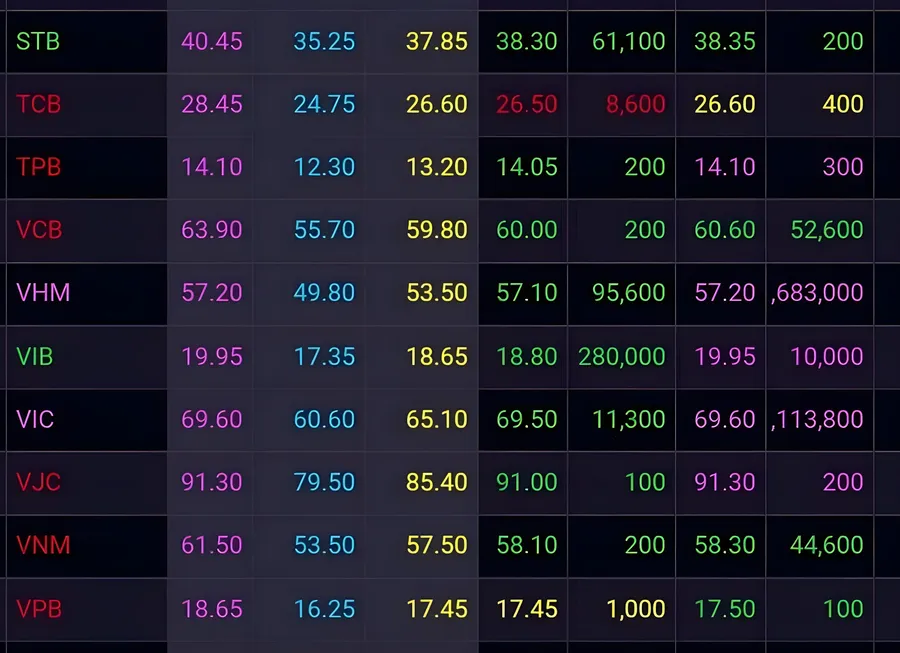
VIC gained 2.62% and VHM gained 6.14% on July 29. Together they added approximately 13.90 points, or 57.77% of the VN-Index gain. FPT rose 3.33%, HPG 3.10%, and MWG 3.58%, providing additional support beyond the Vingroup group.
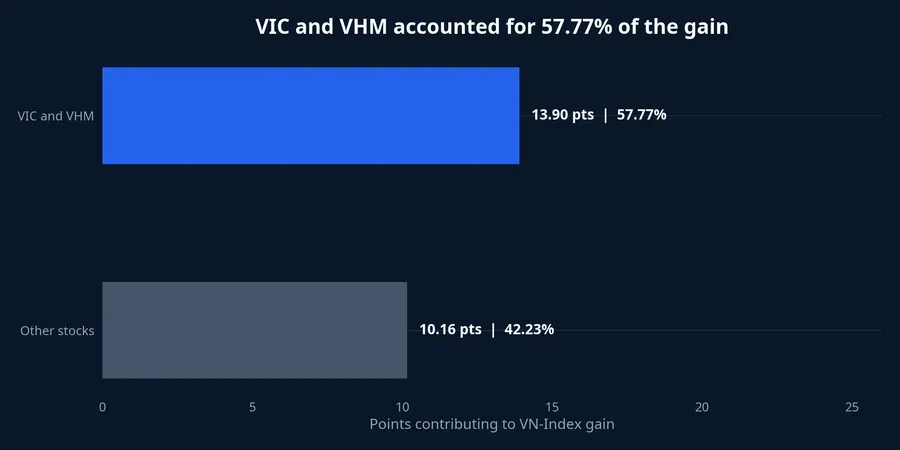
The numbers do not justify calling the advance artificial. VN-Index is capitalization-weighted, so larger companies should naturally have greater influence. But a 57.77% contribution also makes clear that the headline did not represent every sector evenly. The more concentrated the index contribution, the more important it is to check breadth and volume alongside it.
There is not enough evidence to assign the gains in VIC and VHM to one single cause. Flows into large-cap companies may reflect company-specific views, portfolio rebalancing, or index-linked buying. The careful reading is to recognize the concentration in index points, rather than turn coincidence within one session into a certain causal story.
What to read together in the next session
Ahead of this trading week, ASEANSC analysts identified 1,700-1,710 as an area to watch, while Yuanta Vietnam expected the index to trade within 1,640-1,710 during July 27-31.VOV July 29 placed VN-Index directly inside that observation range. That does not create a firm forecast; it sets the market’s next test.
The first signal is the index level. Holding above 1,700 would be more constructive for the rebound, although the round number alone decides nothing. The second is breadth: advancers need to keep outnumbering decliners to show that buying is spreading. The third is volume: higher turnover alongside price gains would help confirm that buyers are willing to pay up.
The order matters. An index can stay firm because a few large names are strong, even when a broad set of shares is not participating. Breadth then tells investors whether the move is reaching beyond those names. Volume adds a further check on conviction. Reading the sequence from price position to breadth and then turnover avoids a common mistake: treating a single closing number as a complete diagnosis of market health.
Conversely, if the index stays above 1,700 while breadth narrows and volume falls again, the move will remain concentrated. A dip below the round number without dominant declines or rising selling volume could merely be a retest of the newly reclaimed range. Risk would become clearer if the index breaks the 1,675.19 low while breadth deteriorates and volume rises on the sell side. That low remains a one-session observation, not a support level confirmed repeatedly.
The present conclusion is straightforward: the rebound has improved in price performance and closing strength, but it has not yet earned confirmation as a durable uptrend. That thesis becomes more constructive only if price position, breadth, and volume improve together. Over the next few sessions, those three signals matter more than whether VN-Index merely sits above a round number.