

PNJ has just faced a very tangible working-capital test. From July 1 to 20, the company reported VND 1,588 billion in revenue while the value of goods repurchased from customers reached VND 5,900 billion. That is not a VND 4,312 billion loss, but it is a gap large enough to make investors examine the timing of cash outflows, inventory inflows, and the eventual return of cash.Znews
It is important not to label the entire amount as diamonds. PNJ described it as total goods repurchased from customers. Nor should revenue be treated as all cash collected on the day, or repurchase value as all cash payable immediately. The more useful question is how the trade-in policy has changed PNJ's cadence of cash and inventory.
What the VND 5,900 billion gap tells us
A repurchase does not make an asset disappear. PNJ exchanges cash, or a payment obligation, for goods that must then be sorted, valued, reworked, converted, or sold again. If turnover is fast, capital returns through sales. If goods stay in inventory, the company must retain more available cash or use credit to keep operating.
The fact that repurchases were about 3.7 times revenue in the first 20 days of July is therefore a signal of absorption capacity, not proof that PNJ lacks cash. It does show how a dispersed capital commitment can become a concentrated demand when many customers seek to sell back at once. With jewellery, conversion back into cash also depends on quality, certification, design, and demand from the next buyer rather than a single centralised price board.

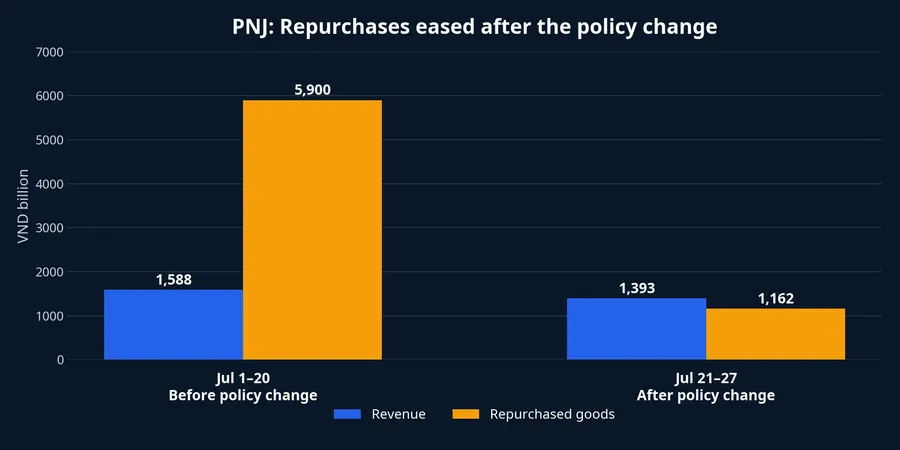
The chart shows a stark difference between two periods, but it does not establish a single cause. The new process is a plausible explanation because it changed payment timing and added a product-conversion option. Customer mix, the value of individual items, and the pace of resale demand during the final seven days may also have mattered. Public data do not yet allow a precise allocation among those factors.
The new process shifts pressure through time
Under PNJ's notice, customers can convert all or part of a repurchase value into another product, or receive cash over 120 days. The first payment is 10% of the repurchase value, with the remainder paid at T+30, T+60, T+90, and T+120. Cash-receipt transactions are accepted from 3pm to 5pm each day at designated stores.PNJ
Mechanically, that means cash need not leave the company in full when goods are received. A customer who chooses another product converts a cash-withdrawal need into a goods transaction; a customer who opts for cash sees the obligation spread over several periods. This supports near-term liquidity, but it does not erase the obligation. The relevant question becomes whether cash inflows and outflows match over the next 120 days.
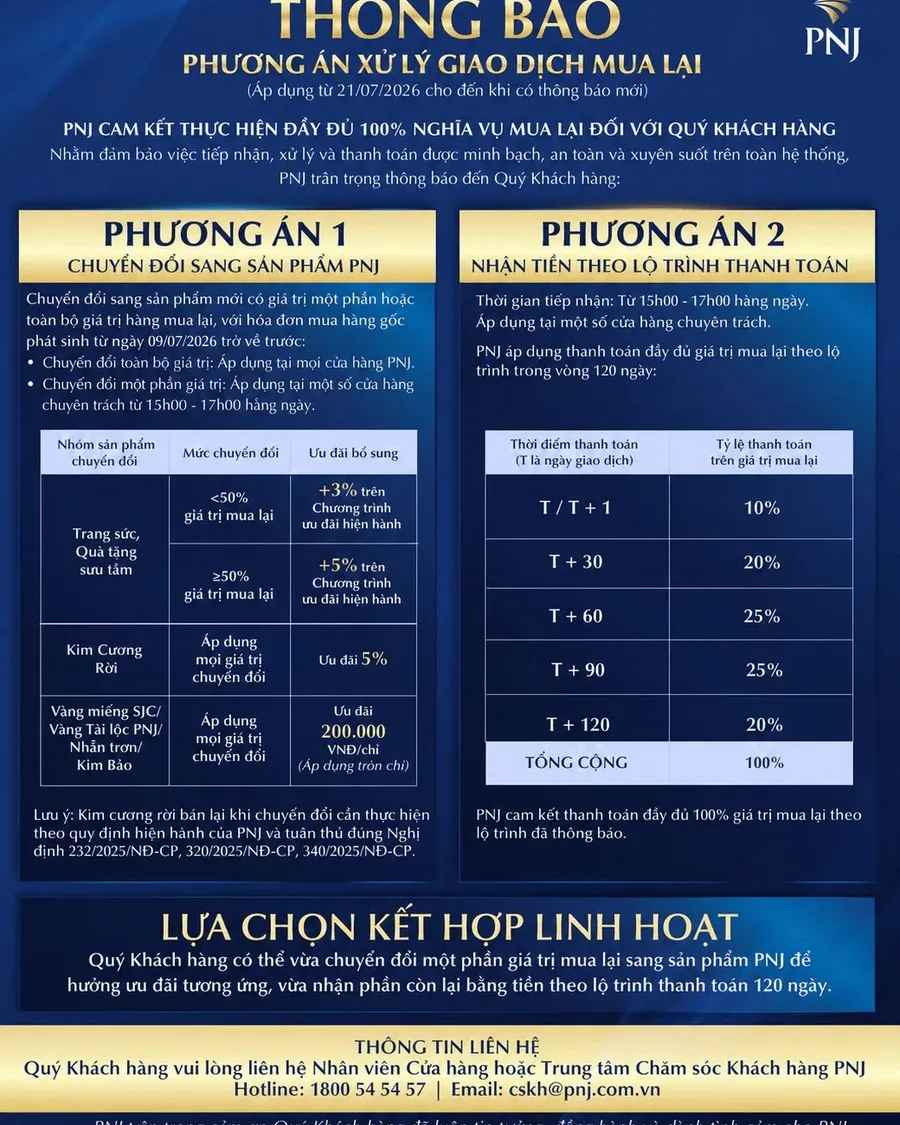
That distinction matters to customers as well. A repurchase policy is a commitment with conditions on location, processing time, and payment schedule. It is not the same as a cash account that can be withdrawn in full, on the same day, at every store. Keeping those ideas separate helps customers assess product liquidity and investors assess the true nature of the working-capital commitment.
Seven better days do not settle the issue
From July 21 to 27, PNJ recorded VND 1,393 billion in revenue and VND 1,162 billion in repurchased goods, VND 231 billion below revenue. PNJ also said 95% of customers selected product conversion. The result indicates that immediate cash pressure eased after the process was adjusted.Znews
The scope of that 95% figure matters. It is a share of customers, not of transaction value; a small group choosing cash could still account for a material amount payable. The disclosure also does not separate fresh-cash revenue from revenue associated with product conversions. Calling those seven days proof that liquidity has fully normalised would therefore go too far.
For the first 27 days of July, PNJ repurchased VND 7,062 billion in goods.CafeF That aggregate has to be considered alongside the 120-day payment schedule, rather than against one week's revenue alone. Matching the comparison window is the best defence against over-reading a brief improvement.
The balance sheet is the next place to look
At the end of the latest quarter in internal data, PNJ held VND 923.54 billion in cash and equivalents and VND 3,586.41 billion in short-term financial investments, for a total of VND 4,509.95 billion. This is a meaningful layer of short-term assets, but the comparison alone cannot establish a cash shortfall: sales cash flow, maturing deposits, credit, and transaction-by-transaction payment timing also matter.
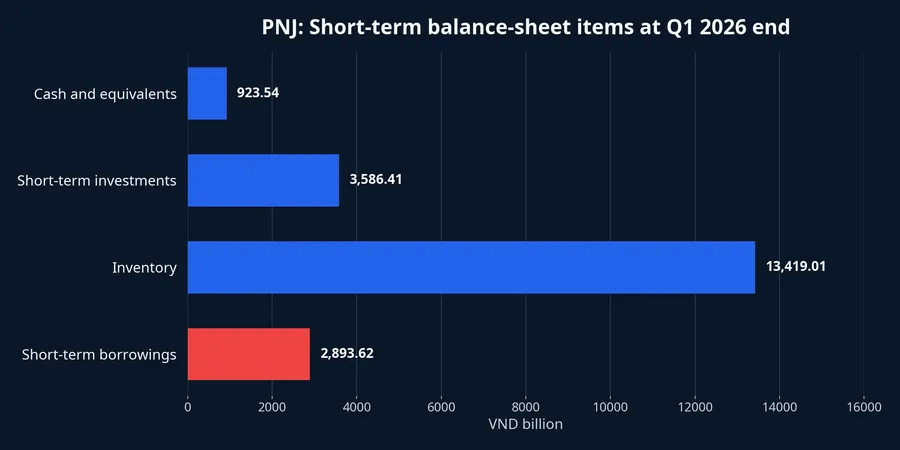
Inventory of VND 13,419.01 billion and short-term borrowings of VND 2,893.62 billion are the notable balance-sheet lines. Operating cash flow for the quarter was VND 3,557.79 billion. These are not interchangeable pools: inventory is not automatically ready cash, while short-term investments can carry their own maturities and withdrawal terms. Together, though, they provide a framework for judging PNJ's capacity after the repurchase wave.
The next financial statements should be read through four checks. First, did cash and deposits fall sharply? Second, did inventory rise because of returned goods, or did it continue to turn over with sales? Third, did short-term borrowing and interest expense change materially? Finally, did operating cash flow continue to track accounting profit?
Conclusion: wait for the next quarterly test
The current thesis is that PNJ's immediate liquidity pressure has eased, but evidence is not yet sufficient to say the pressure has ended. Staged payments and a high share of customers choosing conversion are supportive. Yet cash obligations still extend across 120 days, and the improvement will only be confirmed if cash does not deteriorate materially while repurchased goods turn over.
This is a case for waiting for evidence rather than extrapolating from one week. The next quarterly report, especially changes in cash, inventory, short-term borrowing, and operating cash flow, should show whether PNJ has absorbed the shock or merely moved the pressure into later periods.