


A 9% annual rate is designed to make savers pause. When comparable savings deposits offer less, the difference is large enough to make someone with VND 100 million consider switching products. Yet the first question should not be about the headline rate. It should be whether that money can genuinely remain untouched until maturity.
A certificate of deposit is, in practical terms, an agreement to trade some access to cash for more interest. Not every product restricts early access in the same way, and some offer early settlement, transfer, or pledging as collateral. Still, none of those features automatically turns the certificate into immediately available cash. The central point is simple: the higher rate only makes sense for genuinely surplus funds, after an emergency reserve has been separated out.
A 9% rate is a specific offer, not the market norm
Znews reported on July 28 that VPBank certificates of deposit paid 6.2% to 7.8% a year for purchases from VND 10 million, with terms of one to six months. The 7.3% to 9% range applied to purchases from VND 100 million. The word “up to” therefore matters as much as the 9% figure itself.Znews
BVBank is offering online certificates from VND 10 million. Its end-of-term option pays 8.2% a year for six-, nine-, and 12-month terms, while monthly-interest options pay 7.90% to 8.06%. The stated programme runs from July 17 to December 31, 2026, or until its VND 1,000 billion quota is reached.BVBank
These examples show why comparing offers requires matching the conditions, not merely scanning the highest number. Principal, term, payment frequency, and early-access rules should all be the same before two products are compared. A peak certificate rate against an ordinary savings rate on a different term can make the gap appear more generous than it is.
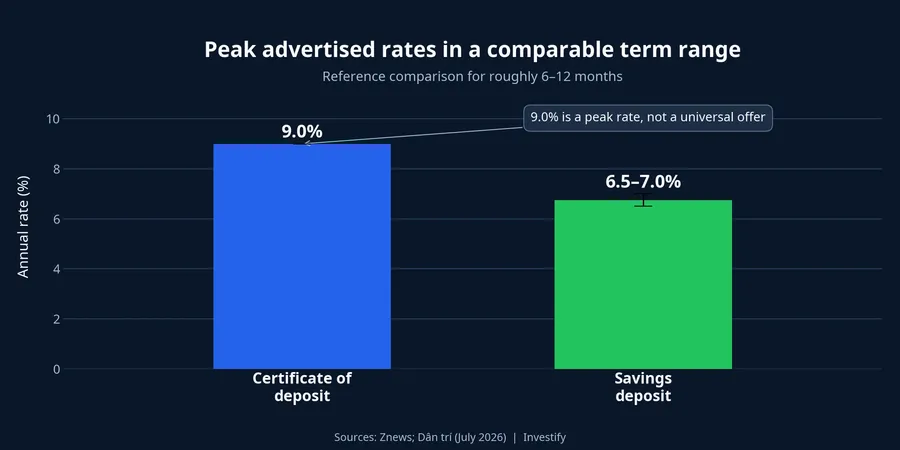
Nor does a 9% headline mean every VND 100 million purchase earns 9%. Rates can vary with the issuance date, balance tier, payment method, and promotional quota. An advertisement is useful for identifying an offer, but it is not a substitute for reading the product terms before funds are transferred.
How much extra interest is actually on the table?
Consider an illustration rather than a promised return. If VND 100 million qualifies for 9% a year and stays invested for six full months, simple interest is about VND 4.5 million. At a reference savings-deposit rate of 6.5% to 7.0% a year for a similar term range, six-month interest would be about VND 3.25 million to VND 3.5 million.Dân trí
The difference is therefore VND 1.0 million to VND 1.25 million. That is meaningful money, especially with larger principal or repeated placements. But it also identifies the real choice: the saver is receiving a limited payment for accepting less room to manoeuvre over six months.
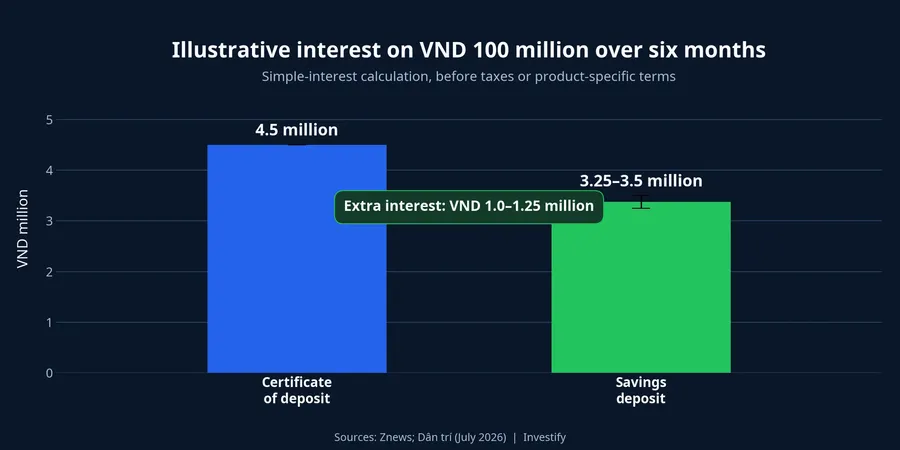
The calculation has boundaries. It uses simple interest, assumes the full term is completed, and does not include the individual rules of a particular issue. If cash is needed early and the holder must take consumer credit, pledge the certificate at a borrowing cost, or transfer it under unfavourable conditions, the additional VND 1.0 million to VND 1.25 million can disappear quickly. The higher yield is compensation for a constraint, not a free gain.
Early access is where product labels start to matter
Savings deposits commonly permit early settlement. Under the rules on early withdrawal interest, the amount withdrawn early earns no more than the institution’s lowest demand-deposit rate at the time of withdrawal; whether part of a deposit can be withdrawn while the remainder keeps its existing rate depends on the product agreement.Government Portal
With certificates of deposit, the relevant document is the terms for the exact issuance being purchased. Znews noted that early settlement may receive only demand-deposit interest or incur a fee, depending on the product. Some products instead use transfer or pledging arrangements rather than direct withdrawal.Znews
BVBank says its online product can be settled early, transferred, and used as collateral. ACB also highlights transfer of certificates of deposit through the ACB ONE app. Those are useful features, but the effective interest, processing time, fees, and documentation should be checked just before purchase.BVBankACB

Transfer does not mean a guaranteed instant withdrawal. It means selling ownership to another party. Pledging the certificate is also a loan secured by the certificate, not the return of the deposited funds. Both can be workable in a particular circumstance, but neither should be treated as a replacement for an emergency fund that can be used immediately.
Deposit insurance and emergency cash solve different problems
VND-denominated certificates of deposit held by individuals at participating institutions fall within deposit insurance coverage. From July 13, 2026, the maximum payout is VND 350 million for insured principal and interest combined, per depositor at a participating institution.Deposit Insurance of Vietnam
That protection matters, but it should not be confused with personal liquidity. Deposit insurance addresses a situation in which the receiving institution triggers an insurance payout obligation. Paying for a medical bill, a vehicle repair, or an urgent expense next month depends on available cash and the early-access clause. An insured product is not automatically an emergency reserve.
Put the certificate in the right cash bucket
For new investors, the clearest method is to sort money by purpose before comparing rates. Funds set aside for unexpected expenses should prioritise access. Funds with a defined use date that will not disrupt the cash plan are better candidates for certificates of deposit.
Then read four lines in the terms: minimum purchase, term, interest-payment method, and the treatment if cash is needed early. If transfer or pledging is available, ask who buys the certificate, what loan rate and fees apply, and how long the money takes to arrive. Those answers determine whether 9% remains attractive after the value of access to cash is included.
It is also worth separating a rate comparison from a prediction about future rates. A certificate that pays more today does not make it a universally better home for cash; it simply offers a stated return under stated conditions. Product terms and advertised rates can change between issuances, so an earlier promotion should not be assumed to apply to a new purchase. For a saver, the practical task is narrower: match the maturity date to a real cash-flow date and make sure the emergency reserve remains outside that commitment.
The conclusion is not that certificates of deposit are always superior, or that savings deposits are always safer. A higher rate is reasonable compensation when money can stay until maturity. When funds may be needed early, access is often worth more than the interest difference. Before deciding, the most useful signal is the current terms of the exact product, not the largest number in its advertising.