

Ford has raised its 2026 earnings outlook, but the important point is not the revised range by itself. The second quarter showed that the company could improve economics per vehicle even as revenue and wholesale volume declined. The missing step is to turn the recovery in F-Series supply into actual margins and cash flow in the second half.
The thesis is straightforward: Ford's core operations have improved, but the higher outlook is only confirmed if Ford Pro recovers as the aluminum bottleneck eases. This is not a story of accelerating revenue. It is a test of the earnings quality of Ford's core truck and commercial-vehicle franchise.
Lower volume, stronger economics per vehicle
Ford reported second-quarter revenue of USD 48.3 billion, down 4% year on year, while wholesale volume fell 12% to 1.039 million vehicles. Yet adjusted EBIT reached USD 2.5 billion, USD 0.4 billion higher than a year earlier, and adjusted margin rose from 4.3% to 5.2%.
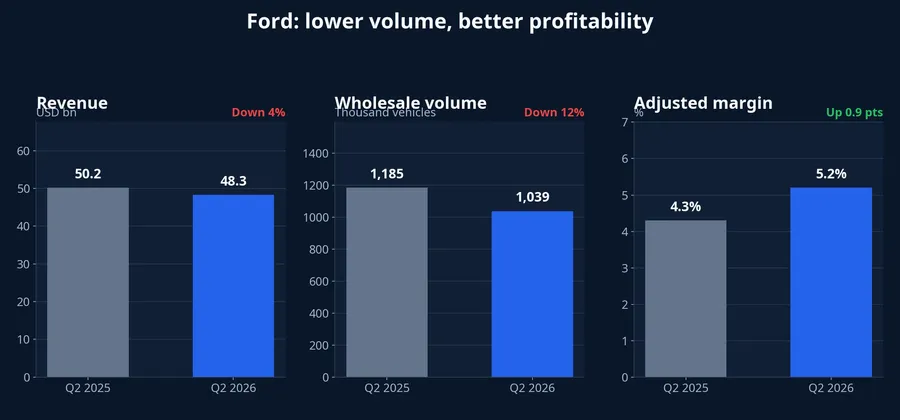
That combination is unusual: sales volume shrank while the share of revenue retained as profit improved. It suggests that mix, pricing and cost management offset part of the volume shortfall. It should not, however, be read as proof that Ford has fully solved its supply-chain problem. One quarter of better margins demonstrates resilience under pressure; it does not establish how repeatable those margins will be when volume normalizes.
The GAAP result adds another layer. Ford posted a net loss of USD 1.3 billion after USD 4.2 billion of special pre-tax charges, including USD 3.6 billion tied to its exit from the BlueOval SK battery joint venture and USD 0.5 billion for cancelled EV programs. Those charges explain why adjusted profit and reported net income point in different directions. Both matter: adjusted EBIT describes current operations, while the accounting loss shows that Ford's EV strategy reset still carries a material cost.
F-Series matters through two profit pools
Ford does not disclose F-Series revenue or profit on a stand-alone basis. It would therefore be inaccurate to attribute all of Ford Blue or Ford Pro to one truck family. The better approach is to watch the two businesses where F-Series has an important influence: Ford Blue, which serves retail internal-combustion and hybrid customers, and Ford Pro, which serves commercial clients.
Ford Blue generated USD 26.1 billion of revenue, up 1% year on year. Its EBIT climbed from USD 661 million to USD 1.135 billion, lifting margin from 2.6% to 4.4%. The figures are consistent with a helpful mix of higher-value trucks and SUVs. The disclosure does not isolate the contributions from price, trim mix and cost, though, so it would be an unsupported leap to assign the entire gain to F-Series.
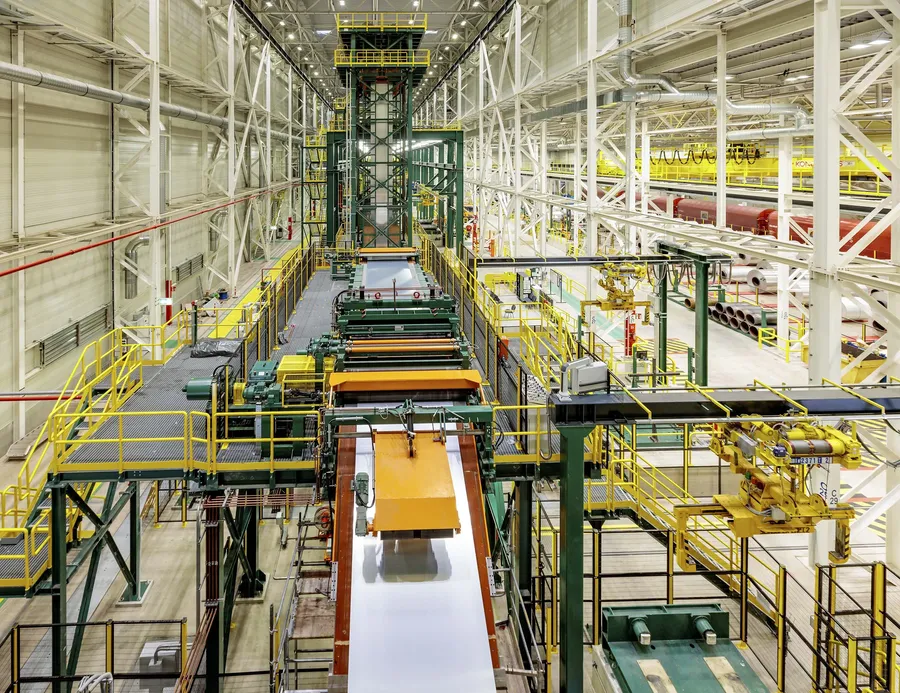
Ford Pro is the more consequential watch point. Its revenue fell 5% to USD 17.8 billion, while EBIT declined USD 600 million to USD 1.718 billion. Margin consequently slipped from 12.3% to 9.7%. Ford said the commercial business was still recovering from temporary aluminum-supply constraints at Novelis. This is the clearer evidence of earnings that have not yet returned, because Ford Pro is the most profitable part of the company's automotive operations. It also makes the segment a better validation test than a company-wide revenue number: a recovery in deliveries matters most when it restores the segment that carries the highest margin.
The second half is the test of the higher outlook
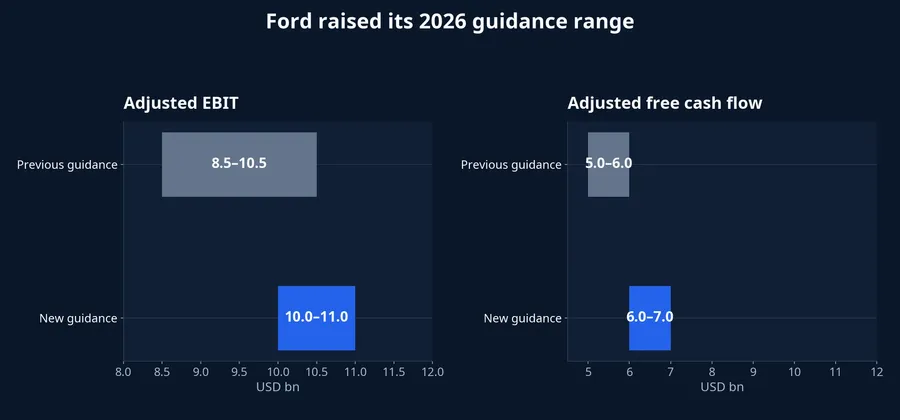
Ford raised its full-year adjusted EBIT range from USD 8.5–10.5 billion to USD 10–11 billion. Its adjusted free-cash-flow range moved from USD 5–6 billion to USD 6–7 billion. The USD 1 billion increase in the EBIT midpoint is large enough that later reports need to supply operating evidence, not just reiteration.
Most of the logic behind the update sits in the second half. Ford expects roughly USD 1 billion of favorable year-on-year profit impact from Novelis, and it aims to cut about USD 1 billion in material and warranty costs. Those savings are expected to offset approximately USD 1 billion of additional investment in its affordable EV platform and Ford Energy. Put simply, having trucks available to ship is not enough. Ford needs to ship them at a mix, price and cost level that restores Ford Pro profitability. If volume recovers but incentives, input costs or warranty expenses rise in tandem, the net benefit may fall short of the base case. By contrast, a Ford Pro margin recovery alongside Ford Blue holding near 4.4% would be far more persuasive than a volume figure alone. The comparison matters because it separates demand from execution: unit availability can rise quickly, but profitable fulfillment depends on the cost and pricing discipline that follow it.
Cash flow needs to be separated from one-off items
Ford generated USD 4.3 billion of operating cash flow and USD 2.1 billion of adjusted free cash flow in the second quarter. This matters because margin expansion that does not turn into cash is not enough to establish operating quality. The full-year free-cash-flow forecast, however, includes an expected USD 500 million tax refund in 2026, related to an IEEPA tax refund recorded in the first quarter. The refund is real cash if it arrives on schedule, but it is not recurring cash generated by vehicle sales. When tracking progress toward USD 6–7 billion, readers should separate cash generated by sales and working capital from the tax component. That distinction matters especially for a company simultaneously reshaping EV output and investing in a new platform.
Ford Model e still posted an EBIT loss of USD 919 million in the quarter, although the loss narrowed by USD 410 million from a year earlier. Ford currently expects the business to lose about USD 4 billion for the full year. Ford Blue and Ford Pro therefore remain responsible for funding much of the transition. Truck and commercial margins are not merely a short-term scorecard; they directly affect the company's ability to fund its longer-term strategy internally.
What would confirm the thesis
The base case is that Ford has demonstrated improved core profitability, while the raised outlook must be validated by Ford Pro and free cash flow in the second half. U.S. vehicle demand, input costs, warranty expense, tariffs and geopolitical shocks could all change the outcome. Ford said its outlook does not include a significant escalation in the Middle East, a sharp U.S. economic downturn or new, unannounced tariff changes. Three indicators in the next report matter most: Ford Pro's margin, conversion of earnings into adjusted free cash flow, and progress on material and warranty costs. If they improve together, the USD 10–11 billion outlook will have clearer operating support. If volume rises while margins and cash do not follow, the market will have reason to treat the revised outlook as an expectation still awaiting delivery. These signals test execution, not availability alone.