


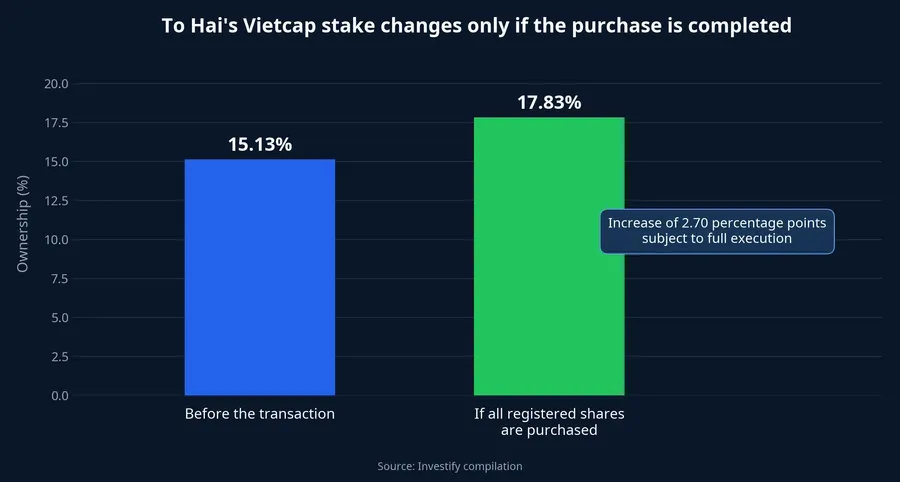
A registered share purchase can reshape expectations within hours. Yet the most important detail in VCI's case is easy to miss: To Hai does not currently own 17.83% of Vietcap. That is the prospective stake if the disclosed transaction is fully completed.
VCI rose to its daily ceiling of VND 19,700 per share during the morning session on July 28 after the registration became public. The price move shows that the market regarded the signal as meaningful. But a signal is not an outcome. The central point is simple: the registration changes expectations; the completed-transaction report and subsequent business performance determine whether those expectations are justified.
The ownership figure depends on execution
To Hai, a Board Member of Vietcap Securities JSC (VCI), registered to buy more than 31 million VCI shares from August 4 to September 2, through either order matching or negotiated deals. The stated purpose is personal demand.VietnamBiz
Before the transaction, he held more than 174.3 million shares, or 15.13% of Vietcap's charter capital. If fully executed, his holding is expected to exceed 205.3 million shares and his stake is expected to rise to 17.83%, an increase of 2.70 percentage points.VietnamBiz “If fully executed” is not a minor qualifier. It is the condition behind the entire 17.83% figure.
The roughly VND 573 billion value often attached to the registration also needs context. It is calculated from the July 27 closing price of VND 18,450 per share, not a settled purchase price or cash already deployed.VietnamBiz In an order-matching transaction, the actual cost depends on the prices at which orders are filled. In a negotiated deal, it also depends on the terms agreed by the parties.
For newer investors, the sequence matters: registration, execution, then the results report. An insider can buy all, part, or none of the registered amount. Only the report filed after the trading window closes can establish how many shares changed hands and what the new ownership stake actually is.
The price moved quickly, but it has more than one possible driver
VCI rose to VND 19,700 in the July 28 morning session, up 6.78% from the prior close of VND 18,450. More than 10.5 million shares traded during the morning session.VietnamBiz After a limit-down session on July 27, a large insider purchase registration naturally gave buyers a reason to return.
Still, assigning the entire move to that disclosure would go beyond the evidence. VCI had fallen from VND 23,400 on July 14 to VND 18,450 on July 27, a decline of about 21.15%.VietnamFinance After a move of that size, bargain buying, less selling pressure, and short covering can all contribute to a fast rebound.

The available data supports a timing relationship: the registration appeared as the shares recovered strongly. It does not establish a single causal explanation. A ceiling-price session therefore does not confirm that the transaction will be completed, nor does it independently confirm a sustained price trend.
Second-quarter profit was driven by margin lending
The numbers show a clear earnings bright spot at Vietcap. Second-quarter operating revenue was nearly VND 1,176 billion, up about 1.4% year on year; pre-tax profit was VND 270.8 billion, up 28%; and net profit was VND 250.6 billion, up more than 36%.Kinhdoanhnet When profit grows much faster than revenue, the source of the difference deserves attention.
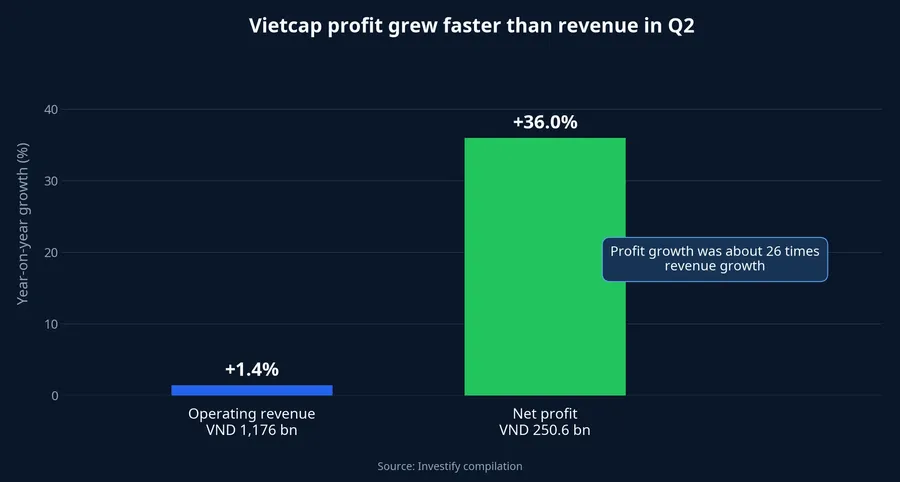
Interest income from loans and receivables reached VND 463 billion, nearly 80% higher than a year earlier. At the end of June, margin loans stood at VND 16,646 billion, equivalent to approximately 0.97 times equity.Kinhdoanhnet That was a more direct contributor to quarterly profit than brokerage.
Brokerage remains important to market position, but the figures do not identify it as the profit engine. Brokerage revenue rose 2% to VND 225.7 billion, while brokerage expense increased nearly 16% to VND 185.7 billion. The direct spread declined by roughly 34% to nearly VND 40 billion.Kinhdoanhnet
For the first half, Vietcap reported VND 591.3 billion in net profit, up 23.5% year on year. Pre-tax profit was nearly VND 675 billion, or approximately 29% of its VND 2,300 billion full-year target.VietnamBiz Results improved, but a substantial share of the annual target still depends on the second half.
The portfolio valuation cushion has narrowed
The balance sheet supplies a second lens. At the end of June, Vietcap's available-for-sale financial asset portfolio had a cost of about VND 12,243 billion and a market value of more than VND 14,047 billion. The pre-tax unrealised gain remained about VND 1,804 billion.Kinhdoanhnet
That figure is still positive, so it should not be described as a net loss on the portfolio. It had, however, narrowed from nearly VND 3,368 billion at the start of the year, reducing unrealised gains by around VND 1,563 billion in six months. Other comprehensive income from the portfolio revaluation was more than VND 432 billion negative in the second quarter.Kinhdoanhnet
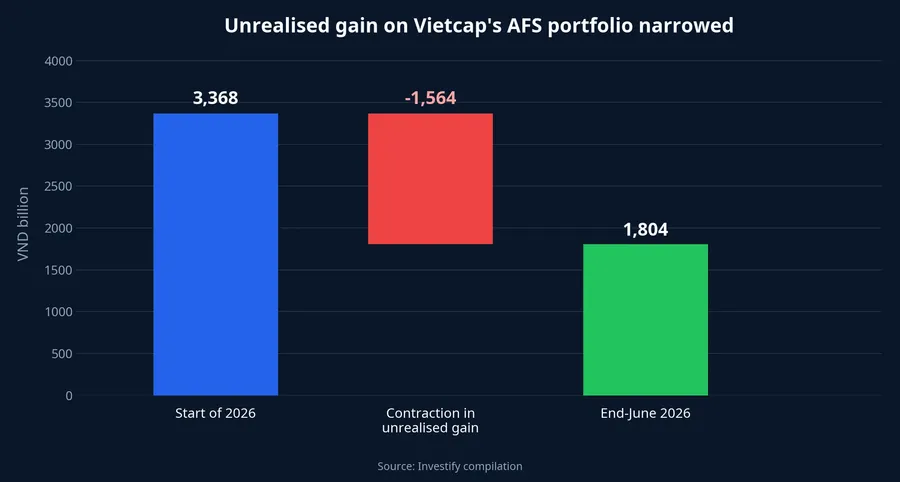
Both observations can be true at once. Quarterly operating profit rose, while the valuation cushion in equity narrowed. Looking only at earnings misses the portfolio movement; looking only at the portfolio misses the increasing contribution from margin lending.
What will validate the narrative
The conclusion is not to turn one ceiling-price session into an investment call. The purchase registration is a constructive indication of intent, but the 17.83% stake remains prospective until the results report is filed. Current evidence is insufficient to assign the price move to one cause or infer what comes next.
Three signals matter over the coming weeks. The transaction report will reveal whether Hai bought the full registered amount. Second-half earnings will show whether Vietcap can improve its progress toward the annual plan. Finally, the portfolio revaluation gap should be read alongside profit to assess the balance sheet more completely.
That is a cautious, not pessimistic, framework: separate intent from outcome, price reaction from a single asserted cause, and current-period profit from the health of the whole balance sheet. For VCI, the completed-transaction report is the next decisive confirmation point.