

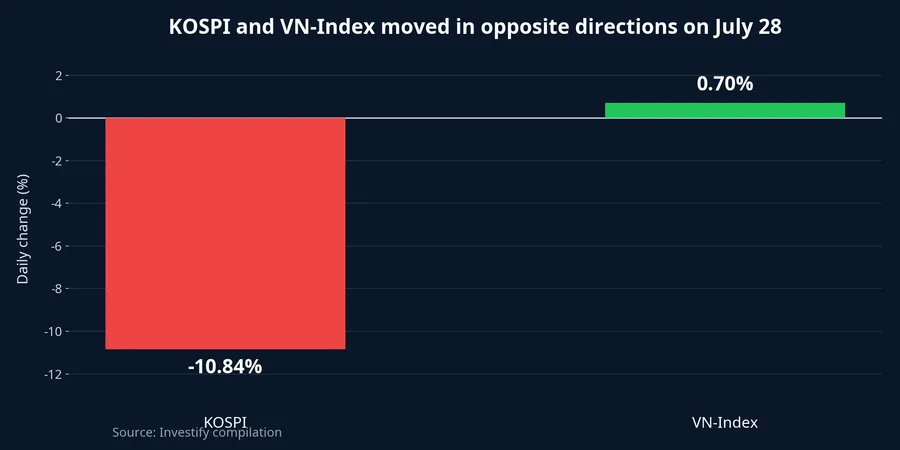
On July 28, the KOSPI closed 10.8% lower at 6,023.66, while the VN-Index gained 0.70% to 1,680.62. The same-day contrast invites an easy conclusion: Vietnam was stronger, or protected from the chip-stock sell-off. That goes further than the evidence allows. What the two benchmarks really show is that an index's colour first reflects the stocks carrying the greatest weight inside it.AP
Think of an index as a weighted scale. The larger a company's market capitalisation, the more its share-price move can tilt the result. A headline index level is therefore useful for seeing direction, but it cannot by itself explain where the force behind that direction came from.
That distinction is especially useful for first-time investors. A rising index does not mean that every listed company rose, just as a sharp index fall does not mean that every business in the economy deteriorated at once. To judge whether a session is healthy, readers need to put the index level beside its composition, its leading groups, the number of rising and falling stocks, and trading volume.
KOSPI was hit in its heaviest area
KOSPI is calculated on a market-capitalisation basis. Large companies therefore do not have the same influence on the aggregate as small ones. Vietnam's VN-Index works in the same broad way. The important difference is that a shock can travel through each market at a very different speed when it strikes a concentrated sector.KRX
On July 28, selling landed squarely on chipmakers. Samsung Electronics fell 13.4% and SK Hynix lost 14.7%. Both companies have meaningful weight in KOSPI, so double-digit drops in both were not merely stock-specific events. They had an immediate, amplified impact on a benchmark already sensitive to the semiconductor group.AP
The decline was not simply a handful of heavyweight shares making the board look worse than it was. South Korea recorded 878 declining stocks, 36 advancers and three unchanged issues. That breadth indicates selling across most of the market rather than a technical distortion caused by only a few large names.Daum
Breadth matters because it separates two very different situations. In one, a few dominant stocks pull an index lower while the rest of the market is relatively stable. In the other, weakness is shared by a large majority of stocks. July 28 resembled the second case in Korea: the heavyweight chip sell-off mattered greatly, but it coincided with a much broader retreat.
News about competition in memory chips was cited as the immediate trigger. Still, the evidence does not justify assigning the entire fall to one development. AP also placed the session after a strong run in many artificial-intelligence-related shares. The more careful reading is that new information met high expectations and sensitive valuations, then the index's heavy chip exposure magnified the selling.AP
What supported the VN-Index
The VN-Index gained 11.61 points on the same day. On HOSE, 200 shares rose and 140 fell. That is not overwhelming breadth, but it is materially different from broad-based selling in Seoul. It suggests that Vietnam's advance involved more participation than a single very large stock lifting the benchmark.
SSI rose 4.55%, HPG gained 3.19%, MWG added 3.00%, MSN increased 2.82%, and MBB rose 2.31%. These names span securities, steel, retail, consumer goods and banking. The list is not the entire market, but the sector mix helps explain why support was more dispersed than a one-theme move.
VN-Index trading volume reached 805,989,839 shares, approximately 28.5% higher than on July 27. When prices rise, advancers outnumber decliners and volume improves, the signal usually has a better foundation than an advance driven only by a few heavyweight shares. One session cannot confirm a new trend, however. Volume becomes informative only alongside breadth and the behaviour of leading sectors in subsequent sessions.
The VN30 gained 0.99%, more than the VN-Index. That detail shows that large caps remained the principal force. The accurate reading is not that the benchmark rose entirely because of broad participation. Rather, large caps performed well while HOSE breadth also leaned positive. Both facts can be true, and both should be monitored.
The other Vietnamese boards offered a reminder not to treat the VN-Index as a complete portrait of domestic equities. The HNX-Index rose only 0.04%, while the UPCoM-Index fell 0.41%. The strength was therefore clearer on HOSE and among large caps. This does not weaken the evidence of improving HOSE breadth; it simply sets the right boundary for the claim.
This is not a resilience contest
The July 28 divergence does not prove that Vietnam is immune to risks behind the South Korean chip sell-off. The two markets were not exposed to the same direct shock. KOSPI came under pressure in a sector dominated by very large semiconductor companies, while the VN-Index does not have a comparable group of memory-chip businesses. Ranking the two markets' resilience from one trading day would miss the mechanism that produced the index moves.
This is also why correlation should not be mistaken for causation. The two benchmarks moved differently on the same date, but that alone does not establish that a particular Vietnamese sector offset a Korean shock. Several explanations can coexist: the industry mix is different, the leading Vietnamese shares had their own buyers, and local breadth was more constructive. The available evidence supports describing the contrast, not claiming a precise causal contribution from any one factor.
Nor should Vietnam's positive session be dismissed. Constructive breadth and the participation of several sectors make July 28's green close more substantial than a session pulled up by one stock. Yet “more substantial” does not mean “durable.” For newer investors, this distinction matters: a promising signal needs to be tested; it is not a reason to ignore risk.
Read the next session through three layers
First, watch breadth. If advancers continue to outnumber decliners and improvement extends beyond the VN30, buying interest is reaching more of the market. If the index remains positive while most shares reverse lower, the point gain will be less persuasive. This is a straightforward way to avoid equating a green index with a healthy broad market.
Second, watch rotation among sectors. A healthier market allows securities, banks, retail or industrial names to take turns supporting the tape rather than requiring the same few stocks to carry every point. It does not require every sector to rise at once. The useful question is whether capital moves into another group when one cools.
Finally, examine the relationship between price and volume. An advancing index with sustained volume and positive breadth often indicates genuine buying participation. An advance with shrinking volume, weakening breadth or increasingly concentrated leadership points to a thinner foundation. These are tools for understanding a market, not a trading formula.
The central conclusion from July 28 is structural. KOSPI fell sharply because selling struck its heaviest group and then spread widely. The VN-Index rose with support from several large-cap sectors and better breadth, although large caps still led. Vietnam's session was encouraging on internal quality, but it is not evidence that the market has detached from regional risk. The next sessions will show whether breadth, rotation and volume can sustain that foundation.