

A $5.5 billion figure can make it sound as if Johnson & Johnson has bought finality in its long-running talc litigation. That is too quick a reading. On July 27, J&J announced a proposed resolution with a maximum payment of $5.5 billion for most remaining US claims alleging that talc products caused ovarian cancer. It is a meaningful shift because it gives an open-ended litigation risk a clearer monetary frame and a proposed payment path.Johnson & Johnson
What it does not establish is a final obligation. J&J has made the proposal conditional on participation by law firms representing at least 95% of the remaining claimants, and on court approval. For investors, these are not minor legal footnotes. They are the line between a conditional proposal and a liability sufficiently settled to model as the final cost to the business.
A large number with a defined perimeter
J&J describes the proposal as addressing most existing US ovarian-cancer claims. The company continues to deny that its talc products cause cancer or contain asbestos. A settlement therefore does not amount to a scientific or legal admission on every claim. It is a way to trade the uncertainty of protracted, individual litigation for a conditional cap on cost.Johnson & Johnson
That distinction matters more than the headline number. A deal can contain much of the current claim set without placing every talc-related dispute into the same bucket. The company says the proposal does not resolve future claims. It also says it has resolved about 95% of filed mesothelioma cases, state consumer-protection claims and supplier disputes. These are legally distinct groups and should not be added together to declare that all talc risk has disappeared.Johnson & Johnson

This is the easy point to miss when a headline says “settlement.” Settlement is not an absolute state. It has a covered population, conditions for effectiveness and a perimeter outside the agreement. Without separating those three layers, readers may mistake $5.5 billion for a price tag on every risk. The announcement does not make that claim.
The 95% test is the proposal's operating condition
The 95% threshold is not a public-relations target. It is the mechanism by which J&J seeks to reduce the number of cases that would otherwise continue separately. If firms representing at least 95% of remaining claims opt in, the company can reasonably expect a large share of existing litigation to be handled under one framework. If the level is not reached, the proposal does not satisfy the condition J&J announced.Johnson & Johnson
High participation reduces fragmented litigation risk, but it does not make the remaining 5% disappear. Non-participating claims may still require individual treatment, and future claims are outside this package. The real risk is interpretive: investors may see a high percentage and forget the contingent nature of the arrangement. Broad consent is encouraging evidence, not a release from every possible lawsuit.
The useful monitoring list therefore extends beyond the $5.5 billion headline. Watch the progress of consent, the court's approval terms and the exact scope of claims released. Those questions distinguish a deal that reduces uncertainty from one that genuinely closes most of the docket. The current announcement gives a clear maximum commitment, but it does not complete the other two answers.
For a first-time investor, the practical distinction is between a ceiling and a completed payment. A ceiling tells you how far a negotiated obligation could extend if its conditions are satisfied. It does not tell you that every claimant has accepted, that every release has taken effect or that the cash has been paid. Reading legal-risk announcements through those stages prevents a large headline figure from being treated as either a guaranteed loss or a guaranteed resolution.
A change in legal route, not proof of outcome
J&J says the talc dispute has lasted roughly 15 years. In earlier phases, the company attempted to use a subsidiary bankruptcy process to centralize claims. Those efforts did not deliver the intended outcome, and J&J has now moved to direct negotiations with leading plaintiffs' firms in federal and state courts.Johnson & Johnson
It would be an unsupported leap to say that the changed route proves the new proposal will succeed. The evidence only establishes a change of mechanism: J&J has moved from an attempt to centralize litigation through bankruptcy to direct settlement of existing claims. The approaches differ in procedure, claimant choice and completion conditions. That difference is exactly why the 95% threshold is central this time.
From a risk-management perspective, the new route has a clear potential benefit. It lets the company negotiate a payment limit and schedule with representatives of claimants rather than face a sequence of hard-to-predict trial outcomes. But that benefit becomes real only if the conditions are met and the court approves the agreement. A procedural change should not be mistaken for a final result.
An accounting reserve is not cash already paid
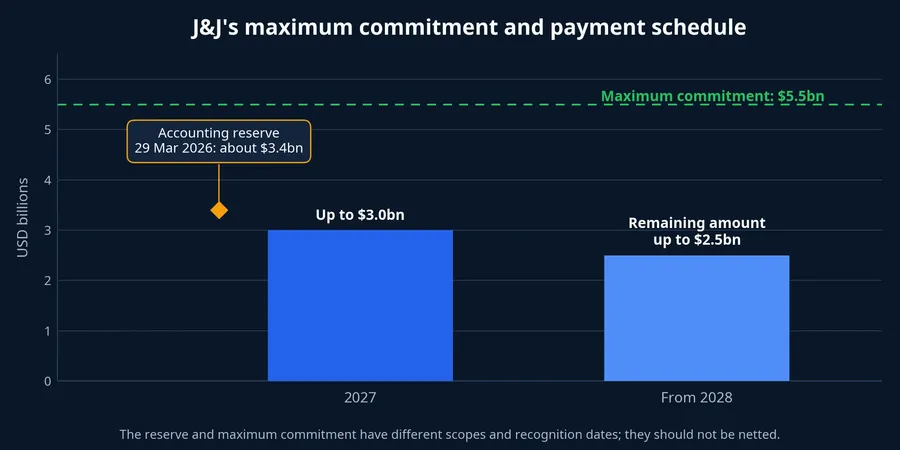
To assess the financial impact, separate three items that are often blended together: the maximum commitment, the accounting reserve and actual cash payments. In its latest quarterly filing, J&J reported a present value of about $3.4 billion for talc-related reserves as of March 29, 2026. The amount includes signed settlements, legal-defense costs and other related charges, with about one-third recorded as a current liability.Johnson & Johnson
It is not valid to subtract $3.4 billion directly from $5.5 billion and call the difference an incremental cost. The two figures have different scopes and recognition dates. A reserve is an accounting estimate at a reporting date. The new commitment depends on participation, approval, allocation and payments by claim. J&J itself says it cannot precisely predict the timing, final outcome or financial impact of the proposed resolution.Johnson & Johnson
The payment schedule needs the same discipline. J&J expects the first payment, capped at $3.0 billion, in 2027, with no subsequent payment due before 2028. That does not make the economic cost disappear. It means cash does not leave the company all at once when the proposal is approved.Johnson & Johnson
The monitoring list matters more than the immediate reaction

The thesis is narrow but clear: J&J is turning a long-running legal risk into a more measurable obligation, not eliminating that risk. That is better than a situation with no proposed cap or payment path. It remains a conditional conclusion because crucial legal variables have not yet been completed or tested in practice.
The next disclosures should be read for the 95% representation threshold, the approval decision and J&J's legal-liability note. After that, investors can assess changes to reserves, any special charge and cash payments from 2027. If those milestones develop as proposed, uncertainty should keep narrowing. If any condition stalls, $5.5 billion should still be read as a bounded proposal, not the final bill.