
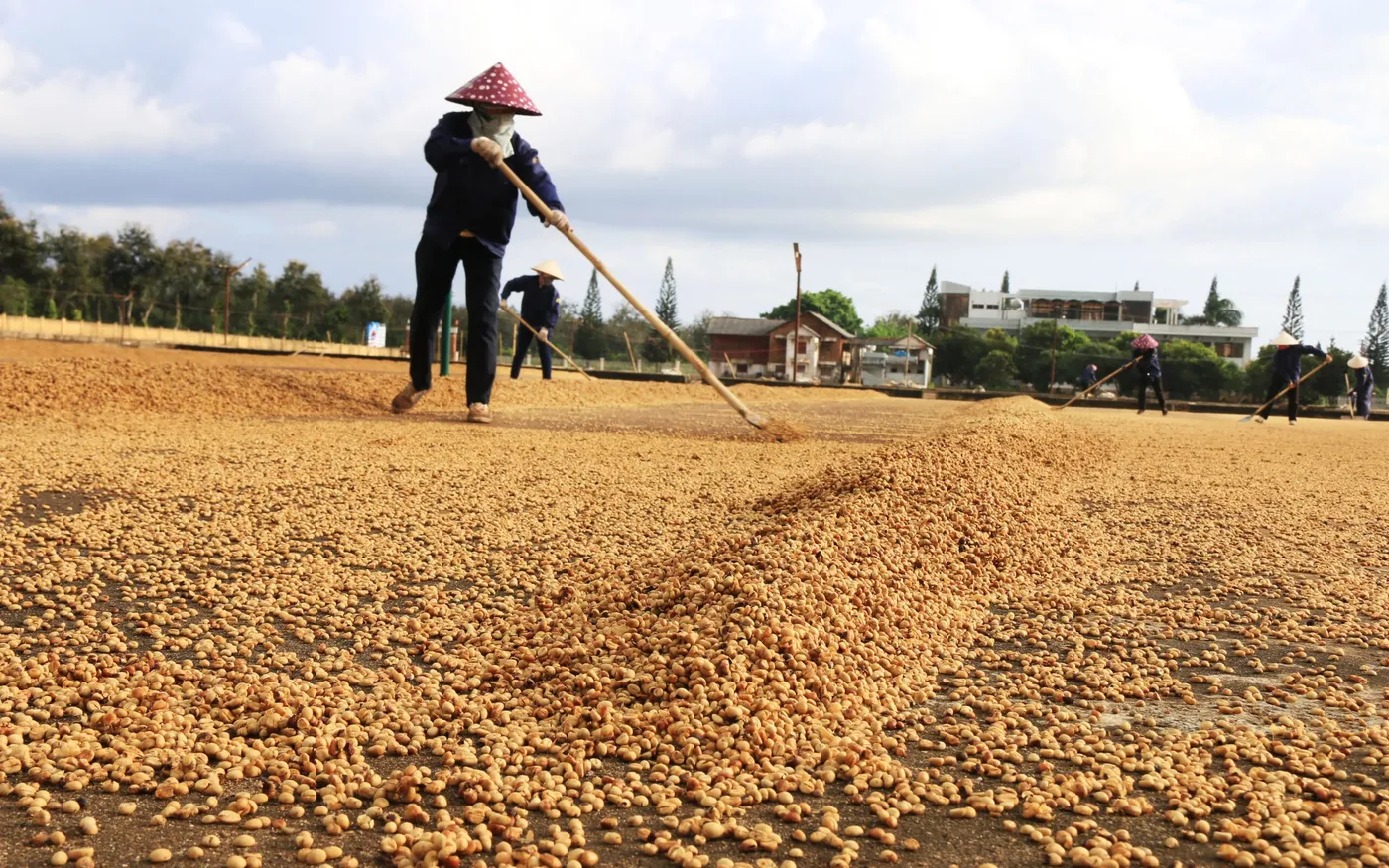

On July 28, the coffee benchmark stood at 338.50 US cents per pound, up 4.3% on the day and 23.9% from June 26. That does not mean forecasts for a large Brazilian crop were wrong. It highlights a distinction that is essential in commodities: an expected harvest and coffee available for prompt delivery are not the same thing.
Think of a crop that has ripened in the field. A production forecast estimates how many beans the trees can yield over the season. A near-term market instead needs to know how many beans have been picked, dried, processed, quality-checked, warehoused and made ready for sale. When any of those post-harvest stages slow down, a large crop on paper does not immediately become price-lowering supply.
The central point is straightforward: the market is responding to usable short-term supply, rather than crop size alone. That does not eliminate the prospect of lower prices once Brazilian coffee reaches the market more steadily. It explains why that pressure was not fully visible by late July for market participants.
A large crop is not the same as coffee ready to sell
Brazil matters greatly to arabica, the variety commonly referenced through New York futures. Harvest progress there is therefore more than an agricultural statistic. It is an indicator of how quickly fresh supply can enter the delivery chain.
In Cooxupé's operating area, the latest harvest progress was 47.3% of planted area, below 59% at the same point last year and the five-year average of 58.3%. Across Brazil, Safras estimated that 64% of the crop had been harvested by July 16, versus 77% in the same period of 2025 and a five-year average of 70%.The AgriBiz
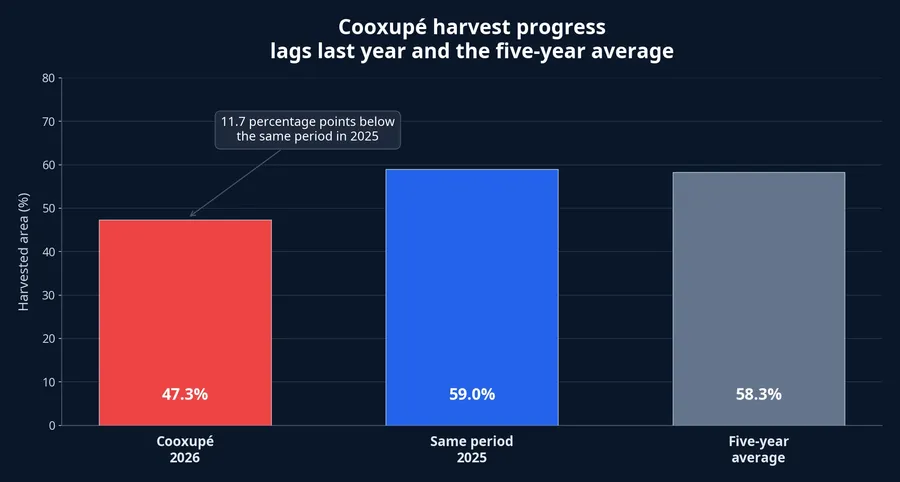
That gap does not mean Brazil has suffered a crop failure. It means that new-crop coffee is moving through the first gate more slowly than usual. In a market that needs standard-grade coffee for delivery, the timing of supply can matter as much as the total number of beans available at the end of the season.
This is why a production forecast should not be read as an inventory report. Forecasts address seasonal potential; inventories and harvest progress address current availability. They are complementary data sets, but they are not substitutes.
For a new investor, this distinction also prevents a common analytical shortcut. A headline about a bigger crop may describe the direction of supply over a full season, while a futures contract can be pricing a much shorter delivery window. Reading both the calendar and the condition of available coffee makes the apparent contradiction easier to understand.
Rain slows the entire post-harvest chain
Rain does more than make picking difficult. High humidity can slow drying and processing as well. If cherries fall to the ground or beans dry unevenly, sorting becomes more demanding and the share that meets trading standards can be affected.
Itaú BBA, as cited by The AgriBiz, said heavy June rain slowed harvesting, drying and processing. It also flagged quality concerns in South Minas, Cerrado Mineiro and Mogiana Paulista because of fallen cherries. On July 27, Safras & Mercado still reported that rain and high humidity were delaying harvesting and affecting arabica quality.The AgriBizSafras & Mercado
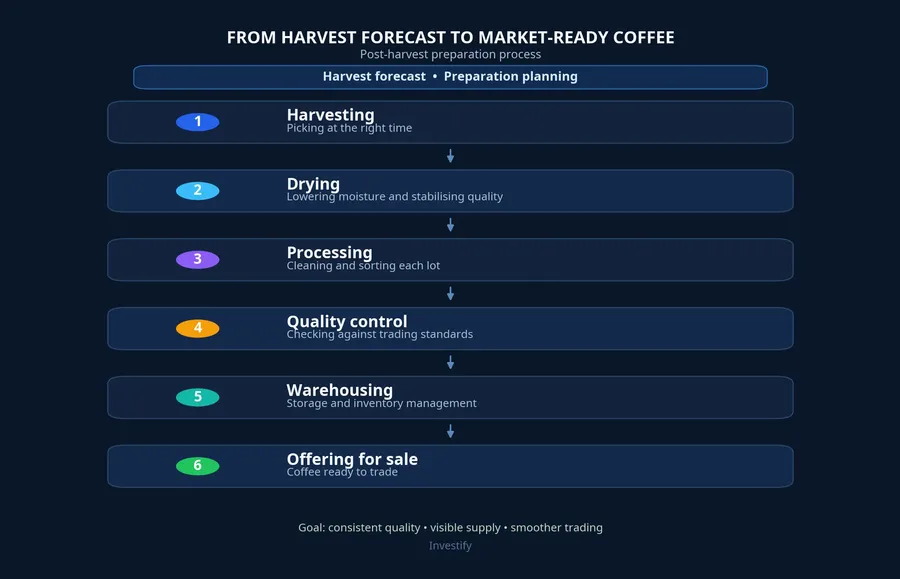
It is important not to overstate this mechanism. Rain does not mean the whole crop has been lost. The immediate effect is delay and a risk to quality, both of which can ease if drier weather returns and processing catches up. Price action should therefore not be assigned to weather alone; this is a mechanism supported by physical-market data, not the only explanation.
The post-harvest chain also explains why prices can move sharply even when the seasonal supply outlook is constructive. A buyer needing coffee near a delivery date cannot replace a certified lot in a warehouse with a production forecast. That time gap is what makes the market so sensitive.
Thin certified stocks amplify sensitivity
A thin stock buffer magnifies the effect of a slow harvest. Safras & Mercado reported that certified coffee stocks at ICE Futures warehouses were 320,615 60-kilogram bags on July 22, down 8,144 bags from the prior day.Safras & Mercado
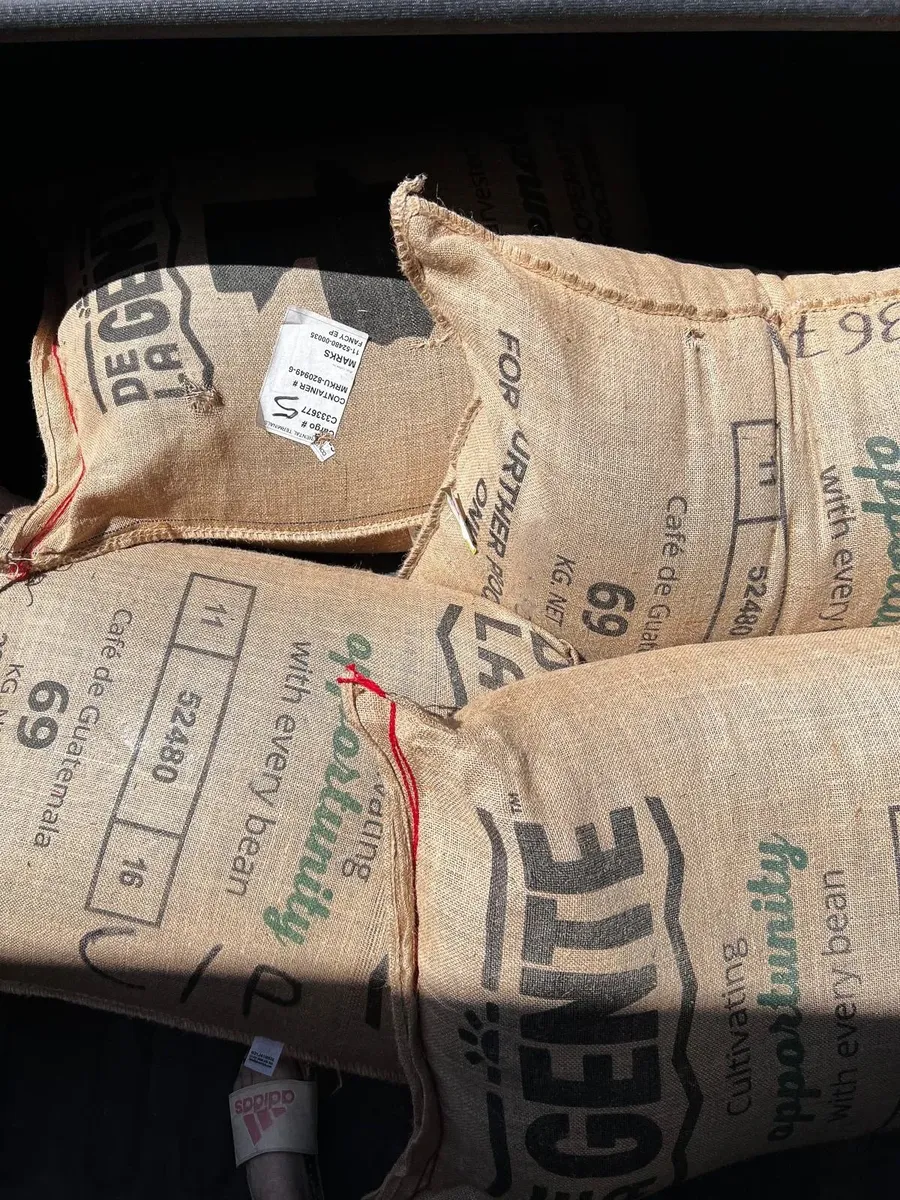
That figure does not prove that the world is short of coffee. ICE inventories cover only part of global supply and serve a specific role in futures delivery. But when that system's eligible supply is thin, headlines about rain, harvest progress or quality can have a larger effect on futures prices.
Brazil's physical market has not suggested that sellers need to release coffee at any price, either. On July 23, Safras & Mercado said trade was close to stalled because buyers' acceptable prices had not met sellers' asking prices.Safras & Mercado This is a snapshot, not proof that growers will withhold supply for an extended period. It does, however, fit the view that harvested coffee is not automatically coffee ready to be sold.
More than one force is moving prices
It would be too simple to say that rain alone drove the rise. Safras & Mercado said the July 27 session also drew support from short-covering by funds and speculators.Safras & Mercado That is a short-term trading factor and can widen price moves beyond what changes in physical supply would imply.
Weather expectations for future crops are another, separate layer of information. They can shape market sentiment, but should not be conflated with observed data on the current crop's progress and quality. Keeping the drivers separate helps new investors avoid treating every daily price move as a lasting shift in supply and demand.
The large-crop outlook remains an important counterweight. Itaú BBA forecast global coffee production for the new crop year at 190 million bags, up 6.1% from 2025/26, while consumption is forecast at 180 million bags, up 3.6%. The report estimated a 9.9-million-bag surplus and global inventories of 26 million bags.The AgriBiz Those are forecasts, not bags already in storage. If new-crop supply flows more evenly, this counterweight could translate into clearer price pressure.
What determines the next phase
The thesis is this: a large crop becomes a downward force on prices only when it is converted into certified supply offered quickly enough to the market. For now, slower harvest data, quality risk and a thin certified-stock buffer are keeping attention on short-term availability. That explains the market's sensitivity, without negating the prospect of greater supply over the crop year.
The key signals for the coming weeks are whether Brazil's harvest progress narrows the gap with normal levels, whether weather becomes dry enough for drying and processing, whether bean quality improves and whether ICE stocks stop declining. Physical trade in Brazil also matters: a narrower gap between buyers and sellers would show that supply is moving more freely. If these indicators improve together, the large-crop forecast will have a firmer route to becoming observable price pressure.