
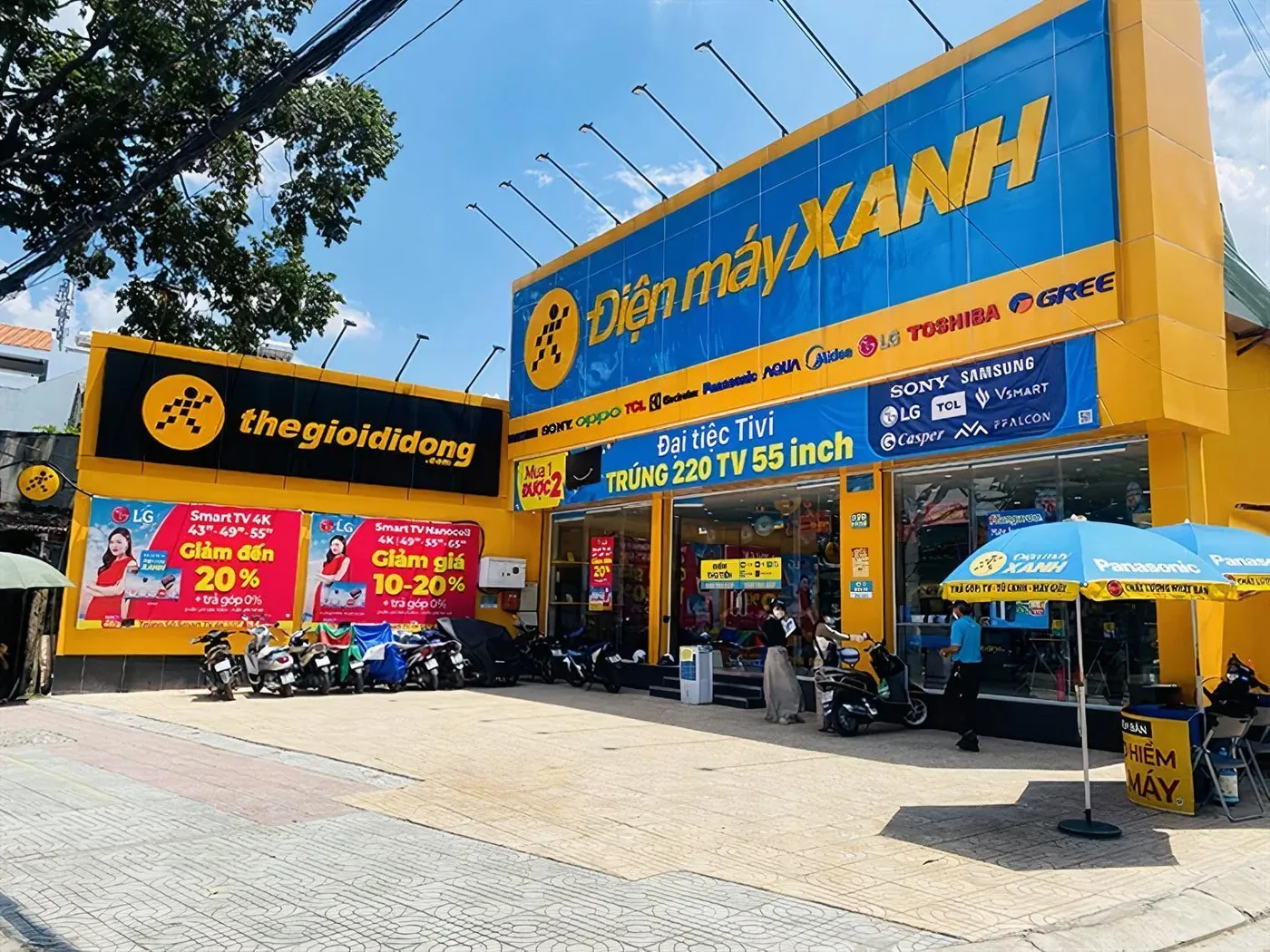

Dien May Xanh's implied value at its reference price is higher than MWG's market capitalization. It is an arresting comparison: if the subsidiary appears larger than its parent, has the market overlooked MWG's value? The intuition is understandable, but it is only the beginning of the analysis. A market-cap comparison is useful only after the numbers are put on the same footing and attributed to the economic interest MWG actually owns.
The current calculation has three separate layers. DMX has received listing approval but does not yet have a traded market price; a reference price is not a price discovered by supply and demand; and DMX's full implied value cannot simply be added to MWG. The central conclusion is therefore straightforward: the gap raises a valuation question worth watching, but it does not establish that MWG is cheap.
Listing approval is not the first trading session
On July 27, the Ho Chi Minh City Stock Exchange approved the listing of nearly 1.27 billion DMX shares on HOSE. The company has also approved a VND 80,000 reference price for its first trading session.Tin nhanh Chứng khoán
Those milestones are often treated as one event, although they mean different things. Listing approval marks a legal and procedural step toward the exchange. The reference price sets the opening benchmark. Only actual matching orders will produce a closing price, turnover, and liquidity that show how the market evaluates DMX.
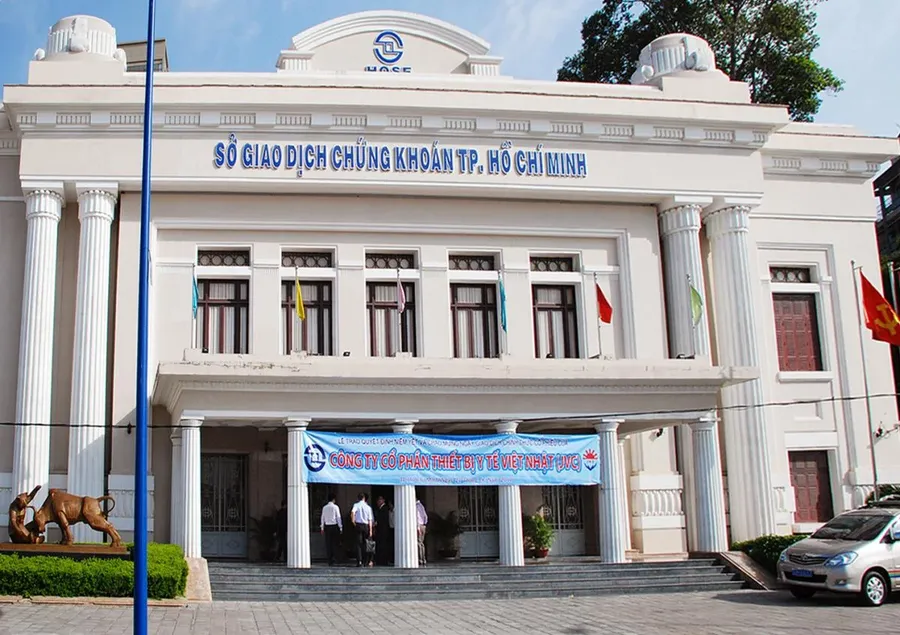
Put simply, VND 80,000 is the start of price discovery, not its outcome. Once trading starts, DMX may trade above, below, or near that level. Calling its value at VND 80,000 a market capitalization today would blur the line between an implied valuation and a price tested by exchange trading.
That distinction matters most to new investors because the same word, “value,” can describe two very different things. One number comes from a stated reference price multiplied by shares; the other is updated through trades that incorporate fresh opinions, liquidity conditions, and uncertainty. Neither is meaningless, but they should not be treated as interchangeable evidence in a valuation conclusion.
What the 8.6% gap does and does not say
At the VND 80,000 reference price, DMX has an implied market capitalization of VND 101,417.76 billion. MWG closed at VND 63,300 on July 27, giving it a market capitalization of VND 93,415.97 billion. On that direct comparison, DMX's implied value is approximately 8.6% higher.Tin nhanh Chứng khoán
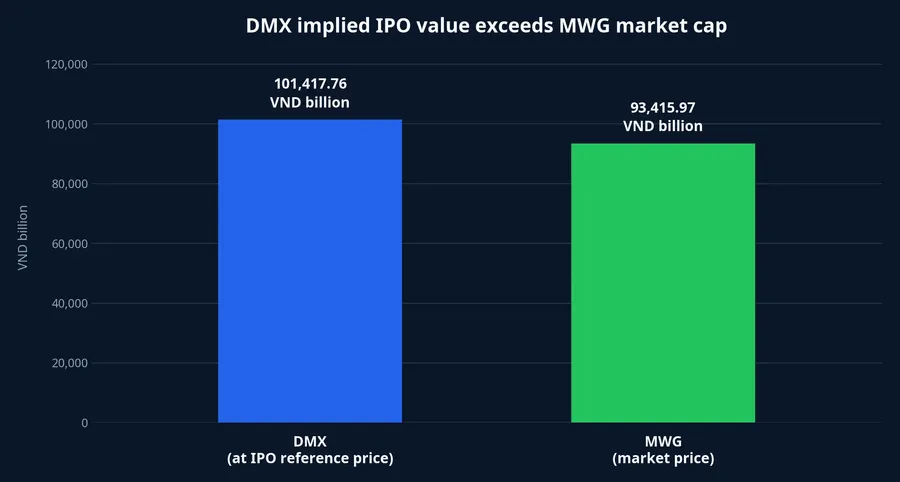
The chart is useful because it makes the numerical gap visible. Still, the two bars do not carry the same type of evidence. DMX is calculated from a reference price before it has traded on HOSE; MWG reflects a closing price formed by buyers and sellers. It is fair to place them side by side to ask a question, but not to label the difference a discount embedded in MWG.
Nor does the higher implied figure automatically validate the IPO reference price as DMX's long-term fair value. It may be a sensible basis from which the market begins its assessment, yet subsequent trading is what will show where investors are willing to value the company. That missing evidence is central to the analysis.
The comparison also needs a consistent date. A parent share price can move daily while the subsidiary is still awaiting its first session. If MWG changes before DMX trades, the apparent gap will change even if nothing has changed in DMX's operating business. This is another reason to view the July 27 calculation as a snapshot rather than a stable verdict.
Use MWG's ownership interest, not DMX's whole value
A sum-of-the-parts valuation does not take the subsidiary's entire market capitalization and compare it with the parent's. The relevant input is the value of MWG's ownership interest in DMX. That ownership percentage should be checked in the post-IPO filings and matched to the same date as DMX's share price, because any change in ownership changes the value attributable to MWG shareholders.
This is a technical point with a decisive practical effect. If a parent owns less than 100% of a subsidiary, the residual belongs to other shareholders and cannot be assigned to the parent. That is why the claim that “DMX alone is worth more than MWG” can mislead: it compares the total value of one subsidiary with the parent's equity value while bypassing the actual economic interest.
There is no need to force an immediate answer from an incomplete model. A useful worksheet can leave the ownership percentage and the subsidiary's traded price as explicit inputs until the relevant filings and market data are available. That is more disciplined than filling the blank with an old figure or assuming that the parent captures every dong of value created at the subsidiary.
The calculation is not finished after that ownership adjustment. MWG has businesses outside DMX, but each requires a separate view of earnings power, cash generation, and funding needs. A growing retail chain may increase revenue while demanding more working capital; a business improving its efficiency may not merit the same valuation multiple as a mature one. Assigning zero value would be as careless as inserting a convenient number simply to make the sum look attractive.

IPO proceeds are not free cash for the parent
Tin nhanh Chứng khoán reported that DMX raised more than VND 13,315 billion in its IPO and intends to use all proceeds to repay bank debt. As of March 31, 2026, DMX's borrowings stood at VND 22,158.89 billion, equal to 110.7% of equity.Tin nhanh Chứng khoán
That context explains why IPO value should not be treated as a pile of cash that can immediately be added to MWG. If proceeds are used to repay DMX debt, the first direct effect is on the subsidiary's balance sheet. It can reduce financial pressure there, but it does not mean the parent instantly receives equivalent distributable cash.
Double counting is an even more common pitfall. Consolidated accounts usually already include a subsidiary's cash, debt, revenue, and assets. An investor who uses consolidated cash and then adds DMX's full value may be counting the same resource twice. A safer framework separates the value of the DMX stake, the value of other businesses, net cash after excluding amounts already captured in the subsidiary, and obligations at group level.
The same discipline applies to debt reduction. Lower debt can improve resilience and affect how the market values a business, but its benefit should be assessed through the changed balance sheet and future financing burden. It should not be recorded once as IPO cash and again as an unadjusted asset value. A sum-of-the-parts model is only as useful as its treatment of these overlaps.
The parent-company discount still matters
Even after DMX begins trading, the value of MWG's stake need not flow in full into the parent's share price. MWG shareholders hold DMX through a corporate layer. Their economic benefit depends on dividends, reinvestment, capital transactions, and the group's capital-allocation decisions.
For that reason, a parent-company discount is not necessarily a market error waiting to disappear. It can reflect access to cash flows, segment-level transparency, corporate costs, and the way management deploys capital. The discount may narrow if post-listing data clarifies value and capital allocation; it may persist if those questions remain unresolved.
The appropriate conclusion today is an explicit wait for confirmation, not a buy-or-sell call. The relevant signals are DMX's actual trading price and liquidity after listing, MWG's post-IPO ownership interest, and the balance-sheet and capital-use plans at both companies. Once those inputs share the same time frame, investors can test whether the gap reflects a reasonable holding-company discount or a valuation opportunity. Until then, the market-cap comparison remains a good question, not an answer.