


LPBank's shareholder list, updated on July 27, points to a change that naturally catches the market's attention: two related individuals now hold a combined 9.859% of its charter capital. That is large enough to create a new centre of influence in the shareholder base. It is not, however, the same as control, nor does it replace the need to read the bank's financial statements.
For newer investors, that distinction matters. A high-profile shareholder can quickly reshape expectations, but voting rights, free float and earnings quality are three separate questions. Start with the number, then separate the mechanisms behind it, rather than turning an ownership transaction into an investment conclusion.
Two separate stakes add up to 9.859%
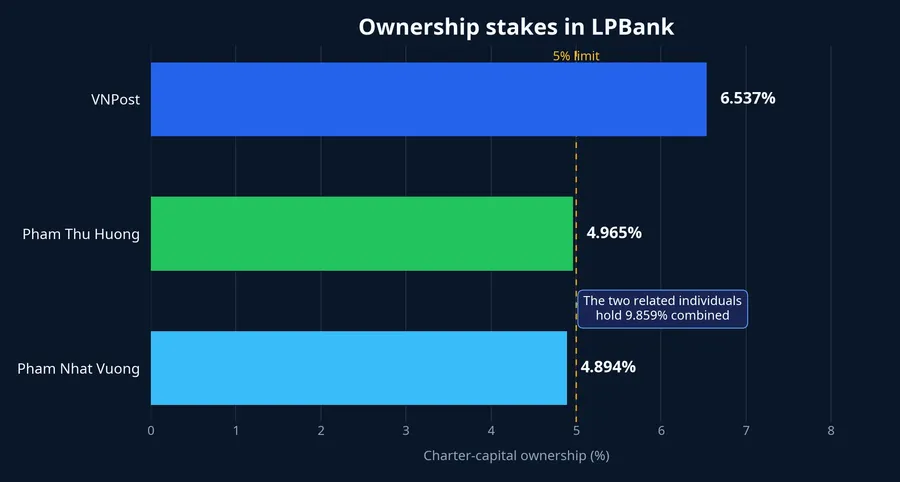
Pham Thu Huong, Vice Chairwoman of the Board of Directors of Vingroup Joint Stock Company, holds 148,313,788 LPB shares, or 4.965% of charter capital. Pham Nhat Vuong, Chairman of the Board of Directors of Vingroup Joint Stock Company, holds 146.2 million shares, or 4.894%. LPBank classifies the two as related persons, so the combined direct stake receiving market attention is 9.859%.CafeF
The important detail is that each holding remains below 5%. In the same disclosure, VNPost holds 195,286,044 shares, equivalent to 6.537% of LPBank. Treating the two individuals as a single shareholder would obscure both the legal structure and the actual ownership rights attached to each name.CafeF
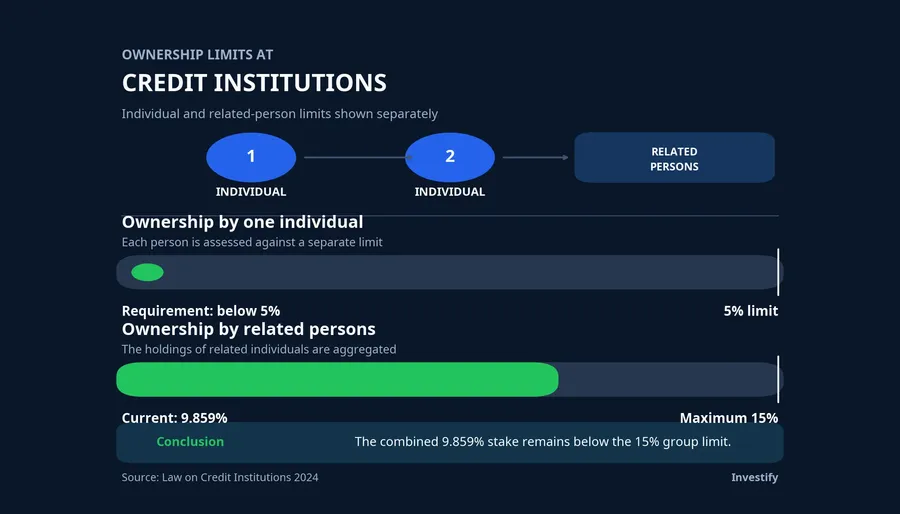
Vietnam's Law on Credit Institutions caps an individual's ownership in a credit institution below 5% of charter capital, while a shareholder and related persons are capped at 15%. On the published figures, both individual stakes sit below the personal limit and the combined holding remains below the related-person limit.Xây dựng Chính sách
Related persons do not become one vote
In simple terms, the related-person designation requires the holdings to be aggregated when ownership limits and disclosure obligations are assessed. It does not turn shares registered in two names into one share or one voting right. Each ordinary share remains attached to its registered holder and the rights that go with it.
If Ms Huong and Mr Vuong exercise their rights as a shareholder group, their 9.859% holding exceeds the 5% ordinary-share condition for nominating people to the board or the supervisory board, unless LPBank's charter sets a lower threshold. That is meaningful influence: a group could bring its voice into the governance process. It still requires coordinated action and the proper procedure; the right cannot simply be assumed from adding two ownership ratios together.Xây dựng Chính sách
Under the law, the right to request an extraordinary general meeting belongs to a shareholder or shareholder group holding more than 10% of ordinary shares, unless the bank's charter specifies a lower ratio. The current 9.859% remains below that statutory marker. Matters such as charter-capital changes, share offerings, mergers or dissolution require even higher approval ratios at a general meeting. The sound conclusion is that ownership has become more concentrated, not that either individual can decide unilaterally.
Free float cannot be calculated by simple subtraction
A common reaction is to take all outstanding shares, subtract the stakes of the named owners, and call what remains free float. That shortcut lacks essential information. Free float also depends on who sold, whether shares face transfer restrictions, the position of insiders and related parties, and the methodology used by each index provider.
Across July 21 and July 23, more than 148 million LPB shares changed hands through put-through transactions, close to the number of shares Ms Huong holds. This was a transfer of existing shares, not a new issuance that increased LPBank's share count.VietnamBiz
There are therefore two plausible outcomes. If the seller's holding had previously counted as freely tradable and the buyer's new stake does not, the free float could decline. If the seller's shares had already been excluded, the effect could be much smaller. Without disclosure of the seller and an updated classification, there is no basis for saying that LPBank's free float fell by exactly 9.859%.

Trading liquidity is not determined by a static ratio alone. The supply actually available for sale, buying interest, the structure of put-through trades and sentiment around a shareholder's name all affect matched volume. More concentrated ownership can make everyday supply thinner, while heightened attention can lift trading activity in the short term. Both forces can be present at once.
The financial statements remain the real test
A shareholder change can create expectations, but it does not automatically improve credit growth, lower funding costs or strengthen debt collection. Vietcap's first-half update put LPBank's pre-tax profit at VND 5,973 billion, down 3.1% year on year, even as total operating income rose 16.8% to VND 11,212 billion. Provision expenses rose 134.9% to VND 1,552 billion, indicating that higher operating income did not flow through intact to profit.Vietcap
That is why a shareholder's name should not replace the core scorecard. Investors still need to read credit growth alongside net interest margin, operating costs, non-performing loans, provisioning and coverage. Only then does it make sense to place those indicators beside P/B, P/E and earnings expectations to understand what the market is pricing into LPB.
This sequence is more than a checklist. Credit growth says whether the balance sheet is expanding; net interest margin shows how much lending and funding are contributing to earnings; provisioning and loan quality test how durable that earnings base is. Valuation ratios are useful only after those operating inputs are clear. A lower P/B, for example, does not by itself show that a bank is inexpensive if expected profitability or asset quality is deteriorating.
The ownership change coincides with put-through activity and market attention, but the available facts do not establish the cause of every move in LPB's share price. In addition to shareholder news, short-term trading can reflect supply and demand, event-driven sentiment and flows into banking stocks. It would be overreach to assign the entire price response to one factor without evidence that separates each factor's contribution.
The thesis: more influence, not instant change in quality
On the numbers, 9.859% is a meaningful increase in ownership concentration and could create a substantial voice if the two individuals coordinate their shareholder rights. Yet it remains short of the statutory thresholds described above, says nothing conclusive about a fixed reduction in free float, and does not directly measure LPBank's operating quality.
The point of this event is therefore not that new shareholder names have transformed the bank. The next disclosures to watch are any board nominations, coordinated voting or a stated cooperation plan. In parallel, the next quarterly financial statements will show whether profit, provisioning and asset quality have changed in a way that supports the new expectations.
Until those disclosures arrive, the disciplined reading is straightforward: treat the ownership change as a governance fact, and keep the bank's operating evidence as the test of value.