


An SJC gold tael is not priced only from the international gold quote converted into Vietnamese dong. It also includes a locally determined premium, plus the gap between the dealer's buying and selling prices. During July 20–25, that domestic layer moved faster than the international base: SJC fell from VND 147.5 million to VND 141.5 million per tael, while world gold rose from USD 4,008.04 to USD 4,051.70 per ounce.Đồng Tháp
Put simply, the two price boards can move in opposite directions without contradicting each other. World gold remains an important base, but the SJC premium over converted world gold narrowed enough to pull the domestic quote lower. For a new investor, this is a more useful framework than assuming that an increase abroad must automatically lift SJC at home.

Two moves in the same week
The opening-week price needs to be placed in context. SJC was selling at VND 147.5 million per tael early on July 20, then at VND 146 million by the end of that day; by the afternoon of July 25, its selling quote was VND 141.5 million.Doanh Nhân Sức khỏe & Đời sống Comparing closing quotes, the decline was VND 4.5 million per tael, or about 3.08%; the VND 6 million figure captures the full path from the first quote of the week to the final afternoon quote.
Over the same dates, market data show world gold rose about 1.48%. The two percentages should not be treated as prices with identical units or identical pricing mechanics; what matters is that they moved in opposite directions during the same observation window. That divergence leads to the key question: which domestic force outweighed the rise in world gold?
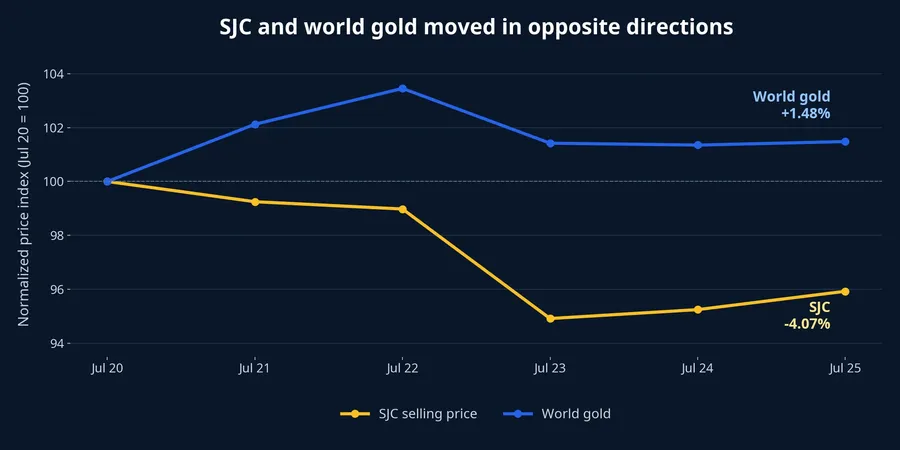
July 23 makes the adjustment especially clear. SJC's selling price fell from VND 146 million to VND 140 million per tael, while its buying price dropped from VND 142 million to VND 135 million from the previous day's close.Thanh Niên World gold also declined 1.96% that day, so it would be wrong to attribute the entire move to domestic conditions alone. The data show only that SJC fell substantially more than the international price during that session.
The calculation includes a domestic layer
Think of the SJC quote as a house with two floors. The lower floor is world gold after conversion into Vietnamese dong. The upper floor is the local premium, where supply and demand, brand, costs and each dealer's pricing all play a part.
On July 20, converted world gold was about VND 126.9 million per tael, against an SJC selling price of VND 146 million. The premium was therefore about VND 19.1 million per tael. By July 24, converted world gold had risen to about VND 128.44 million, while SJC was selling at VND 140.5 million, bringing the premium down to about VND 12.06 million.
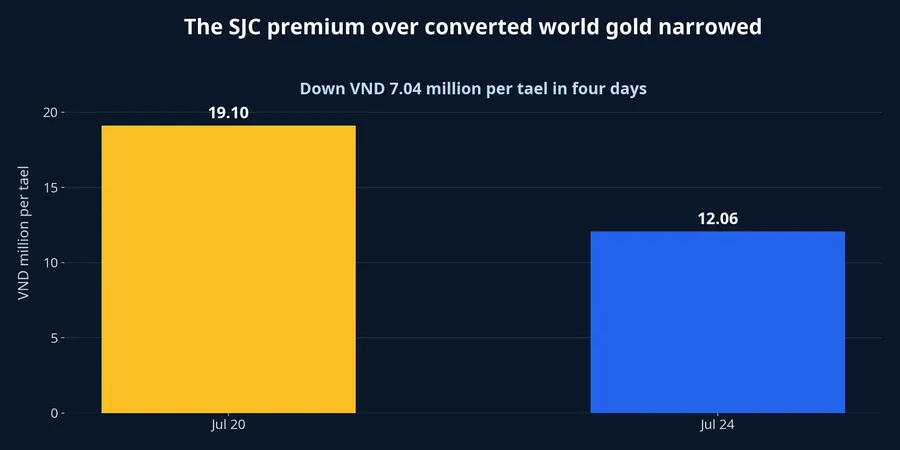
That means the premium narrowed by roughly VND 7.04 million per tael in four days. The contraction was larger than the gain in converted world gold, so the final result was a lower SJC price even as world gold rose. This is an arithmetic explanation of last week's move, not a forecast that the premium must keep falling.
A gold-business representative quoted by Thanh Niên said the July 23 decline was mainly driven by domestic supply and demand, with excess supply putting pressure on prices.Thanh Niên There has, however, been no official disclosure tying the move to a specific new supply of gold bars. The cautious conclusion is that domestic supply-demand conditions and pricing changed; the available evidence does not support assigning the cause to a single action by the State Bank of Vietnam.
The legal framework should not be reduced to a story about one sole source of supply either. Decree 232/2025/NĐ-CP treats gold-bar production as a conditional business activity that requires licensing.Chính phủ That does not mean supply will immediately increase, but it does separate the legal mechanism from the market move observed in a particular week.
Exchange rates are the bridge, not the only answer
World gold is quoted in US dollars, so USD/VND is what converts it into dong. From July 20 to July 24, USD/VND rose from 26,261 to 26,325.5, or about 0.25%. That lift supported the converted base price; it does not explain why SJC fell.
This distinction matters for new investors reading daily headlines. If world gold is unchanged but USD/VND rises, the converted price is still higher; if world gold falls while USD/VND rises, the two forces can partly offset one another. Yet when the SJC premium contracts by several million dong per tael, a small currency move can be completely overwhelmed.
A Federal Reserve headline or a rise in world gold therefore reveals only part of the calculation. The Fed's policy meeting is scheduled for July 28–29, an event that may affect both world gold and the dollar.Kiplinger The post-meeting reaction in gold and USD/VND is the evidence to watch, rather than treating pre-meeting expectations as a settled outcome.
The buy-sell spread is a visible cost
The premium over world gold answers how far SJC stands above the international base. The buy-sell spread answers a more immediate question: how much would a buyer give up by selling back straight away? They are different measures, but both shape the experience of holding a gold bar.
At the July 20 close, SJC bought at VND 143 million and sold at VND 146 million per tael, leaving a VND 3 million spread.Sức khỏe & Đời sống During the July 23 decline, the spread reached VND 5 million; by July 25, the VND 137.5 million buying quote and VND 141.5 million selling quote implied a VND 4 million gap.Đồng Tháp
A wide spread does not predict whether gold will rise or fall. It says that a buyer needs a larger price increase to recover transaction costs on exit. For that reason, a week of lower selling prices alone does not demonstrate that gold has become inexpensive in a way that benefits a buyer.
A monitoring framework for the coming week
Last week's thesis is that the domestic premium, more than the rise in world gold, determined SJC's direction. That thesis remains valid only if the premium keeps narrowing or stays at a lower level. If domestic demand widens it again, SJC could rise faster than world gold even with little exchange-rate movement.
Read three signals together: world gold, USD/VND and the SJC premium over converted world gold. Then look at the buy-sell spread, because it shows the transaction cost confronting a holder. The next few daily quotes will clarify whether the latest premium contraction was a short adjustment or a more durable change in how the market prices gold bars.
The important lesson is not that SJC somehow moved “wrong” relative to world gold. The two boards reflect different layers of information. Understanding the domestic premium, exchange rate and buy-sell spread together helps a new investor avoid putting an entire decision on a single number.