
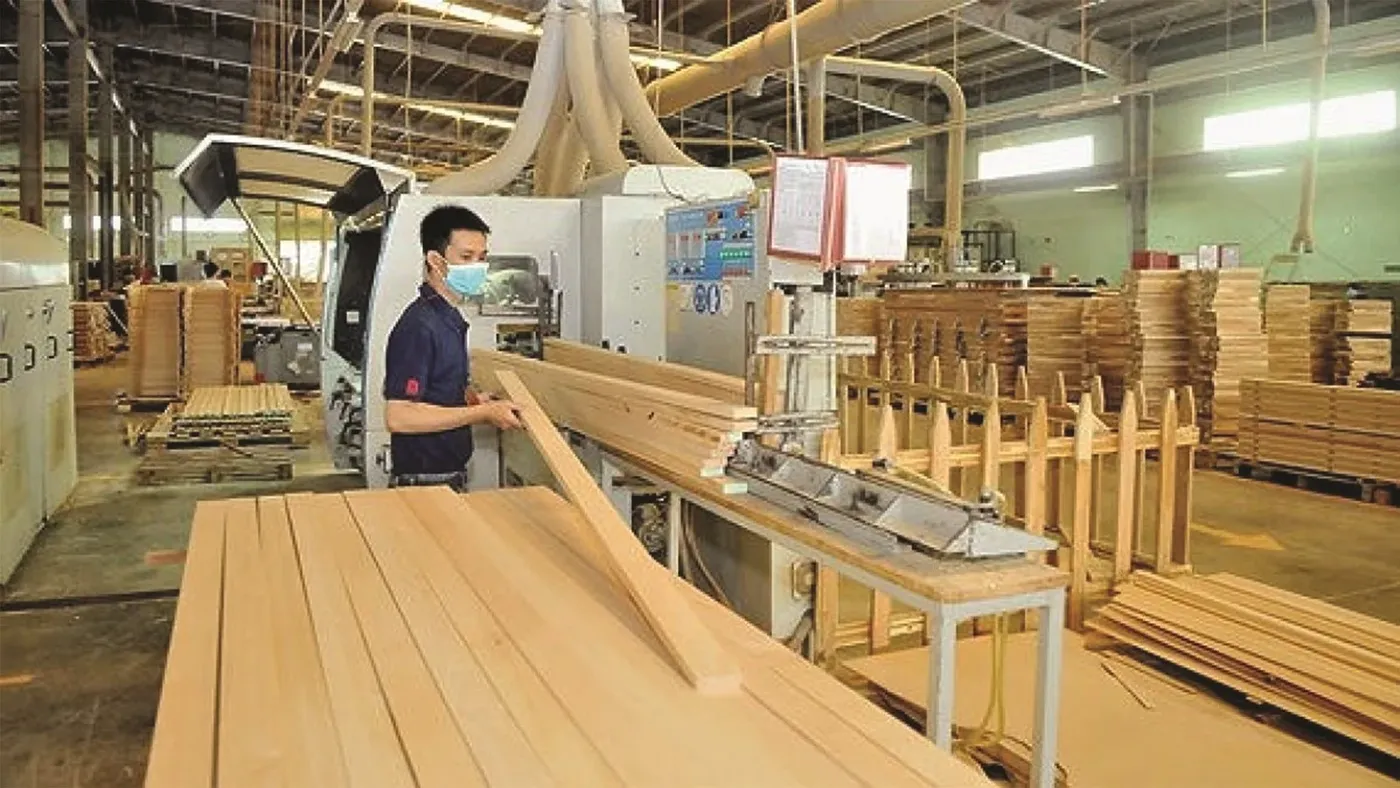

Nearly 5 million hectares of planted forest is a substantial footprint. Yet, from the perspective of a furniture mill, that area does not answer the crucial question: how many trees are wide, stable and traceable enough to become high-value products? Vietnam has scale in planted forests, but that advantage has not translated proportionately into a supply of large-diameter timber for deeper processing.Finance & Investment Newspaper
Put simply, wood chips, pellets and export furniture do not require the same input. A tree may be ready for early harvesting and chipping, but still be unsuitable for sawing into wide, straight and durable boards. Vietnam is not short of trees. The issue is that the material stream remains weighted toward uses that accept small-diameter wood, while deeper processing needs a different grade of timber and a different supply chain.
Forest area is not a measure of usable timber quality
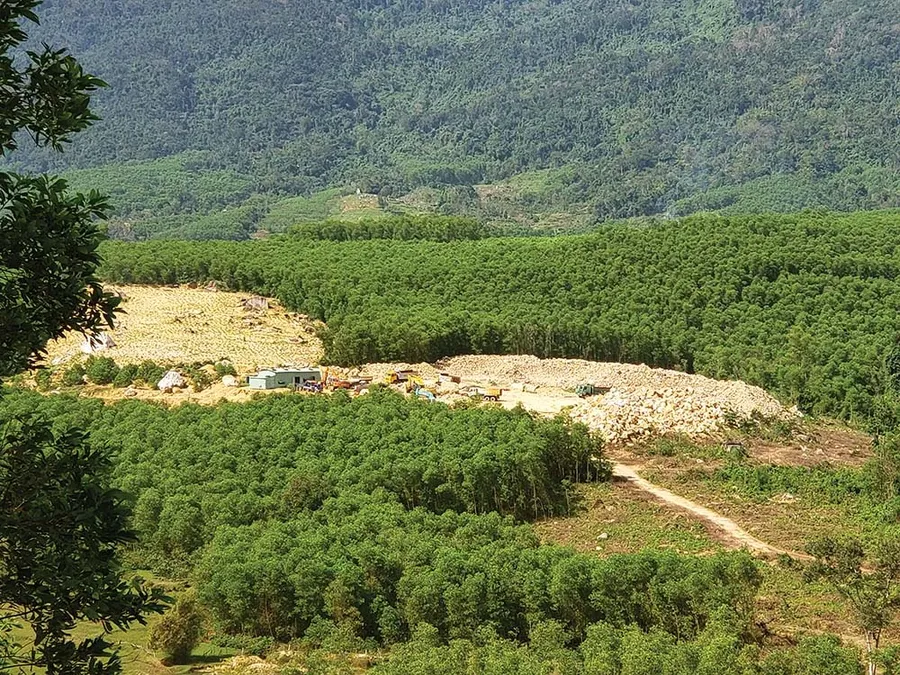
An aerial image of planted forest can make supply look abundant. But area tells us only that trees occupy the land. It says little about stand age, trunk diameter, silvicultural standards or whether a specific lot can fulfil a specific order. Those are the details that shape a log's commercial value.
Data provided by the Vietnam Timber and Forest Products Association put raw-material demand across the main export product groups at approximately 59.5 million cubic metres in 2025. Wood chips and pellets consumed 46.5 million cubic metres, or more than 78%, while export furniture and engineered panels used about 13 million cubic metres.Finance & Investment Newspaper
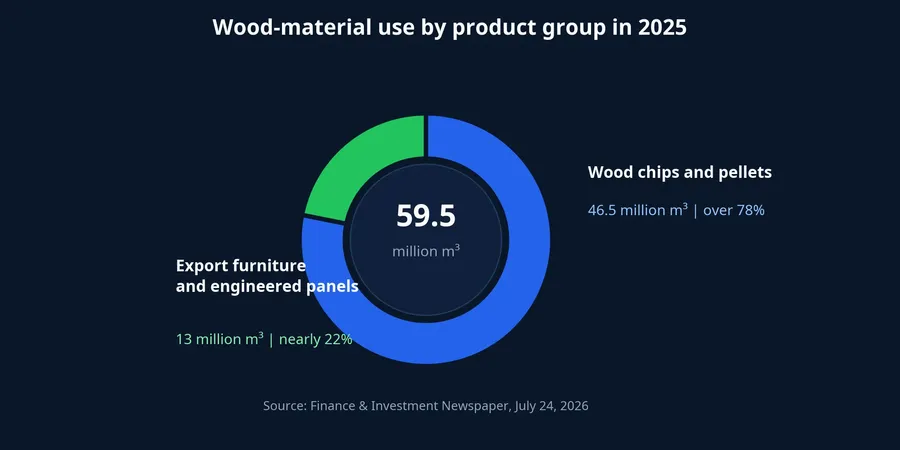
That chart does not imply that chips and pellets are unimportant. They remain vital outlets for large volumes of plantation wood. What it does show is that most material is currently absorbed by products that can use smaller logs and impose fewer requirements on the shape and consistency of each trunk.
Furniture and engineered panels demand more uniform inputs. A mill does not simply buy cubic metres; it needs specifications, straightness, durability and dependable supply. Higher harvested volume, therefore, does not automatically lift value across the chain. If incremental material still goes mainly to chips and pellets, scale may rise while the supply available for deeper processing does not improve in step.
A long rotation changes a household's decision
Large timber does not emerge simply because growers prefer a higher selling price. The businesses quoted by the source say the harvest cycle for this type of timber typically lasts 7 to 10 years, and can be longer.Finance & Investment Newspaper That span turns a technical choice into a question of cash flow and household risk management.
Harvesting early brings cash in sooner and shortens exposure to storms, fires, pests and price swings. Holding trees for longer may yield a more valuable log, but growers need the capacity to wait and confidence that a buyer will pay against clear standards. When offtake contracts are not sufficiently reliable, a short rotation is an economically understandable choice, not evidence of short-term thinking.
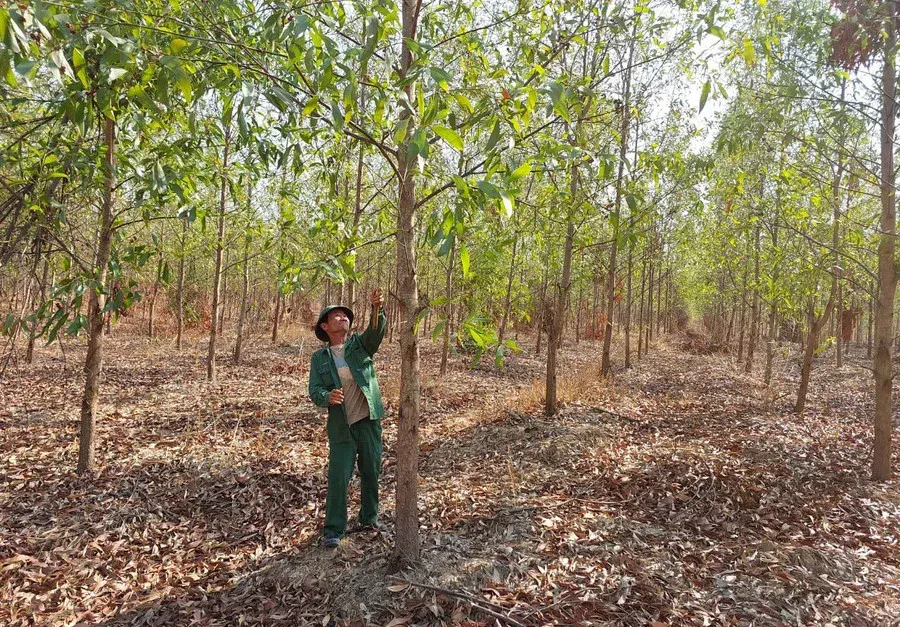
The dispersed nature of ownership makes this harder. Raw-material policy must reach about 1.4 million forest-growing households, meaning many small decisions with different financing needs and risk tolerance.Finance & Investment Newspaper It would be a mistake to assume that an encouragement campaign will become large timber on its own a few years later.
This is why processors and growers are two halves of the same chain. Processors need visibility on the type, location and volume of timber available years ahead. Growers need to know the purchasing standard, pricing method and whether a contract makes the waiting period manageable. Without commitments that last long enough, both sides have sound reasons to optimise for the present.
Traceability begins at the forest lot, not the mill gate
Even a sufficiently large log may not enter a higher-value chain if its origin cannot be demonstrated. Export markets increasingly expect businesses to show where wood was grown, which land it came from and whether environmental requirements were met. Traceability is therefore more than a file attached when cargo leaves the port.
The July 24 report says the sector still lacks an up-to-date national database for forest area, species mix, stand age and harvest output.Finance & Investment Newspaper That data gap reaches all three sides of the market. Authorities have less visibility on areas suited to large timber. Businesses struggle to plan procurement and deliveries. Forest owners, in turn, have difficulty proving their product against a common standard.
Think of forest data as a product logbook. It should begin with lot boundaries, species and stand age, then follow cultivation, harvesting and transport. Once information is standardised, a mill can match an order with a suitable raw-material area. Longer contracts can then price small and large timber differently on a more meaningful basis instead of treating wood as an undifferentiated volume.
Carbon-credit markets may provide supplementary income that helps growers retain trees for longer. They are not, however, an automatic solution. Their impact depends on clear measurement, transparent benefit rights and participation costs that do not exceed the potential return. For now, purchasing contracts, suitable financing and usable data are the more direct levers.
What shows whether the value chain is actually shifting
Wood and wood-product exports reached USD 8.6 billion in the first half of the year, up 4.9% year on year.Finance & Investment Newspaper That is encouraging evidence of sales demand, but it is not enough to conclude that domestic raw materials have moved into deeper processing. Export revenue and the quality of raw-material areas are connected, but neither is a substitute for the other.
New investors do not need to become forestry specialists to follow this story. More informative disclosures include the area of large-timber forest tied to offtake, the duration and standards of purchasing contracts, the share of traceable material, and any shift of wood into furniture and engineered panels. These indicators help separate a paper plan from a supply chain that is actually taking shape.
The sector is targeting USD 25 billion in exports by 2030.Finance & Investment Newspaper Larger sales will retain more value domestically only if input quality changes too. The larger picture suggests that the priority is not expanding area at any cost. Vietnam needs arrangements that let growers wait for a large-timber rotation, contracts credible enough for processors to plan against, and forest data robust enough to route wood into the right market.
The thesis is straightforward: the wood sector's next advantage is not more trees, but a better way to grow, track and sell the trees already in the ground. Weather, financing and offtake risks still warrant monitoring, yet they do not change that direction. The clearest confirmation will be announced long-term linkages and a growing share of traceable material, rather than another larger planted-area figure. In other words, investors should watch the quality of supply-chain commitments, not just the scale of planting.