

Vietnam has gained another legal tool in its trade file with the United States. That is very different from a Vietnamese shipment being charged a lower tariff at a US port. For investors, confusing those two steps risks prematurely pricing a better order outlook or stronger margins for exporters.
The base case therefore belongs in plain sight: the additional 12.5% tariff that USTR is applying to Vietnamese goods remains in force. Decree 292/2026/ND-CP may strengthen Vietnam's case for continued engagement, but only a new US notice or rule can alter the tariff cost actually paid.USTR
This is a chain of decisions, not a switch
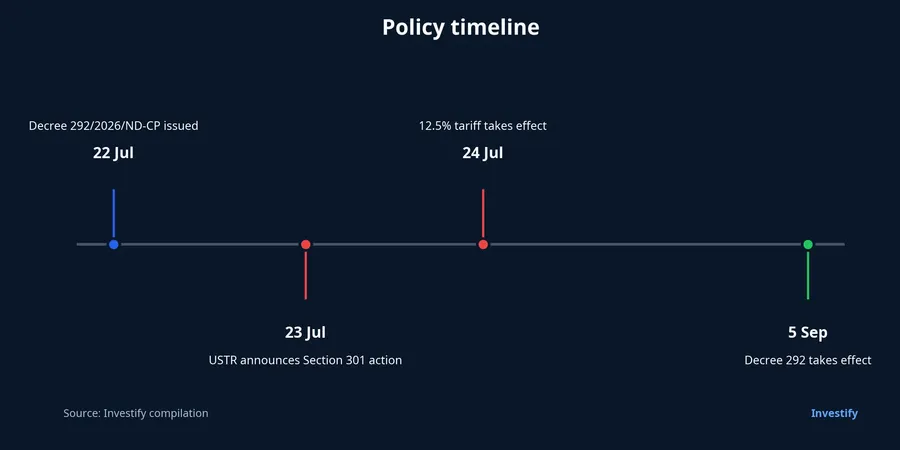
The Vietnamese government issued Decree 292/2026/ND-CP on 22 July, with effect scheduled for 5 September. It adds goods wholly or partly mined, produced or manufactured using forced labour to Vietnam's import-prohibition list. That matters because it provides a clearer domestic legal framework around an issue now central to the US action.Chính phủ
But a domestic rule cannot rewrite the United States' import tariff schedule on its own. Any tariff change requires a US assessment of the law, its implementation, and especially evidence that the mechanism works. The distinction may sound technical, yet it marks the gap between a negotiating advantage and a saving that can already be booked.
USTR has taken action under Section 301 of the Trade Act of 1974 against 60 economies. Its stated premise is that the absence of an effective ban on goods made with forced labour can burden or restrict US commerce. This is not a measure aimed only at an individual company found to have violated a rule; it is USTR's classification of national-level mechanisms.USTR
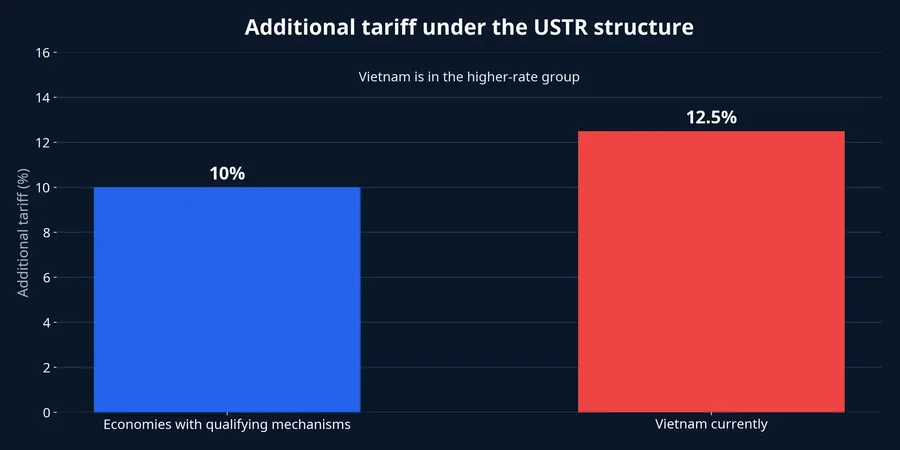
Under USTR's published structure, economies with a ban, a relevant trade-agreement commitment, or a qualifying partial mechanism fall into a 10% group. Vietnam is currently in the 12.5% group. The measure began at 12:01 a.m. Eastern Time on 24 July.AP
The timing explains why no conclusion is available yet
The closeness of the dates can make one event look like an immediate response to the other. The public record does not establish that. The decree was issued before USTR's final announcement, yet its effective date comes after the 12.5% tariff had started. Public materials do not show whether USTR fully assessed the new text, or assessed it and left Vietnam's classification unchanged.
That timeline also tells investors what not to infer from a headline. A rule can be issued before a foreign decision without being fully operational when that decision is made. Conversely, a rule that takes effect later may still become relevant to a subsequent review. The useful question is not whether the two dates look close, but whether the US authority publishes a new assessment and attaches a different rate to a defined group of goods.
That is why investors should avoid both extremes. The decree is not meaningless merely because tariffs have not fallen: it can still make Vietnam's file more complete. Equally, a legal step cannot be treated as a completed negotiating result. The larger picture is two parallel processes: Vietnam is developing its mechanism while the United States has already set the current tariff rate.
Phạm Thu Hằng, Spokesperson of the Ministry of Foreign Affairs of Vietnam at the Ministry of Foreign Affairs of Vietnam, said USTR's decision did not fully reflect Vietnam's realities and efforts. She also said Vietnam would continue engaging the United States to seek an adjustment. This is an official position from Vietnam's foreign ministry, not a US tariff change notice.Báo Chính phủ
What would actually confirm a changed scenario
New investors often look for an encouraging headline that means the risk has passed. Here, the credible signal has to come from the authority that levies the tariff. A new USTR notice, a Federal Register document, or revised US customs tariff and filing guidance would provide direct evidence that the applicable rate has changed.
If the United States moves Vietnam to the 10% group in the current structure, the relevant document would need to identify the covered goods and start date. Constructive statements or reports that the two sides remain in contact are not substitutes for those details. USTR also says the measure covers most imports but lists product- and circumstance-specific exclusions. Even after any adjustment, an investor needs to look at tariff codes rather than just a company's name.USTR
On Vietnam's side, implementation will become more concrete when the decree takes effect, detailed tariff-code lists are issued, and processes to identify and block violating goods are operating. The Ministry of Home Affairs is the competent authority for this prohibited-goods group under the new rule.Xây dựng Chính sách Those steps do not guarantee a US tariff cut, but they address the question of enforceability.
Tariffs reach companies through contracts and codes
The impact will not be evenly shared by every exporter. The tariff is collected at the US border, the importer pays first, and the parties then return to the contract table to decide who absorbs the additional cost. The final outcome turns on the tariff code, contractual terms, and the ability to raise prices without losing the order.
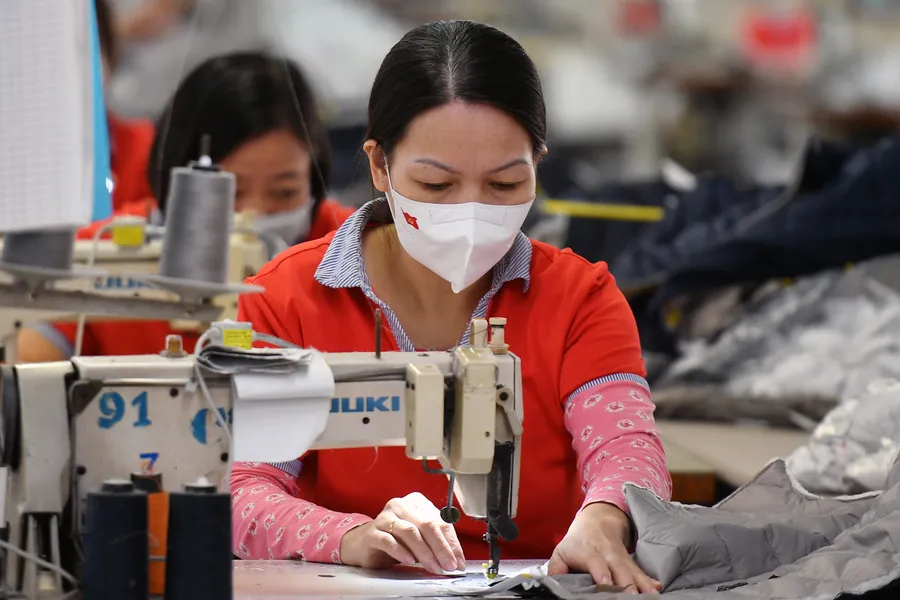
A company selling less differentiated products on short contracts, while competing directly with suppliers from economies facing a lower rate, is likely to have weaker bargaining power. It may need to cut its factory-gate price, share the cost with the buyer, or accept a lower margin. This is a mechanism to monitor, not a claim that every company earning revenue in the United States will suffer the same outcome.
The contract date matters as much as the product. A supplier may be protected temporarily by a fixed-price agreement, while the next renewal becomes the point at which the buyer seeks a concession. Another exporter may have a tariff clause that allocates the cost to the importer. Neither outcome can be inferred from a company name or from the broad label of an export industry; it requires the commercial details that public policy announcements rarely contain.
Conversely, harder-to-replace products, longer contracts, or an excluded tariff code may offer more pricing resilience. Public evidence is not yet sufficient to allocate the effect of this tariff precisely by company or sector. Nor does a share-price move around a policy headline prove causation: market sentiment, portfolio positioning, and expectations for orders may all be involved.
Conclusion: retain the base case and watch the documents
The central thesis remains intact: Decree 292 strengthens Vietnam's legal footing for the next stage of engagement, but it does not automatically reduce the US tariff. The 12.5% rate remains the base case until USTR or another competent US authority issues a replacement measure.USTR
The practical watch list for the coming weeks is a new US document, the product-code scope and effective date of any change, and the implementation progress of Decree 292 in Vietnam. Until those pieces arrive, the disciplined read is neither to ignore the decree nor to treat it as a tariff cut: it is a negotiating basis, not yet a changed border cost.