

US markets face two distinct tests over the same two days. The Federal Reserve will shape expectations for the cost of capital. Microsoft, Meta, Apple and Amazon will reveal how far the revenue promise of artificial intelligence is translating into profits and cash. Their announcements cluster around July 29 and 30, making it easy to conflate the market’s response, even though the information answers different questions.Kiplinger
That distinction matters especially for newer investors. Interest rates alter how markets value future cash flows; earnings test the cash flows themselves. A stock can fall after a strong revenue release if capital expenditure raises concerns about cash conversion. It can also rise on merely in-line sales if margins and cash flow show a healthier underlying business.
The first signal is the cost of capital
The Fed meets on July 28 and 29 before releasing its decision. As of July 24, markets assigned a 64.2% probability to the Fed holding rates steady, according to CME FedWatch data cited by Kiplinger.Fed Kiplinger That is a snapshot of expectations, not a decided outcome.
The decision is only half the reading. Kevin Warsh, Chairman of the Board of Governors of the Federal Reserve, will lead the post-decision press conference. Investors will also parse the Fed’s language on inflation, employment and the next phase of policy. An unchanged rate may be unsurprising; a shift in the expected timing or pace of easing can carry much broader consequences.
In plain terms, bond yields express the return investors require from a relatively safe asset over a period. When yields rise, profits expected years from now are usually discounted more heavily in present-value terms. That is why growth stocks, particularly companies making large data-centre investments, tend to be more sensitive to changes in the cost of capital.
This is not a mechanical rule. Yields also respond to economic data, bond demand, energy prices and positioning ahead of an event. A simultaneous move in yields and the Nasdaq after the press conference is a clue worth investigating, not proof that one Fed sentence was the sole cause.
Nasdaq’s decline raises the bar for confirmation
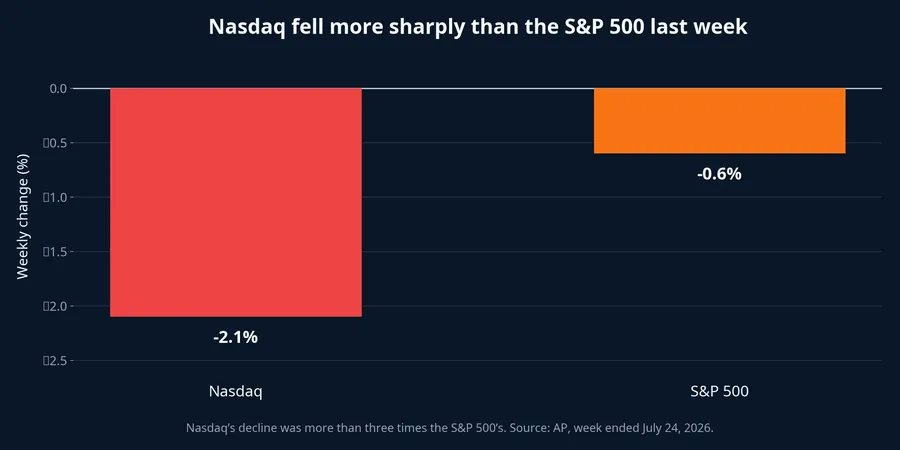
The Nasdaq finished the week down 2.1%, compared with a 0.6% decline for the S&P 500. The gap does not establish a cause, but it shows that technology enters this event-heavy week more sensitive than the broader market.AP The point is not to label the entire sector weak. It is to recognise that each earnings report now faces a higher evidential bar.
For a Vietnamese investor holding a Nasdaq fund or US shares, that distinction is practical. A move in the index bundles interest-rate expectations, sentiment and flows. The response to an individual company’s report adds evidence on business quality. Comparing that stock with the Nasdaq can be more informative than focusing on its absolute price move alone.
One framework for four earnings reports
Microsoft and Meta are scheduled to report after the US market closes on July 29. Meta says its second-quarter earnings call begins at 1:30 p.m. Pacific Time; Apple and Amazon follow after the close on July 30.Kiplinger Apple Amazon
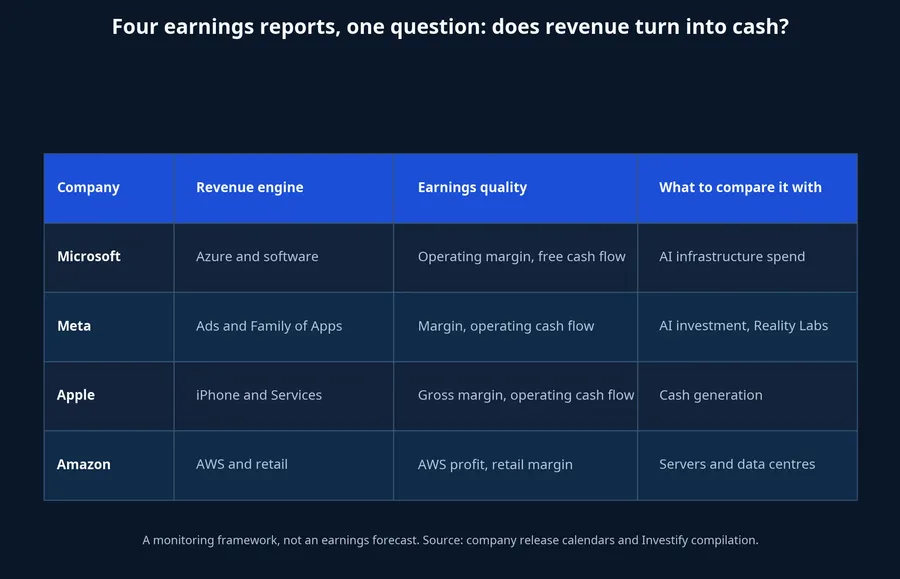
It would be a mistake to stop at a headline saying “beat” or “miss.” Microsoft should be read through Azure growth, operating margin and free cash flow. Azure indicates whether cloud and AI demand is becoming revenue; the latter measures show whether that revenue can absorb the company’s sizable infrastructure spending.
Meta is not only an advertising story. Advertising growth and the margin of its Family of Apps indicate how much support the core business is providing. Those figures should then be considered alongside AI capital expenditure and developments at Reality Labs. If sales rise but margins narrow or operating cash does not keep pace with investment, the quality of the growth deserves a more cautious assessment.
For Apple, iPhone demand, Services momentum, gross margin and operating cash flow form the relevant set. At Amazon, AWS matters because it combines infrastructure growth with segment profit, while retail needs to be assessed through margin rather than revenue alone. Four businesses differ in their mechanics, but all come back to the same test: do reported sales and profits turn into cash after investment?
Resist assigning a cause too early
Suppose Microsoft and Meta decline in step with the Nasdaq immediately after the Fed announcement. Their earnings have not yet arrived, so it would be premature to call the reports disappointing. A repricing of the cost of capital, or a reduction in positions built ahead of the event, would be plausible alternatives. Once the results and investor calls begin, the relative performance of each stock against the Nasdaq offers a clearer way to separate company-specific news from the macro move.
Discipline is equally important on the upside. A post-earnings gain could reflect revenue, margins, capital-spending guidance, or simply expectations that had already fallen. The strongest evidence comes from comparing company metrics with moves in yields, the sector index and management’s explanation. No single headline number can replace that comparison.
The thesis for this two-day test
The larger picture is that US technology now has to clear two hurdles at once: the cost of capital must not deteriorate unexpectedly, and AI investment must show signs of becoming revenue, margins or cash flow. These are not wholly separate stories. Rates determine the discount applied to future cash flows, while operating results determine the cash flows being discounted.
The thesis, then, is not a call on the Nasdaq before the evidence arrives. Watch bond yields after the Fed press conference, core-business growth, margins, free cash flow and each company’s capital-spending plans. If yields fall and cash generation improves, the two signals reinforce each other. If yields rise while investment continues to weigh on cash conversion, valuation pressure has a clearer foundation. When the signals conflict, the evidence does not yet support a directional conclusion; the following trading sessions are where markets will begin to separate the drivers.