

A chocolate bar on a shelf is not made with today's cocoa price alone. It carries the cost of beans bought earlier, time spent in inventory, manufacturing expenses and a brand's pricing decision. That is why cheaper cocoa is not a promise of a lower shelf price on the next supermarket visit.
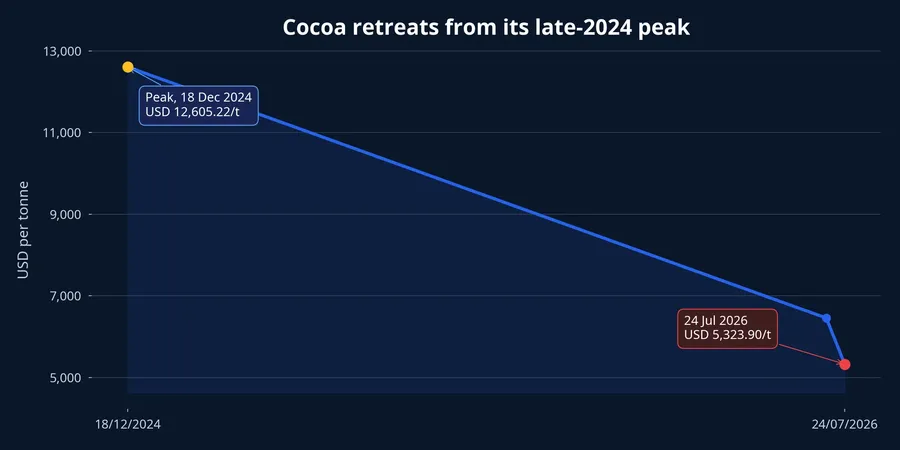
On 24 July, cocoa was priced at USD 5,323.90 per tonne in Investify's database, down 57.8% from its USD 12,605.22-per-tonne peak on 18 December 2024. Between 9 and 24 July alone, it fell from USD 6,455 to USD 5,323.90 per tonne, a 17.5% decline. This is a major shift at the beginning of the supply chain, but the beginning of the chain and the retail shelf do not move to the same rhythm.
The core point is simple: a lower raw-material price is constructive for chocolate makers, not a conclusion about retail prices or profits. To see where the benefit has gone, investors need to watch whether old costs have cleared through inventory and whether a company chooses to retain or share the saving.
Market prices arrive before factory costs
Think of the cocoa market as a price board for the next cargoes to be purchased. A factory, however, cannot replace all of its inputs at the new price after a single trading session. Companies commonly pre-purchase part of their needs or use futures to lock in costs. That protects them against a sudden rise, but it also prevents them from immediately enjoying a fall.
The everyday analogy is a bakery that has already ordered several weeks of sugar at a high price. If sugar becomes cheaper tomorrow, the batches baked from the existing delivery still carry the old cost. Chocolate has an even longer path: beans are transported, roasted, ground, blended, moulded, packed and distributed. The screen price is instant; cost of goods sold is the outcome of many earlier purchasing decisions.
This is also why investors should not turn a commodity decline into a definitive earnings narrative. Lower prices may reflect easier supply expectations, weaker processing demand, or both. The available evidence does not allocate the move to one cause with confidence. For a processor, the more relevant measure is the average cost of the beans that actually enter production.
Inventory is where the old price remains
Purchased beans do not become a retail bar overnight. A business may hold raw beans, cocoa mass, cocoa butter, cocoa powder, work in progress or packaged goods. Each layer of inventory was created at a different moment and therefore carries a different cost.
New purchases pull the average cost lower only as high-cost stock is consumed. A company can therefore still report margin pressure even after the cocoa chart has visibly fallen. Put simply, the market changes its price first; the accounts require time to catch up.
There is no single lag for every company. It depends on procurement policy, inventory turnover, safety stock, supplier contracts and product mix. A business with fast-moving products may feel the new cost sooner than one with a long distribution network. Rather than guessing the number of months, readers should look at inventory disclosures, purchase commitments and management commentary in earnings reports.
That distinction matters because lower input costs do not automatically mean a better quarter. The effect becomes visible only as old inventory is sold and replacement purchases enter the production mix. A company that bought heavily at the previous high can look very different from one that was less protected or turns its stock quickly. The price chart is therefore an early indicator, while reported gross margin is the confirmation.
Cocoa is not the entire cost of a bar
Even when average cocoa costs decline, a 57.8% fall cannot be applied directly to the price of a chocolate bar. Sugar, milk, fats, energy, packaging, labour, freight, warehousing and selling costs are also part of the equation. Their weight differs between dark chocolate, milk chocolate and products containing nuts or fillings.

Freight or energy may rise while cocoa is falling. The accurate relationship is therefore not “cocoa falls, so chocolate falls by the same amount.” It is “cocoa falls, creating room for a company to choose.” That room may become stronger margins, promotions designed to rebuild demand, or may be partly absorbed by other costs.
Shoppers should also separate list price from the price actually paid. A brand may hold the pack price while increasing promotions, changing pack sizes or offering products at a more accessible price point. Those choices allow it to test customer response without cutting an entire price list at once. Promotions, volumes and average selling prices are often more informative than one shelf label.
For the same reason, a falling input price can be shared in several ways. A manufacturer may preserve the headline price and rebuild profitability. It may offer discounts through selected retailers, making the benefit less visible on the package. Or it may use the saving to launch a different format. None of these choices can be inferred from cocoa alone; each needs to be read alongside the company's own volume and pricing disclosures.
Lindt illustrates the demand equation
Lindt & Sprüngli's first-half 2026 results make that trade-off clear. Average selling prices rose 11.8%, while volume and mix declined 7.5%; organic sales still increased 4.3%.Lindt Higher prices protected sales, but customers did not remain entirely indifferent to them.
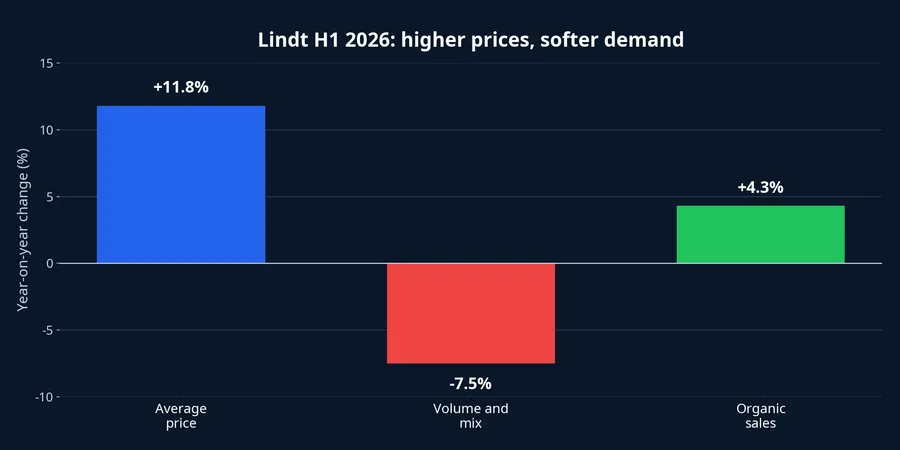
Lindt has said it may selectively lower prices in some markets in the second half to support growth.Reuters That does not mean every chocolate maker will cut prices; brand positioning and consumer demand differ by market. It does show that a lower input cost merely creates the option. The decision still depends on whether volume needs reviving.
Price and volume together tell the useful story. If prices hold and volume is stable, more of the benefit from cheaper inputs can plausibly reach margins. If promotions are required to relieve pressure on volumes, consumers may benefit sooner and margin improvement may be smaller. If both price and volume are weak, lower cocoa alone may not be enough to change the picture.
What to watch instead of one price move
For investors new to commodities, follow the order of price transmission. Start with cocoa and the supply outlook. Then examine cost of goods sold, inventory turnover and gross margin in company reports. Only after that come average selling prices, promotions and volume. This sequence prevents an input signal from being mistaken for a confirmed outcome.
There are two distinct scenarios. In the constructive case, average input costs ease, selling prices do not need to fall sharply and volumes stabilise; margins then have a basis to recover. In the other case, weak demand forces companies to spend the saving on promotions or lower prices. Consumers benefit, but profit does not improve by the same amount. The deciding evidence will be in the next earnings reports, not in a single line on a commodities screen.
That is why a sharp cocoa decline is the beginning of the story, not its finish. The thesis is price-transmission lag: the benefit becomes credible only when lower costs appear in cost of goods sold, margin pressure eases and volumes stop deteriorating. When all three occur together, investors will know whether the benefit is reaching profits, promotions or shoppers.