

VietCredit booked VND 780.7 billion in credit-provision expense in the second quarter of 2026, more than its VND 471.7 billion pre-tax profit. Read in isolation, those two lines can look contradictory: how can a lender remain profitable when provisions exceed profit? The answer sits higher up the income statement. Before provisions were charged, lending operations had generated a sufficiently large profit pool to leave the company in positive territory.VietCredit
That is a genuine Q2 strength, rather than an accounting paradox. It is not, however, enough to settle the question of earnings quality. When a loan book expands rapidly, interest income and credit risk can grow together. The right reading is therefore straightforward: VietCredit cleared the provision test this quarter through its interest income, while the durability of profit depends on what future credit-quality indicators show.
Reading the income-statement bridge correctly
The financial statements show net interest income of VND 1,771.8 billion in Q2, up 176.6% year on year. This is the spread between interest income and interest expense before operating costs, service activity and provisions. After the other operating items and costs were accounted for, pre-provision operating profit reached VND 1,252.4 billion.VietCredit
VietCredit then recognised VND 780.7 billion of provision expense and retained VND 471.7 billion in profit before tax. Based on the reported figures, provisions equalled approximately 62.3% of pre-provision profit. That is substantial, but it did not eliminate the entire pre-provision profit pool. Comparing provisions directly with pre-tax profit therefore tells readers how heavy the risk charge was; it does not by itself determine whether the company made a loss.
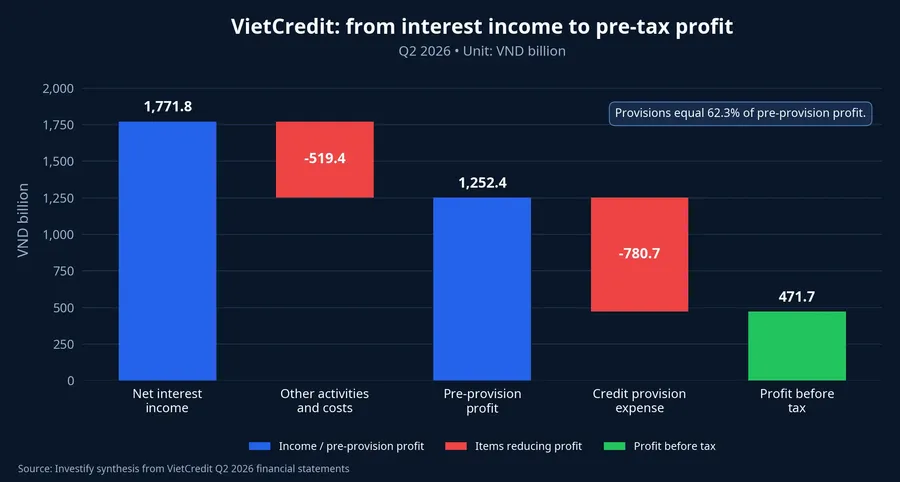
Put simply, an income statement is a sequence of deductions. Net interest income is the important starting source. Operating costs, service activity and provisions reduce what remains in turn. For a consumer-finance company, provisions are not a peripheral line item. They are the cost of recognising the risk that some loans may not be collected as expected.
A larger loan book brings both income and pressure
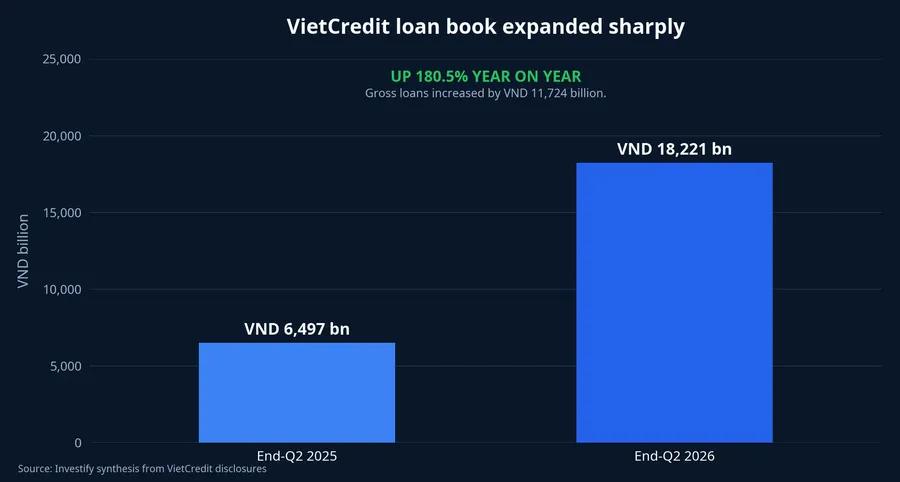
Customer loans stood at VND 18,221.2 billion on June 30, 2026, an increase of 180.5% from a year earlier. A larger book supports higher interest income because more loans are generating interest. That direct relationship is clearly visible in the Q2 disclosures.VietCredit
Yet higher revenue does not automatically mean that each new dong of lending is better quality. The report also recorded a VND 399 billion net loss from service activities as operating and collection costs through digital-lending partners rose with disbursement scale. Provision expense grew 409.9% year on year, faster than loans. These facts describe a business expanding quickly; they do not establish that credit quality deteriorated at the same rate.VietCredit
There are several plausible explanations for the faster rise in provisions. A bigger loan book needs a larger absolute provision balance. Loan composition may have shifted toward riskier buckets. The company may also have adopted a more conservative approach to recognising risk. The public report shows the outcome, but not enough detail to assign the contribution of each explanation precisely.
This distinction matters especially for newer investors, because a large growth rate can feel reassuring. Loan growth measures scale, not quality. Credit quality needs to be read alongside special-mention loans, non-performing loans, provision usage and the trend in provision expense over several reporting periods.
Three provision metrics should not be treated as one
VietCredit used VND 1,127.3 billion of provisions to handle credit risk in the first half of 2026. After provision use and charges during the period, its loan-loss reserve balance was VND 824.6 billion at the end of June, compared with VND 652.9 billion at the end of 2025. All of these figures relate to credit risk, but they have different accounting meanings.VietCredit
Provision expense is the charge recognised in the period and flows through the income statement. The provision balance is the remaining reserve on the balance sheet at period end. Using provisions to handle risk is the process of dealing with qualifying loans under the applicable rules while continuing to monitor them off balance sheet. Calling all three “provisioning” obscures the difference between a current earnings charge and the remaining risk buffer.
That distinction also prevents premature conclusions from a single quarter. A large provision charge can reduce current profit without proving that the end-period buffer is weak. Conversely, a larger reserve balance does not automatically prove that the loan book is safer. The loan balance, classification of loans and risk already handled all need to be read together.
The NPL gap needs a reconciliation
VietCredit's explanation letter reported an NPL ratio of 6.02% as of June 30, 2026. In the financial statements' loan-classification table, group 3 loans were VND 691.5 billion, group 4 loans VND 419.9 billion and group 5 loans VND 265.0 billion. Adding those non-performing groups and dividing by VND 18,221.2 billion of customer loans produces approximately 7.55%.VietCredit
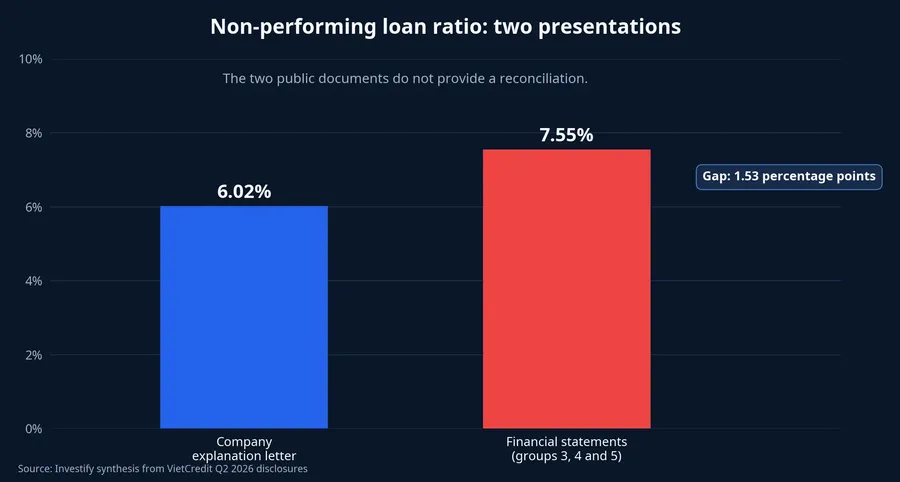
The difference is 1.53 percentage points. That is not enough to conclude that either document is wrong. The denominator, loan-book scope or calculation convention may differ. But the two public documents do not provide a reconciliation of the numerator, denominator and loan scope. Investors should therefore avoid inferring that bad loans have fallen or asset quality has improved.
Another reported growth figure should likewise be checked against the base numbers. A company news item said Q2 pre-tax profit rose 230% year on year, while the financial statements report VND 241.9 billion for Q2 2025 and VND 471.7 billion for Q2 2026. Those two figures imply growth of about 95%. Net profit increased from VND 208.9 billion to VND 376.6 billion, or approximately 80.3%.VietCredit
This is not a conclusion about the entire company. It is a reason to prioritise the underlying financial-statement figures and check the calculation. In consumer finance, an eye-catching percentage cannot substitute for understanding the denominator and the reporting period behind it.
Conclusion: Profit passed one quarter, quality needs more evidence
The numbers show that VietCredit generated enough net interest income to absorb a high provision charge and still produce pre-tax profit in Q2. That is a positive outcome for the period. Yet loans, service costs and provisions all rose sharply, which says the business is scaling faster than certainty about the quality of that scale.
The article's thesis therefore remains unchanged: Q2 profit has a base in interest income, but its durability has not been fully proven. The next report should answer whether net interest income continues to rise faster than provisions, how group 2 and non-performing loans are changing, and whether VietCredit publishes a clear NPL reconciliation. If those links improve together, the current profit will carry more weight. If they do not, high earnings may chiefly reflect a larger loan book.