


The phrase “ending specific land prices” can easily conjure the wrong picture: one fixed price for every plot, whether it sits on a main road or deep in an alley. That is not what the proposed Land Law amendment says. The draft would replace a separate, case-by-case valuation layer with a land-price table plus an adjustment coefficient; the table would still distinguish land type, area and location.VnExpress
In plain terms, this is a change in how the calculation is organised, not an instruction to erase location differences. It is also only a draft. The Ministry of Agriculture and Environment is consulting on the dossier until August 10, so any assessment of effects must remain conditional on the proposal being retained and passed.VnExpress
That leads to a clear thesis: the proposal alone does not support a forecast that property prices will rise or fall. The more useful question is how the replacement mechanism works, and which conditions determine whether it reflects market reality or departs from it.
What are specific land prices under the current framework?
Think of a specific land price as a valuation prepared for an individual eligible case. It is used in situations with direct financial consequences, including land allocated to organisations without auction or investor-selection bidding, one-off land rent, valuation of land-use rights in state-enterprise equitisation, and compensation when the state recovers land.VnExpress
Under this approach, a consultant can use comparison, income, residual or adjustment-coefficient methods to prepare the proposed price. The file then goes to an appraisal council before a provincial People’s Committee makes the decision. The key point is that the framework has a separate processing layer for each case rather than applying a general table immediately.VnExpress
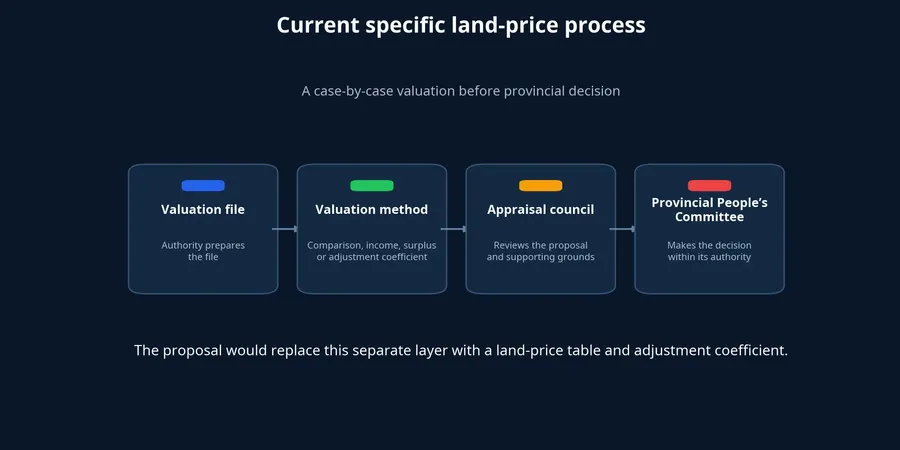
This can accommodate the distinctive features of a given plot. It also requires time, people and more checkpoints. When a project is awaiting the calculation of its financial obligations, the duration of that process can itself become part of the uncertainty around cost and schedule.
What the draft would change, and what it would not
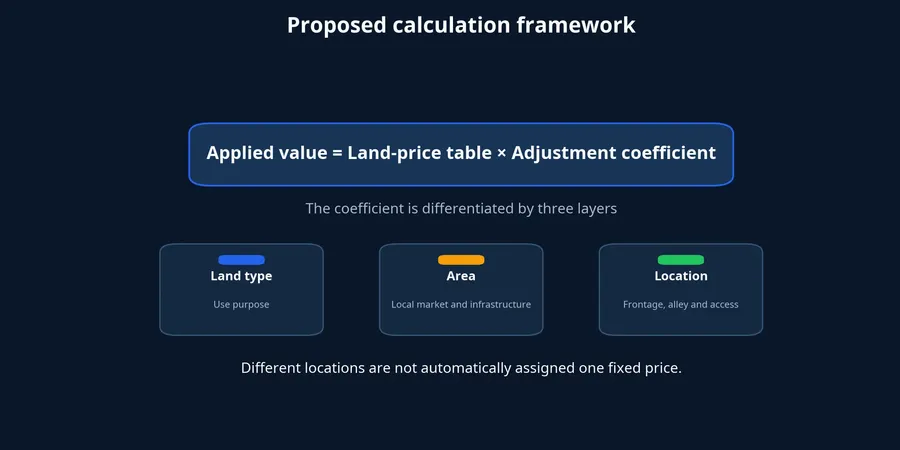
The proposed removal concerns the “specific land price” layer, not the differences between locations. According to the draft details reported in the press, the land-price table would still be built by land type, area and location. The adjustment coefficient would raise or lower the table value for that same combination.VietnamFinance
A practical shorthand is therefore: the value used for financial obligations or compensation comes from the table value multiplied by the adjustment coefficient. That is a description of the mechanism, not a complete formula that lets anyone calculate every payment. Legal conditions, area, term and land-use purpose can still change the final result.
This distinction matters especially for homebuyers. The land-price table serves certain administrative and financial-obligation purposes; it is not a compulsory price list for every market transaction. The selling price of an apartment or house still depends on supply and demand, mortgage rates, project legality, infrastructure and affordability. The path from a draft mechanism to a transaction price is therefore a chain of conditions, not a straight arrow.
The focus shifts from individual files to underlying data
The most consequential change is where judgement is concentrated. The current mechanism places substantial weight on each case file, the consultant and the appraisal stage. The proposal would place more weight on the underlying table and coefficients that provincial authorities build, submit to the provincial People’s Council for decision, and later revise or supplement.VietnamFinance
That could make the calculation easier to inspect if its inputs are public, current and sufficiently granular. Yet no mechanism automatically fixes poor data. If transaction prices are inflated, base data are stale, or coefficients are too broad, the error does not disappear. It moves from one individual file into a tool applied across a group of areas or locations.
The Ministry of Agriculture and Environment has highlighted the need to connect land data with tax, notarisation and banking data to limit price manipulation and multiple price levels. That is more important than the name of the mechanism itself, because the quality of a table rests on whether its input data can identify abnormal transactions.VnExpress
Different groups face different transmission paths
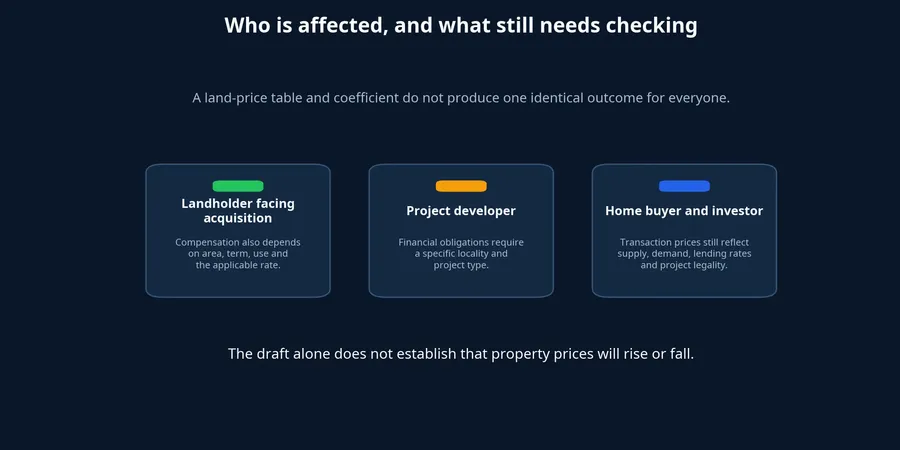
For a landholder whose land is recovered, the table and coefficient would form part of the basis for compensation under the proposal. The outcome also depends on recovered area, term, purpose, form of land use and the applicable compensation rate. Looking at a coefficient alone and declaring that compensation will rise or fall leaves out most of the calculation.VietnamFinance
For a project developer, land-use fees and land rent are input costs. The draft also links financial obligations to area, term, land-use purpose, table value, coefficient, exemptions or reductions, infrastructure investment costs and the relevant collection rate. Investors following property companies should therefore wait for locality- and project-specific rules instead of assigning one uniform effect to the whole sector.VietnamFinance
For homebuyers and individual investors, the effect is more indirect. Land cost can be one component of a project’s economics, but sale prices have other drivers. Nothing in the draft establishes that this change would automatically push home prices up or down. Until the table, coefficients and local application are known, a firm conclusion would be speculation.
Three things to watch before August 10
First, watch what remains after the consultation period. A proposal in a consultation dossier is not an issued legal document, much less a rule already in force. It is a basic distinction, but one that can disappear when a complex policy item is compressed into a headline.
Second, examine how each locality classifies locations, builds its table and sets coefficients. A common framework becomes meaningful only when households, companies and investors can see which data are used, how frequently they are updated, how abnormal transactions are filtered, and how sharply the mechanism distinguishes a main road from a small alley.
Third, watch the transitional rules. Files already under valuation, projects calculating financial obligations and compensation plans not yet completed will need a clear treatment if the law changes. This is the part that may affect individual project timing directly, but its outcome cannot yet be inferred from the draft’s general principle alone.
Conclusion: wait for the data and the legal text
The proposal does not flatten every plot into one price. It shifts the emphasis from a separate valuation for each case to a location-differentiated table and an adjustment coefficient. That approach could be more transparent and easier to test if the data are strong. It could also amplify errors if the base table and coefficients lag reality.
The evidence now available is insufficient to call the direction of property prices. The signals worth monitoring are the draft’s content after August 10, the data design and land-price tables in each locality, and the transitional rules for cases already in process. Those are the pieces that can turn a legal proposal into a concrete financial effect.