


Some 39.36 million PNJ shares changed hands on 24 July, roughly 37 times the previous session's volume. Yet the stock closed at its VND 30,750 floor price, down 6.96%. Those facts are not contradictory: the market found buyers for a vast amount of stock, but buyers did not bid high enough to take control of the closing price.
For a new investor, an extraordinary volume spike can easily feel like proof that big money has arrived and a reversal is imminent. It is safer to separate two questions. One is whether buyers exist to meet sellers. The other is whether selling has been exhausted and buyers have taken the upper hand. The 24 July session clearly answers only the first question.
What the average matched price says about demand
PNJ matched 39.36 million shares worth VND 1,210.73 billion during the session. Dividing turnover by volume puts the average matched price at about VND 30,759 per share, almost identical to the VND 30,750 floor. Put simply, most shares changed hands at the lowest price permitted by the day's trading band.
That detail matters more than a single towering volume bar. When buying demand is genuinely proactive, buyers normally accept higher prices to secure stock. The price then moves away from the floor and holds a higher trading range. Here, demand was present but largely waiting at the lowest available price. It could absorb supply without showing a willingness to chase it.
PNJ did reach VND 32,050 during the session before returning to the floor at the close. That tells us demand briefly pushed the stock away from the low, but could not preserve that ground by the bell. An intraday rebound is therefore not automatically a reversal signal. The closing level matters because it is where the final balance of buy and sell orders settles.
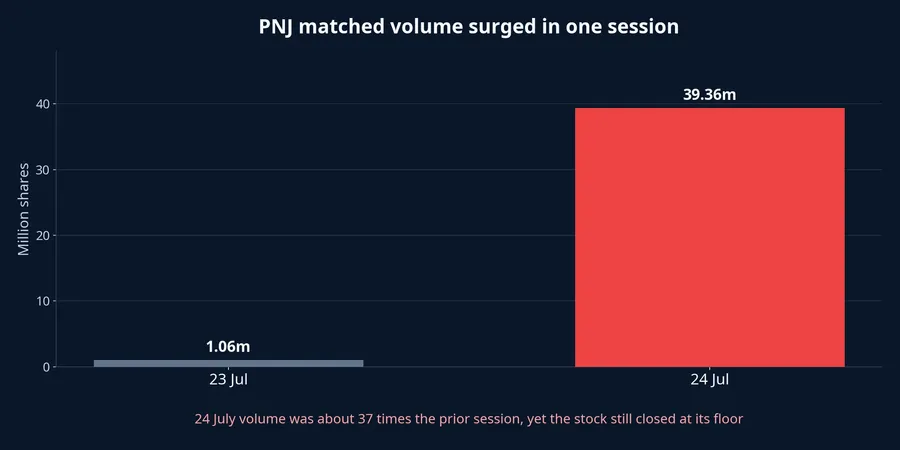
Big turnover does not mean supply has run out
At 10:46 a.m., PNJ had matched just over 1.1 million shares and still had more than 22 million shares offered at the floor.Tin Nhanh CK By the close, matched volume had risen to 39.36 million shares. A large amount of stock therefore found counterparties after that morning snapshot, but the final price still sat at the floor.
This is the distinction between absorbing a large amount of supply and absorbing all selling pressure. Completed trades confirm the first statement. The second needs additional evidence: sellers must stop repeatedly accepting the lowest price, while buyers need enough initiative to hold a higher level.
Order-book figures also need to be treated as a snapshot rather than a forecast for the whole day. Orders can be cancelled, amended or replenished. With no reliable public source for the end-of-session bid and offer balance, the sounder conclusion rests on three confirmed facts: exceptionally high volume, an average matched price near the floor, and a close at the floor.
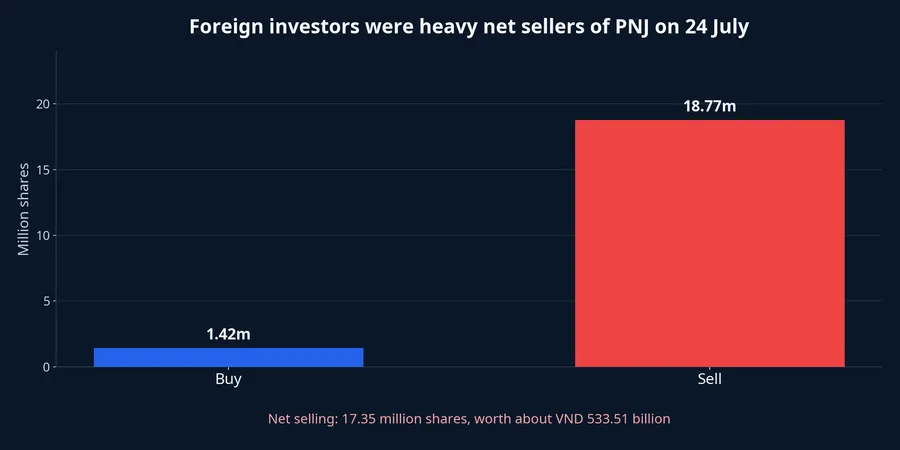
Foreign investors were a meaningful source of supply
Foreign investors sold 18.77 million PNJ shares during the session and bought 1.42 million. That left net selling of 17.35 million shares, worth about VND 533.51 billion. It was a meaningful portion of the supply and helps explain why the market needed substantial demand simply to keep trading flowing.
It would nevertheless go beyond the evidence to assign the entire decline to foreign investors. Domestic selling, risk-management reductions and pressure from margin-funded positions could all have occurred at the same time; the available data cannot identify the motive behind every sell order. What can be said with more confidence is that ownership moved from sellers to buyers, with domestic buyers likely taking a large part of that supply.
That transfer alone does not create a bottom. A more durable floor needs two developments at once: fresh stock offered for sale must shrink, and demand must remain present without waiting exclusively at the price floor. If only one happens, high turnover can still describe a prolonged handover.
Three signals for the next session
The first signal is where trading concentrates. If PNJ again posts heavy turnover but most transactions occur at the floor, it primarily means that investors seeking to exit are meeting investors willing to buy cheaply. A more constructive signal would be a move away from the floor, rebounds after sell-offs, and a close above the day's lowest level.
The second is how floor-price sell orders change through the session. A shrinking offer queue is meaningful only if it does not quickly refill after buying emerges. Volume can rise sharply while supply remains plentiful when new sell orders keep arriving. Watching the intraday sequence is more useful than relying on an early-session screenshot.
The last signal is the intensity of foreign net selling. A sharp reduction would indicate that a major source of 24 July supply is easing. If foreign investors continue to sell tens of millions of shares and the stock is again pressed to the floor, turnover would only show that the market can receive the stock, not that buyers now control the balance.

Conclusion: a handover, not confirmation of a bottom
PNJ fell about 28.49%, from VND 43,000 on 17 July to VND 30,750 on 24 July. Bargain hunting after such a rapid decline is understandable. But many investors being willing to buy at a low price does not mean sellers have run out of stock, nor does it establish the day's low as a stable equilibrium.
The central reading of 24 July is straightforward: buyers absorbed a very large supply, but they did not regain pricing control. The risk in a rushed interpretation is to focus on 39.36 million shares while overlooking an average matched price near the floor and a closing price still at the floor. The picture changes only when new supply eases, sell orders do not quickly rebuild, and the price holds higher after demand appears. Those are the signals to monitor instead of treating volume alone as confirmation that PNJ has bottomed.