

On July 24, PC1 completed an urgent task: it removed four detained board members and elected four replacements for the remainder of the term. That restores the board's ability to make decisions. For a company emerging from a senior-management disruption, however, filling seats is only a necessary condition; confidence returns only when oversight, financial reporting and cash generation produce consistent evidence.MarketTimes
This is the useful lens for PC1 today. A completed meeting, an interim profit figure and a list of contracts should not be collapsed into a single conclusion. They answer different questions. The real risk is treating a functioning board as proof that every operational, financial and legal concern has already been resolved.
A full board still has to demonstrate oversight
Replacing the four members removes a procedural bottleneck. Resolutions, the choice of an auditor and operating decisions no longer risk being delayed simply because the board lacks members. Of the four additions, two are independent board members. Candidate profiles released by PC1 ahead of the meeting point to backgrounds in finance, audit, electricity and energy.Mekong ASEAN
Independence on an organisational chart, though, does not automatically create effective oversight. The new board becomes meaningful to shareholders only if independent members receive adequate information, can challenge management and can request reviews of risk areas. Without disclosure on mandate, data access and the way dissent is handled, investors are still looking at a personnel change rather than a tested control system.
Phan Ngọc Hiếu, Vice Chairman of the Board of Directors of Công ty Cổ phần Tập đoàn PC1 (PC1), said the company would establish a risk-management committee immediately after the meeting and acknowledged that risk management had been a missing element of its governance.Người Quan Sát That is a constructive signal, but a committee name is not an outcome. The next disclosures need to identify its lead, reporting line, independent representation and the way borrowing limits, contracts and conflicts of interest will be monitored.
Interim profit is a starting point, not the conclusion
At the meeting, Hiếu said PC1's first-half profit was up approximately 150% from the same period of 2025, while revenue was less than 10% below plan. These were figures presented by management at the meeting; the company said official figures would follow completion of the audit.MarketTimes
An increase of approximately 150% rightly draws attention, but it says little by itself about profit quality. The interim report must show which activities generated the gain, whether any non-recurring income was involved and whether margins improved or merely reflected the timing of recognition. For newer investors, the distinction matters: accounting profit can be recorded before cash reaches the company.
The report should therefore be read across three places: the income statement, cash-flow statement and notes on receivables. If profit rises while operating cash does not follow, the next question is whether cash is sitting with customers, in work in progress or in working-capital needs. A short headline about rising profit rarely answers those questions.
Debt should not be treated as a stand-alone number either. More useful questions are which borrowings mature soon, which project cash flows are expected to repay them and whether new borrowing is needed to fund execution. A contractor can have a solid order book while still facing strain if it must finance work long before a client pays.
New contracts are workload, not yet cash
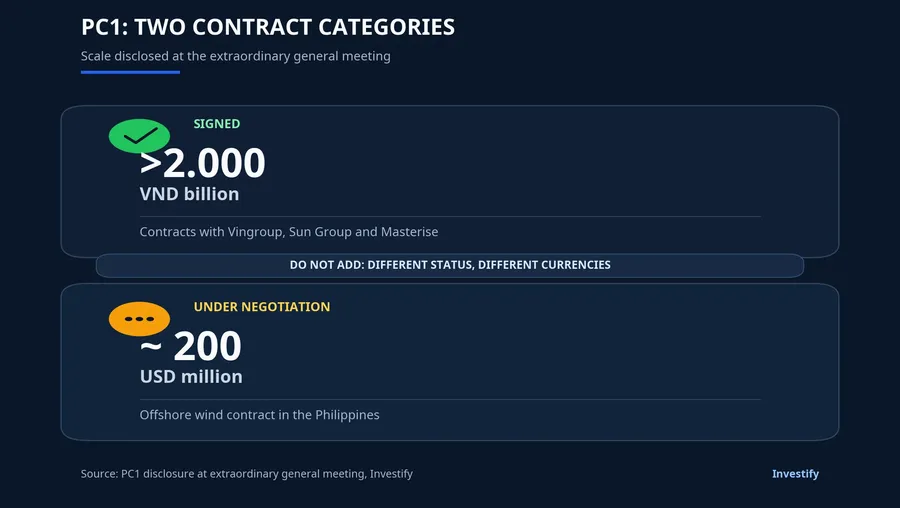
PC1 said it had signed more than VND 2,000 billion in contracts with Vingroup, Sun Group and Masterise. It also said it was negotiating an offshore-wind contract in the Philippines valued at approximately USD 200 million.Người Quan Sát Those disclosures have different statuses and use different currencies, so they cannot be added together and treated as secured revenue.
A signed contract is a more positive signal because it has a legal basis. Yet it still has to move through construction progress, acceptance and the payment schedule before it becomes cash. Investors should watch the project timeline, PC1's direct scope of work, advance-payment terms and funding needs. This is not a claim that the contracts will fail; it is the normal verification chain for a construction contractor.
The Philippines item deserves even more caution. It is a commercial opportunity, not a signed contract. The gap between “under negotiation” and “signed” matters because commercial terms, execution partners and timing can all change. A simple rule for newer investors is not to put every value mentioned at a shareholder meeting into a personal revenue forecast.
The audit is the nearest test of the new structure
According to management's remarks at the meeting, PwC will not continue as auditor because of contractual constraints, and PC1 has submitted three additional audit firms for the list from which this year's auditor can be selected.Người Quan Sát Pre-meeting materials said PC1 could choose from seven audit firms after the additions.Tin Nhanh Chứng Khoán
Finding a replacement keeps the reporting process moving, but it does not substitute for the audit opinion itself. Investors should wait for timely publication, then read the auditor's opinion, matters of emphasis and notes on receivables, debt obligations and related-party transactions. Those disclosures can support or challenge the reassurance created by the reshuffled board.
One further boundary matters. Hiếu said PC1 had received no official notice from investigators about the company's general operations and said the company had been told in meetings that the case concerned individual wrongdoing.MarketTimes That is a statement by company management at the meeting, not an investigative conclusion released by a competent authority.
The post-meeting thesis: wait for evidence, not a slogan
PC1 has addressed the personnel gap and restored its board's ability to decide. That is meaningful progress. The more disciplined conclusion, however, is that this event alone does not confirm a full recovery in governance or financial health.
The three nearest signals are the practical remit of the risk-management committee, the interim report's reconciliation of profit with cash flow and the audit opinion once a new auditor is chosen. Risk would decline materially if these signals align. If one link remains unclear, a full board is still only the beginning of rebuilding trust.