


The forecast is on the table, but the funds' orders have not yet appeared. That is the key gap to remember when reading that ETFs may add HPG in the upcoming portfolio rebalancing. A large figure can make it seem as though demand is already waiting in the market. In reality, it is still the output of an estimate, and the share price can react very differently.
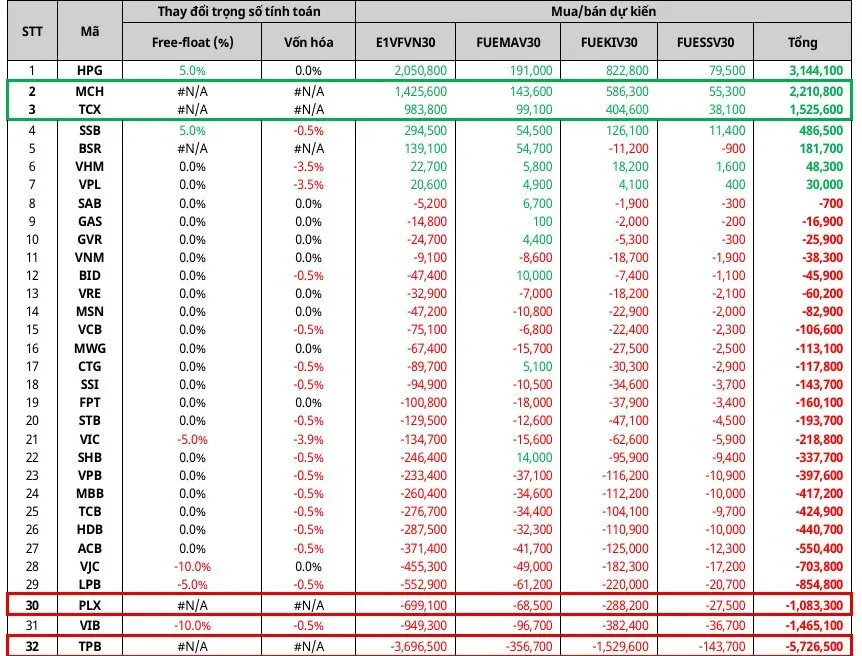
Mirae Asset analysts estimate that related ETFs may buy about 3.1 million HPG shares. The same forecast puts potential buying in MCH at about 2.2 million shares and potential selling in TPB at about 5.7 million shares.Người Quan Sát The central point is straightforward: the forecast describes technical demand that may emerge, not a signal to follow into a stock.
What the forecast actually says
An index-tracking ETF is like a shopper repeatedly checking its basket against a reference list. When VN30 or VNFinLead changes constituents or weights, the fund must bring its actual holdings closer to the benchmark. The difference between the post-review target holding and the pre-review holding becomes estimated buying or selling.
That calculation does not automatically become a trade. Target weights depend on the data used for the index; assets under management move with subscriptions, redemptions and portfolio value. HPG's market price also changes each session. Two brokerages can therefore publish different estimates without either necessarily being wrong.
The Ho Chi Minh City Stock Exchange publishes an index basket, while brokerages estimate ETF trades. One is information about the benchmark; the other is an inference based on assumptions. When a reader sees “expected to buy,” the useful questions are who made the forecast, which date the inputs came from and when the fund is expected to trade.
This distinction matters because an ETF does not make a discretionary judgment every time it rebalances. Its mandate is to track a benchmark as closely as practical, subject to trading costs and the mechanics of execution. A forecast of its buying is therefore not equivalent to a new analyst target, a management update or evidence that the company’s underlying outlook has improved. It can still affect short-term order flow, but it should be read in the right category.
The event calendar shapes the market response
The milestones in this review do not occur on the same day. The reported schedule has funds expected to rebalance from July 27 to July 31, 2026, with July 31 the final rebalancing session and the new basket effective from August 3, 2026.Người Quan Sát The July 23 forecast therefore preceded the actual trading by several sessions.
That gap lets other investors react first. Early buyers may expect ETF demand, while existing holders may use that expectation to take profits. On the rebalancing day, real ETF buying can meet supply that has already been waiting. Trading volume can rise without a matching rise in price.
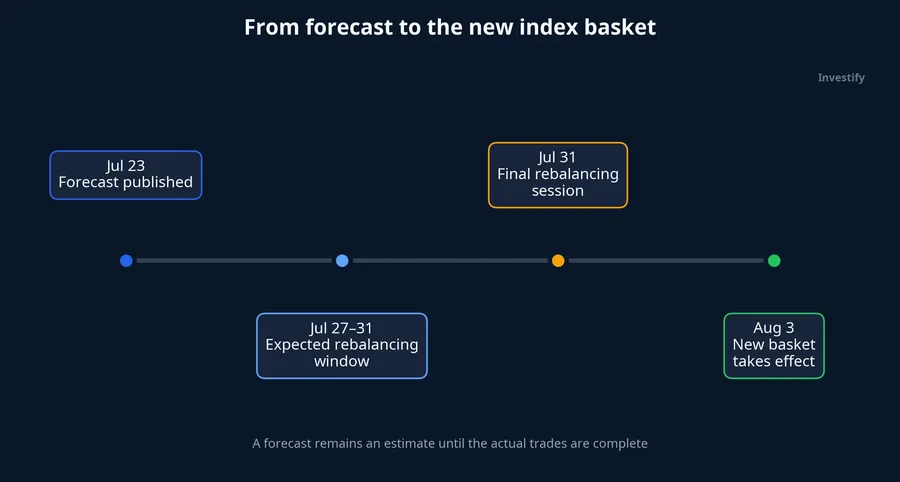
In practical terms, separate four dates: the data cut-off, the basket announcement, the expected trading window and the effective date. A headline that gives only the expected share count skips the other three. Yet those dates help show whether information is still new or has already been partly priced in.
How large is 3.1 million shares?
An absolute number can sound striking, so it needs a liquidity comparison. HPG traded about 37.06 million shares on July 23. Expected buying of 3.1 million shares is roughly 8.4% of that session's turnover. It is a ratio worth watching, but it is not demand large enough to dismiss all counterparties.
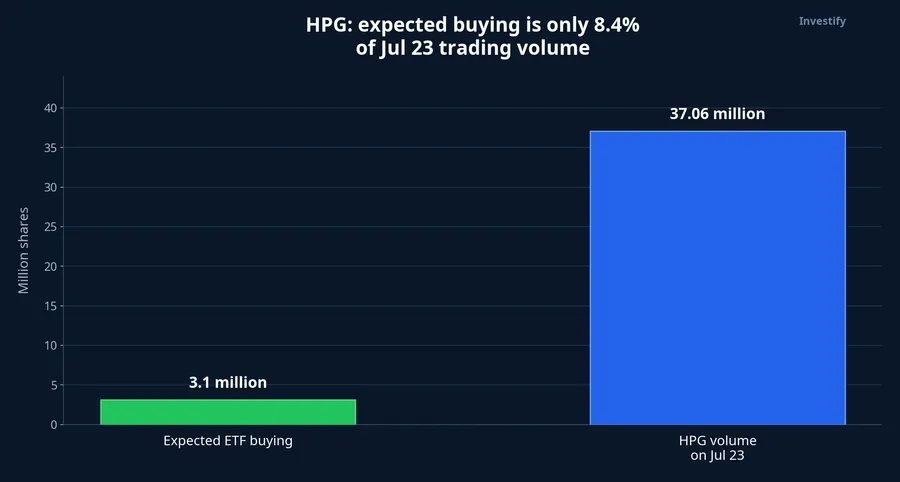
If orders are concentrated in a short period, supply and demand at the match can move more noticeably than usual. Conversely, a stock that turns over tens of millions of shares in a day can absorb that buying through active funds, individual investors, proprietary desks or investors who bought ahead of the forecast. The impact also depends on how funds execute, not only on the headline share count.
The more useful comparison is not “is 3.1 million large?” It is “what share of normal liquidity is 3.1 million, and over what time will it arrive?” The same forecast has a very different meaning for a thinly traded stock and for a liquid name such as HPG.
There is a further practical reason to avoid treating an estimate as a completed trade. Fund size and the price used in the model may have changed by the time orders are placed. The published figure is useful as a range for monitoring potential flow, rather than a precise promise of the final number. That is a more modest interpretation, but it is also the one the data supports.
HPG's price challenges a simple assumption
From the July 15 announcement of the new basket through the July 23 close, HPG fell from VND 22,400 to VND 20,800 per share, a decline of about 7.1%. Over the same observation window, the VN-Index fell from 1,782.12 points to 1,699.38 points, or about 4.6%.
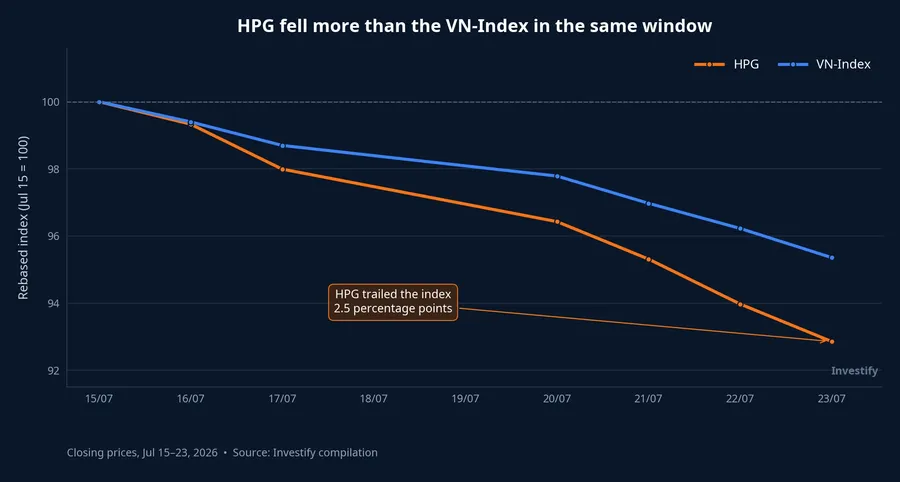
This does not prove that rebalancing caused HPG to fall. The broader market, expectations for the steel sector and stock-specific supply and demand are all plausible explanations; the available data cannot assign each factor a precise contribution. It does, however, reject a much stronger claim: an ETF buying forecast does not guarantee that a stock will rise, even before the expected orders are placed.
It is also why ETF trades should not be read as a verdict on corporate quality. Index rebalancing is a technical event. It does not itself change Hòa Phát's revenue, earnings, cash flow or asset value. Once technical demand has passed, the market returns to fundamentals and the broader trend.
A reading framework for newer investors
First, read the verb precisely. “Expected to buy” is an estimate; “bought” applies only after a real trade is recorded. If a report does not identify the forecaster, input date or execution calendar, its figure is not enough to support a view on price.
Next, put the estimate beside both liquidity and price. An order that is a modest share of normal turnover has a different effect from one in a thinly traded name. If the price has already moved after the forecast circulated, a late buyer may be paying for an expectation already embedded in the market.
Finally, keep technical flows separate from a longer investment case. Earnings reports, steel demand, margins, capital plans and the market backdrop are the data that test corporate value. Rebalancing news can make a session more interesting, but it cannot substitute for those inputs.
The thesis remains unchanged: expected ETF buying of HPG is a signal to monitor potential technical demand, not a stock-buying signal. Until the new basket takes effect, watch whether the estimate changes, how actual volume compares with liquidity and how much expectation is already in the price. Only with all three layers in view does the 3.1 million-share figure acquire its proper meaning.