


Around VND 235 trillion of corporate bonds will mature over the next 12 months. That is large enough to evoke a wall of debt, but it does not by itself identify which issuers will run into trouble. Maturity is simply the date on which principal is due; risk rises when an issuer cannot demonstrate that cash, operating cash flow or new funding will arrive in time.VIS Rating
The aggregate report cannot tell each bondholder where they stand in the repayment queue. A market-wide decline in late payments can coexist with issuers relying on an asset sale that has not closed. The useful test is therefore not the coupon printed on a bond, but the quality of the repayment sources behind it.
The maturity calendar concentrates pressure
VIS Rating estimates maturities of roughly VND 44,000 billion in Q3 2026, VND 77,000 billion in Q4 2026, VND 31,000 billion in Q1 2027 and VND 84,000 billion in Q2 2027. The quarterly figures are rounded, so their sum may differ slightly from the VND 235,000 billion headline total.VIS Rating
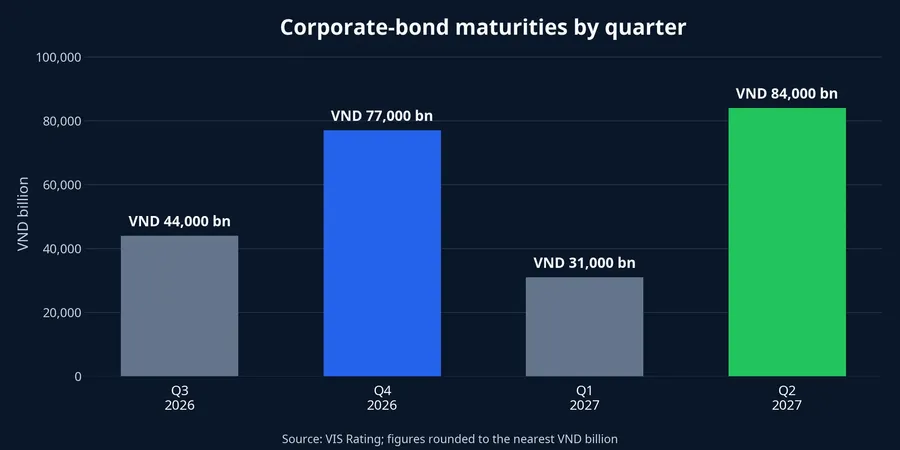
Q4 2026 and Q2 2027 deserve the closest attention. Concentrated pressure does not mean every bond due in those quarters will deteriorate at once. It means more issuers will be seeking new money in the same period, so those with credible credit profiles, collateral and cash generation should find access easier than weaker peers.
Residential real estate makes the concentration more material. About VND 123,000 billion of bonds in this sector mature within the 12-month window, more than half of the total. Roughly VND 40,000 billion is due in Q4 2026 and VND 48,000 billion in Q2 2027. Because sales, legal approvals and cash collection take time in this sector, a plan to sell a project should not be treated as cash already available.VIS Rating
Repayment history is the real risk marker
Across the four quarters, roughly VND 59,000 billion of maturing bonds comes from issuers that have previously paid late or extended maturities. This does not mean every one of those bonds will be late again. It does make the history more important than an attractive coupon, because the issuer has already had to alter a repayment schedule when its original funding source fell short.VIS Rating
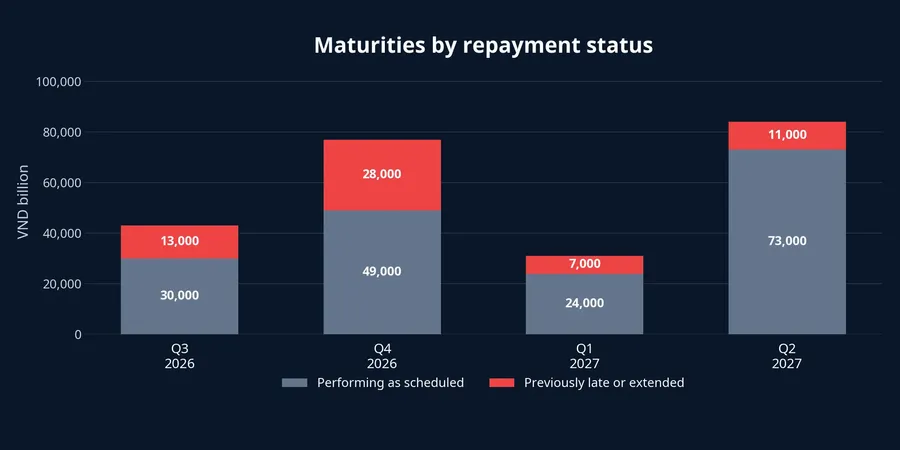
Market averages do not protect the holder of a specific bond. Q2 recorded only one first-time late-payment bond, while the trailing 12-month late-payment rate eased from 0.46% in Q1 to 0.30% in Q2 2026. The cumulative recovery rate for late bonds rose to 47.7%, up 1.5 percentage points from the preceding quarter.TBTCTVN
Those improvements show that the market is not moving in one direction. They do not erase the difference between an issuer that has cash and one that only has a plan. For bondholders, the central question is whether the issuer itself has extended, delayed or renegotiated obligations before.
New money is available, but selective and costly
Refinancing means using new funding to repay an existing obligation. For a long-duration project, it can be normal if the issuer can borrow from banks, issue new bonds, raise equity or generate sales cash flow. The boundary between sound refinancing and merely postponing a problem is evidence: cash received, committed facilities or operating cash flow already generated.
Primary issuance reached VND 223,000 billion in Q2 2026, down 8.5% year on year. Bank issuance fell 39.4%, while real-estate issuance rose 123% year on year and was concentrated among a handful of large developers. Capital has not vanished; access to it has become more selective.TBTCTVN
The cost of new money cannot be ignored. The average nominal coupon on bank bonds issued in Q2 was 8.5% a year, 2.6 percentage points higher than a year earlier. For real-estate issuers, the average was 11.5%, up 0.8 percentage points, and some bonds were reset to 14% to 16% a year.TBTCTVN
A higher coupon can help attract buyers to an issue, but it also raises future interest expense. “Able to issue” is therefore not enough to count as a positive signal. Investors should see which debt is being repaid, how long the new tenor is, and whether operating cash flow can service interest after refinancing.
An extension only buys time
An issuer unable to raise new funds may ask to extend maturity, change terms, sell assets or enforce collateral. These measures differ in substance, but each indicates that the original repayment source has not worked as expected. An extension does not eliminate principal; it moves the payment date forward and depends on the issuer generating cash during the extra time.
An asset-sale proposal becomes credible only when the transaction closes and cash proceeds are sufficient and timely. Similarly, a board resolution authorising issuance is preparation, not proof that funding has been raised. At a real-estate issuer, contracted sales must still clear legal, handover and collection milestones before they can pay a bond.

Collateral is a final layer of protection, not the main repayment source. Bondholders need to establish who owns the asset, where it has been pledged, their payment priority and whether disputes may arise. The process of enforcing collateral can take time because it involves multiple parties and legal obstacles, so the stated asset value does not mean cash can be recovered quickly.TBTCTVN
A reading framework for new investors
Start somewhere other than the coupon. Put all obligations due within the same time window together: bonds, bank loans, interest, payables and investment commitments. A specific bond may still be paying interest on time while another debt of the same issuer comes due sooner.
Then rank repayment sources by certainty. Unrestricted cash, operating cash flow, collectible receivables and signed credit facilities are stronger than a planned project sale. Separate a planned issuance from a completed issuance, and collateral from cash available on the actual payment date.
This distinction is particularly useful when an issuer presents several positive-looking headlines at the same time. A high coupon says what the issuer promises to pay, not where the principal will come from. A large collateral package may improve recovery prospects, but it does not resolve a near-term cash mismatch. And a refinancing plan should be treated as a plan until the issuer discloses a completed transaction or a committed facility.
For a first-time investor, the most practical documents are often the least promotional ones: payment notices, audited financial statements, issuance results and the bond terms. They reveal dates, payment priority, restrictions on proceeds and the specific assets pledged. The goal is not to predict every outcome, but to distinguish evidence already in hand from assumptions that still need to happen.
Finally, read repayment history alongside credit ratings and bond terms. A rating provides a useful independent lens, but it does not replace reviewing cash flow, use of proceeds and collateral priority. If those questions cannot be answered, a high yield does not compensate for the information gap.
The VND 235 trillion maturity block is therefore a test of differentiation, not a blanket prediction of defaults. Issuers that have secured funding, generate operating cash and have not delayed obligations can manage maturities. Those dependent on an unfinished asset sale, an incomplete issuance or another extension face greater refinancing risk. In the coming quarters, the signals to monitor are completed fundraisings, cash-collection progress and changes to repayment schedules.