
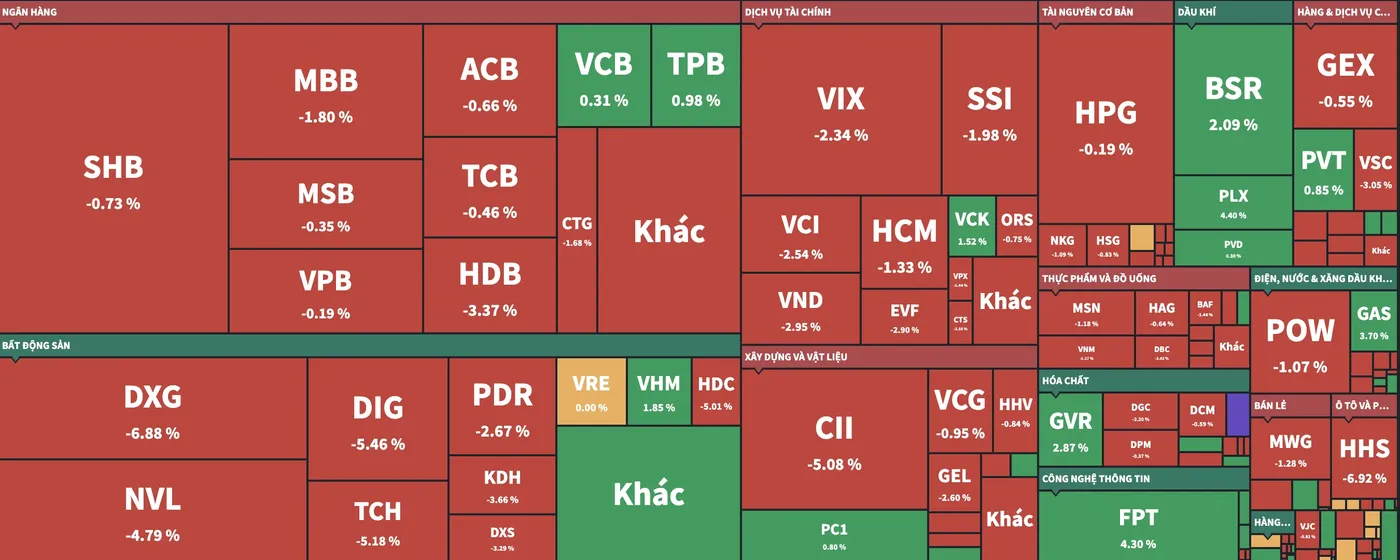

The VN-Index ended July 22 at 1,668.53 points, down 62.03 points or 3.58%. That headline number invites two overly simple interpretations: that every stock fell in the same way, or that a handful of heavyweight shares alone made the index look bad. Neither view captures the full picture.
VIC, VHM and MWG did amplify the fall because of their large market capitalisations. Yet 265 stocks declined against only 68 gainers on HOSE, showing that selling pressure went well beyond those three names. The right conclusion from the session is straightforward: heavyweight shares made the index lose points faster, while market breadth confirms that the wider board was also weakening.
Why similar percentage declines have different index effects
Think of the VN-Index as a scale on which each company carries a different weight. The index is capitalisation-weighted, so a company with a larger market value has more influence. Two stocks can therefore fall by nearly 7% and still subtract very different numbers of index points.
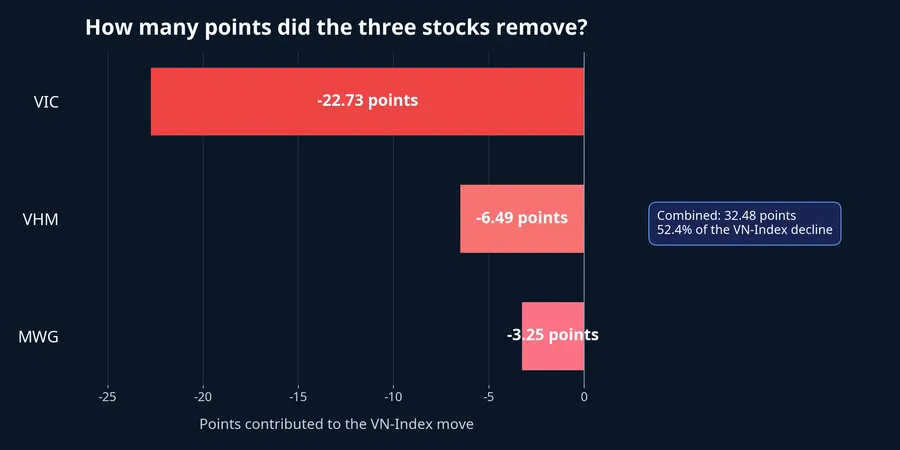
On July 22, VIC closed at VND 202,100, down 6.99%. VHM ended at VND 126,900, down 6.96%, while MWG closed at VND 70,600, down 6.98%. Their percentage moves were almost identical, but VIC's much larger index weight meant a much larger effect.
The end-of-session contribution breakdown shows that VIC removed about 22.73 points from the VN-Index. VHM removed 6.49 points and MWG 3.25 points. Together, the three shares removed 32.48 points, equal to 52.4% of the index's 62.03-point decline.
That helps explain why an investor who did not own any of the three may have seen a smaller portfolio decline than the VN-Index suggested. But the calculation answers only one question: how many points did each stock remove? It does not establish that VIC caused other shares to be sold. VIC's price move lowers the index mechanically; market breadth is needed to assess whether selling extended across the market.
Breadth shows that the red screen went beyond the heavyweights
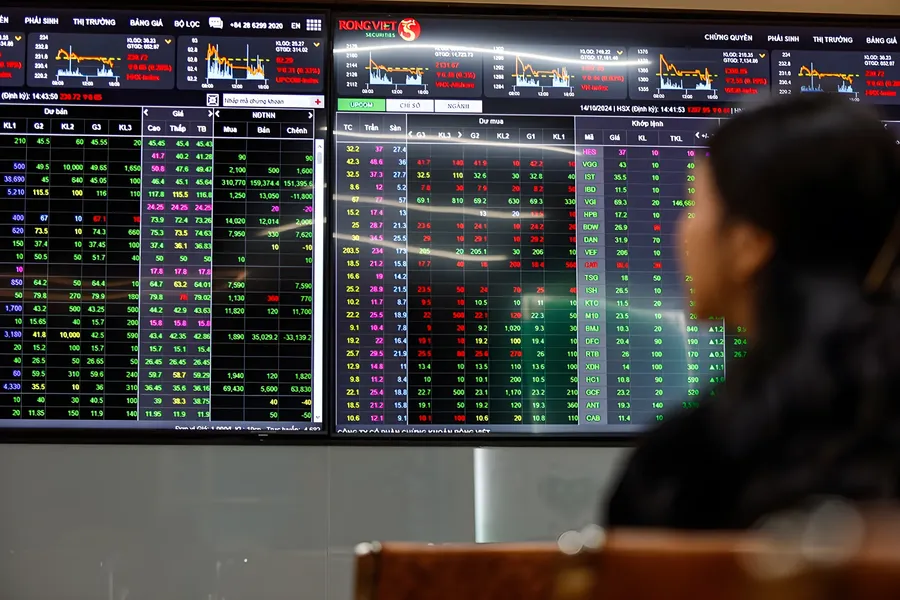
At the close, HOSE recorded 265 decliners and 68 advancers, including 11 floor-price stocks and seven ceiling-price stocks. That is nearly 3.9 declining shares for every gainer. For new investors, this is a useful measure because it tracks how many stocks are moving in the same direction, rather than the market capitalisation of a few large names.
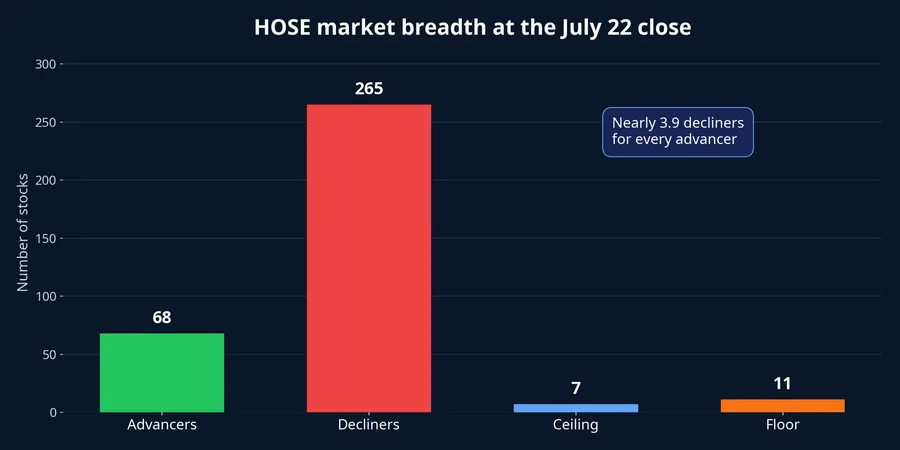
If the sell-off had been confined to VIC, VHM and MWG, the board could still have been more balanced. The closing data does not show that. Most HOSE shares finished lower, so the 62.03-point fall should not be treated as a purely technical distortion of the index.
The intraday pattern reinforces that reading. At 9:30 a.m., the market still had 148 gainers and 83 decliners. By the end of the morning, it had shifted to 63 gainers and 250 decliners, with 164 stocks down more than 1%.VnEconomy The important point is not simply the closing total, but the move from early dispersion to broader selling during the session.
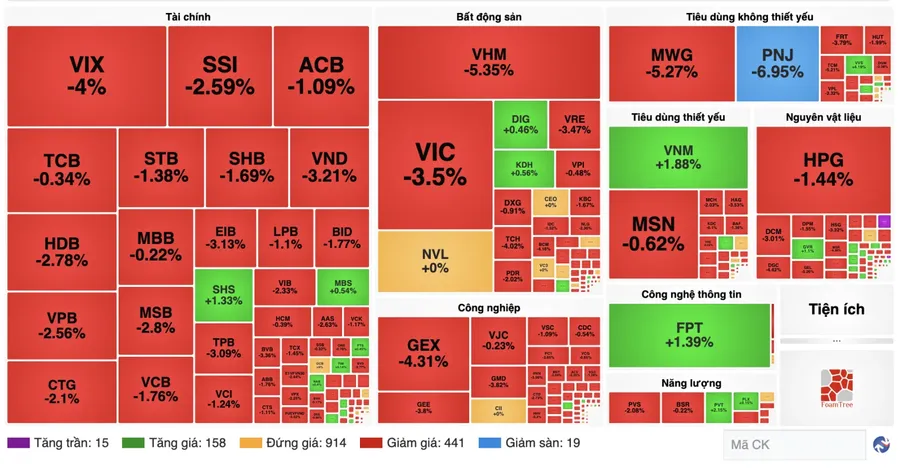
Breadth alone does not identify the cause of the selling, however. Profit-taking, lower margin borrowing, reactions to large-cap moves and defensive sentiment may all have played a role. The available data shows how widely pressure spread; it does not support a precise allocation of responsibility among those drivers.
Liquidity has to be read alongside price
VN-Index trading volume exceeded 915 million shares on July 22, compared with nearly 783 million in the prior session. The roughly 16.9% increase occurred during a sharp decline, indicating more intense turnover. High liquidity by itself, though, does not mean buyers had regained control.
Every matched trade has a buyer, but large turnover does not reveal whether buyers absorbed enough supply to lift prices. VIC, VHM and MWG still closed near their floor prices, while decliners dominated the board. Buyers were present, but they had not changed the balance of the session by the close.
This is the distinction between high liquidity and a convincing intraday reversal. A credible reversal usually combines three elements: a meaningful recovery from the day's lows, improving breadth and leading shares narrowing their losses. July 22 had heavy turnover, but the latter two signs were not yet clear. Calling the session a confirmed dip-buying signal on volume alone would go beyond the evidence.
Three signals for the next session
The first is the reaction of the heavyweight group. If VIC, VHM and MWG stop falling near their daily limits, the VN-Index will face less mechanical point pressure. A rebound in those names can make the index look better quickly, but it does not by itself mean that most portfolios have recovered.
The second is breadth through most of the trading day. After nearly 3.9 decliners for every advancer, a more credible balance would require gainers to improve persistently, not merely for a few minutes after the open. New investors should watch whether the number of sharply falling shares narrows as the index rebounds. That is one way to avoid being misled by a green move concentrated in a few large stocks.
The third is the relationship between price and liquidity. Heavy volume while prices continue lower signals that supply remains substantial. Heavy volume combined with a rebound from the lows and improving breadth would suggest stronger absorption of sell orders. Conversely, a low-volume bounce may simply mean that sellers have paused, not that capital has returned.
Conclusion: Read the index in two layers
July 22 was not a story of “only VIC, VHM and MWG”, even though they removed more than half of the VN-Index's lost points. Nor does every share have the same impact on the index. These are two separate layers of information: point contribution shows whether large-cap shares are amplifying or supporting the index, while breadth indicates the health of the rest of the board.
The most defensible thesis today is that the market weakened broadly, while the heavyweight group made the VN-Index decline look more severe. That reading would change only if three signals improve together: heavyweights stop exerting pressure, breadth recovers and liquidity arrives with better prices. The next session can add evidence on those points; one sharply negative candlestick cannot settle them on its own.