

One update can carry two conflicting signals, and Super Micro has just offered a particularly clean example. The company expects fiscal fourth-quarter revenue near the bottom of its $11.0–$12.5 billion guidance range. Yet SMCI shares rose about 16% in after-hours trading after the July 21 announcement.
The market has not ignored revenue. It has repriced the profit earned on each dollar of revenue and the length of the order pipeline ahead. Preliminary gross margin is far above prior guidance, while new orders indicate that demand for artificial-intelligence infrastructure has not disappeared. The constructive case holds only if those preliminary numbers lead to a confirmed result, deliveries and cash generation.
Revenue at the low end still needs to be read correctly
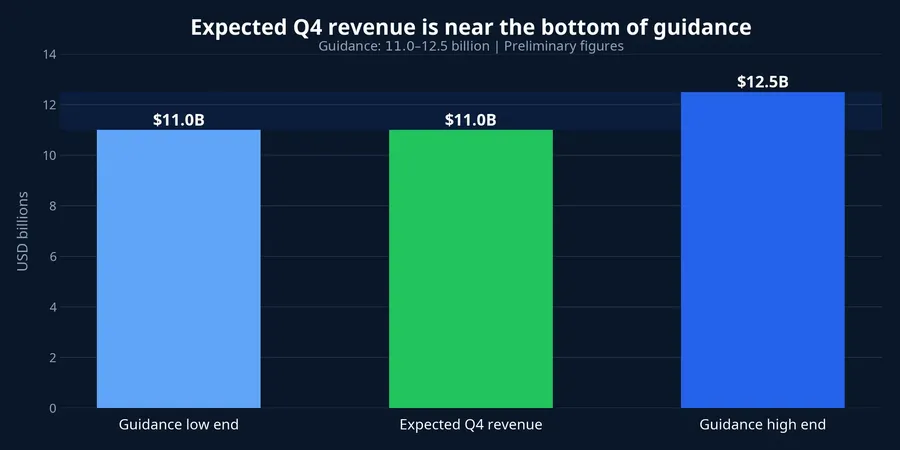
Super Micro said fiscal Q4 2026 revenue, for the quarter ended June 30, is estimated to be near the low end of its $11.0–$12.5 billion range. Those are preliminary figures rather than final results. The company has scheduled its full earnings release and investor call for August 11.
By the numbers, “near the low end” is not a positive surprise on sales volume. It says that revenue has not exceeded expectations. For a provider of servers and data-center infrastructure, revenue also depends on when equipment is delivered, integrated and accepted by a customer. The number should therefore retain its plain meaning: it does not confirm a stronger-than-expected growth quarter.
Equity markets do not apply a fixed multiple to revenue alone. Share prices reflect expectations for the profit retained from revenue in the future. When investors receive a clearer signal on gross margin, it can carry more weight than revenue landing near the bottom of a previously published range.
Gross margin is what changed the calculation
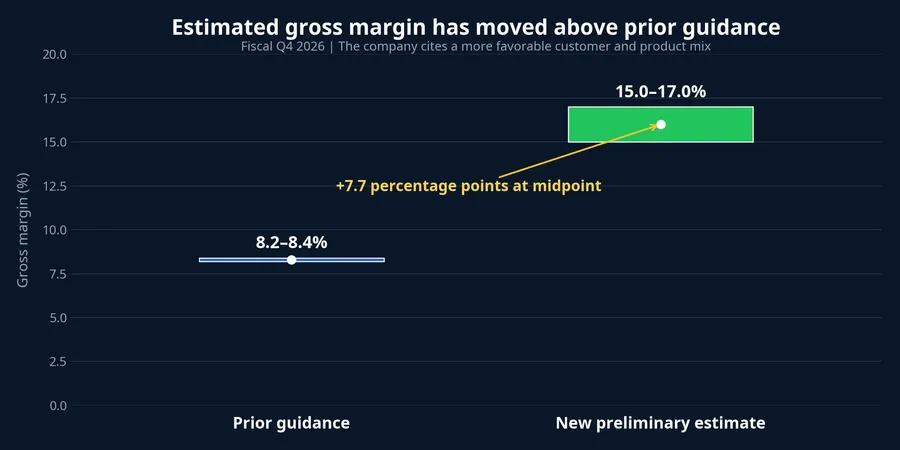
Super Micro estimates both GAAP and non-GAAP gross margin at 15–17%, materially above prior guidance of 8.2–8.4%. The company attributes the improvement mainly to a more favorable customer and product mix.
For a new investor, gross margin is what remains after direct production costs are deducted from revenue. A company that retains 16 cents from every dollar sold has a different outlook from one retaining just over 8 cents, before operating costs, interest and tax. That is why a move of several percentage points in gross margin can matter more than a small difference in quarterly revenue.
Using $11.0 billion of revenue as an illustration, a 15–17% margin implies gross profit of about $1.65–$1.87 billion. The same calculation using the old 8.2–8.4% range gives about $902–$924 million. This is not official profit guidance. It simply shows how sensitive gross profit is to a change in margin.
The notable wording in the update is that the company points to mix, rather than declaring a fixed margin level for future quarters. A small set of contracts or customers can lift margin in one quarter and shift in the next. Investors have a reason for a constructive response, but not enough evidence to treat 15–17% as a new normal.
More than $60 billion of orders is visibility, not cash
On demand, the company said it received more than $60 billion in new orders during the quarter and that backlog reached record levels at the end of fiscal 2026. Those orders are expected to be delivered over future quarters.
Set beside quarterly revenue, the key message is that demand and revenue recognition are not the same thing. Customers may have ordered systems, but revenue is recognized only after delivery, integration, testing and acceptance. That is a plausible reason investors looked beyond the current quarter. It is not the only explanation for the after-hours move: short covering and broader sentiment toward AI infrastructure could also have amplified the price change.
More importantly, the company itself cautions that some orders may not be firm commitments. They may be cancelled or delayed and remain subject to the parties fulfilling applicable terms and conditions. Backlog is therefore a measure of demand and potential revenue, not locked-in revenue or cash already received.

That distinction matters especially for an infrastructure company. A large order needs components, assembly capacity, system integration and a customer ready to take delivery. A delay at any link can push revenue and profit into a later quarter without erasing underlying demand. Repeated delays, however, would force the market to reassess the company’s ability to turn backlog into actual results.
Three facts will test the market response
First comes the official gross margin. The August 11 release will show whether the 15–17% estimate is confirmed and whether the improvement is a one-quarter mix effect or something more durable. Management’s explanation of its customer and product mix deserves close attention because it supports much of the current valuation narrative.
Second is the rate at which orders become revenue. The more-than-$60-billion figure gains credibility when subsequent quarters show equipment being delivered on schedule and revenue being recognized. If backlog keeps growing while revenue repeatedly lands at the bottom of guidance, the gap between stated demand and execution capacity becomes the central question.
Third is cash flow. Filling large orders commonly requires upfront component purchases, inventory and customer payment terms before cash is fully collected. Strong reported gross profit does not automatically mean operating cash flow will improve in the same period. Receivables, inventory and working-capital needs need to be read alongside profit.
Conclusion: the market rewarded quality, not a finished outcome
The central takeaway is clear: investors appear to assign greater weight to the margin surprise and the size of the order book than to revenue arriving near the bottom of guidance for one quarter. That is a conditional valuation judgment, not confirmation that the risks have been resolved. The roughly 16% after-hours rise shows that expectations changed quickly; it does not prove that every expectation will be met.
Over the next few weeks, three signals belong together: the actual gross margin in the full release, progress turning orders into revenue and the company’s ability to convert accounting profit into cash. The constructive thesis strengthens if all three improve. A single attractive preliminary margin figure, by contrast, is not yet a substitute for evidence on execution and cash flow.